

Abby Arthur Smith
Ph.D. Candidate in Sociology,
University of Michigan

Abby Arthur Smith
Abby Arthur Smith is a qualitative and comparative-historical sociologist of morality. Her dissertation draws on archival records from state boards that administered eugenic sterilizations in the United States from the 1930s through the 1970s. She documents a gradual transformation in board members’ imagined relationships between morality, the reproductive body, and society—a change that in turn shaped their perceptions of the legitimacy of eugenics over time.
A second, collaborative line of research concerns how infrastructure shapes lived experiences of race and disability, documenting the co-production of health disparities and identity subjectivities. Taken together, her work demonstrates how science, technology, and medicine shape—and are shaped by—ideas about the value and worth of different types of bodies.
In addition to her Ph.D. candidacy with the University of Michigan Department of Sociology, Smith holds an M.S. degree in Epidemiology from the University of Michigan School of Public Health and is a demography trainee with the University of Michigan Population Studies Center. Her B.A. degree, in public health and sociology, is from the University of Iowa.
Research Publications
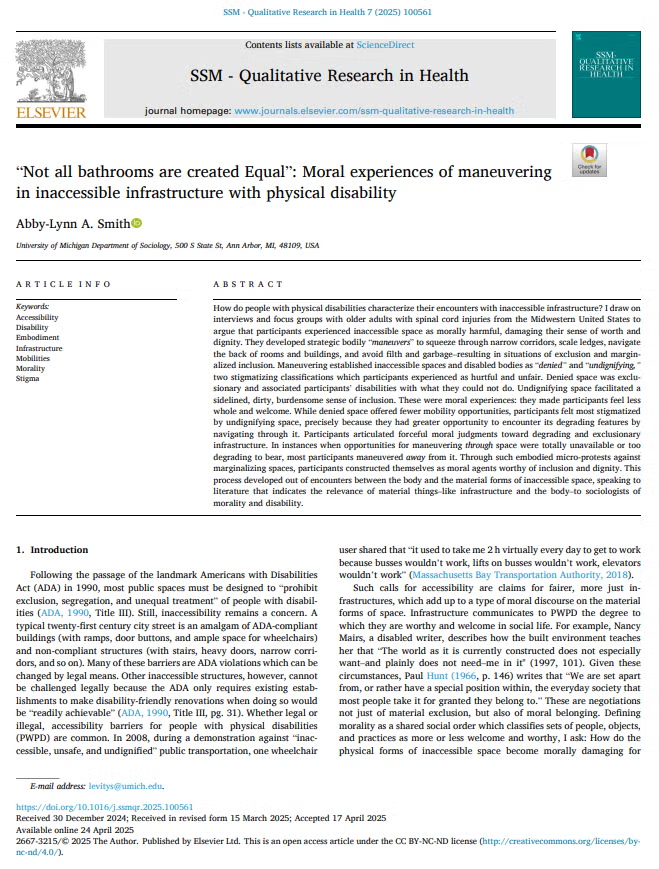
Smith documents how people with spinal cord injuries describe the material forms of inaccessible space in moral terms, as harms to their sense of worth and dignity.
Teaching
In 2025, Abby was offered a fellowship with the Sweetland Center for Writing to teach a writing course of her own design for first-year students as sole instructor. Her course, titled “Writing the Body in Social Context,” teaches incoming freshmen to understand bodies as situated in social relations which shape the writing process.
As a graduate student instructor in the Department of Sociology, Abby has taught three large, required courses—Introduction to Sociology, Sociological Theory, and Research Methods (twice)—and has also designed an undergraduate practicum course titled “Introduction to Historical Sociology: American Eugenics in the Sociological Imagination“.
Abby’s teaching style reflects a commitment to creative, accessible, and inclusive pedagogy, developed through the lens of universal design. She was awarded a Graduate Teaching Certificate through the Center for Research on Learning and Teaching, reflecting her exceptional commitment to undergraduate learning.
Works in Progress
Smith, A. A. Sterilizing the “Social Menace”: U.S. Eugenic Sterilization Professionals’ Negotiations of Morality, Body, and Society, 1922–1974. (Dissertation Project).
In her study of over 700 patient case files reviewed by state “eugenics boards” in Iowa, Michigan, and North Carolina from the 1930s through the 1970s, Smith investigates how state administrators interpreted the legal requirement that the operations must benefit the “good of society.” With each case they reviewed, eugenics professionals negotiated not just individual surgeries, but also the relationship between morality, the body, and society. Results will speak to how transformations in the implementation of public policy reflect changing conceptualizations of the nature of the moral.
Smith, A. A. Moral Capital in Social Movements to Recognize and Redress American Eugenics.
Social movements urging the U.S. government to make right on its history of forcibly sterilizing the “unfit” during the 20th century have resulted in compensation programs, monuments, and apologies in nine U.S. states from 2000 to 2023. These movements are spurred by historians, activists, journalists, and politicians across the U.S. In this oral history interview study (N = 28), Smith explores how these actors leveraged various forms of capital to negotiate a balance between objectivity and moral conviction—boundary work which, she argues, was crucial to these movements’ success.
Seamster, L., Rhym, C., & Smith, A. A. Water Governance as Racial Politics: Implications for Health.