


Untold Stories of the Latin American Club
By: Yosabeth Guerrero Gomez
In the early 1900s, a new wave of emerging Latinx Students at the University of Michigan came about. Club Latino Americano, the Latin American Club, was an organization established for gentlemen of Latin descent at the University of Michigan. The Latin American Club strove to achieve educational and social progression for its members. The following are brief, untold stories about some the lives of the gentlemen who were part of the Latin American Club at the University of Michigan in the early 1900s.
Frederico Collazo was part of the Latin American Club in 1913. Collazo was born on December 6th, 1889 in Puerto Rico. He was from a small tropical town in Puerto Rico called Manati. Frederico Collazo arrived to the United States in the early 19th century to furthermore continue his academic career. He always had a big interest in engineering and in 1915, Frederico Collazo graduated from the University of Michigan with a degree in Mechanical Engineering. During his time in Ann Arbor, Collazo held two addresses on file. From 1912 to 1913, Frederico lived on 317 Division St. Later that year in 1913, he moved to 1218 Washtenaw and stayed there until 1914. Once Collazo graduated, he did not keep contact with the University.
F.S. Altamirano’s full name was Felipe Altamirano Saldiria. He was from Valdivia, Chile. Growing up, he lived on Picarte Street. Felipe Altamirano Saldiria was born on May 30, 1888. He arrived to the United States in 1914 and continued his interests in naval studies at the University of Michigan in February of 1915. Saldiria already held a degree of Naval Engineering from a naval school in Chile of 1906. While at Michigan, Saldiria held addresses on file at 514 East Catherine, 325 East Jefferson, and 812 East Washington. The respective dates for the addresses are 1914, 1915, and academic term from 1916 to 1917. He obatined his Master’s degree in Marine Engineering in 1917 after his time in Ann Arbor he returned to his native land in Chile to work there.
L.M DeBayle was a member of the 1916 Latin American Club. Debayle was born on May 24, 1894. His full name was Luis Manuel Debayle and he studied medicine at the University of Michigan. There were heavy influences in his home in Leon, Nicaragua that encouraged him to pursue a career in medicine. His father and two adult acquaintances in Nicaragua were doctors. In October of 1914, DeBayle enrolled at the University of Michigan. He only had two addresses from his time spent in Michigan. From 1914 to 1915, DeBayle lived at 614 Monroe St. The remainder of his time at Michigan, until his graduation in 1918, he lived at 222 South Ingalls. Luis Manuel Debayle married Matilde Bonilla with whom he had two children.
F. Dimas was a student at the University of Michigan who joined the Latin American Club in 1916. His full name was Frederick Aruti Dimas but sometimes went by Dr. Federico M. Dimas-Aruti. He was born in San Juan, Puerto Rico on February 24, 1898. Dimas came to the United States in his teenage years to receive a better education than the one offered in his home state. He attended Ann Arbor High School and graduated with honors in 1916. From there he attended the University of Michigan Dental School. He then transferred to the University of Maryland. Dimas obtained his degree in dentistry in 1922. While still at Michigan, Frederick lived at 418 N. Division during the 1916-1917 term, and later that year he moved to 224 S. Thayer St. Frederick Aruti Dimas went on to serve in the US Air Force for World War II. He served for four years as a Lt. Colonel in the Dental Corps, U.S. Army. His position was Chief Dental Surgeon. He married an individual named Colita Mercado. Thanks to an alumni catalog reply card filled out by Manuel A. del Valle, a fellow member from the 1913 Latin American Club, it was found that Dimas resided in 1603 Sixteenth St, N.W., Washington 9, D.C.. The card was filled out in Puerto Rico of 1940 in Manuel A. del Valle’s own handwriting. It read, “I understand he [Frederick A. Dimas] is practicing dentistry in Washington D.C.”
M.G. Constain was in the Latin American Club in 1916. His full name was Manuel Jose Constain. He was from Colombia and enrolled at the University of Michigan in 1915. He was born on August 9, 1896. Addresses on file were 717 E. Huron, for the year of 1915, and 523 Washington St. for the 1915-1916 academic terms.
R.S. Caneco’s full name was Raul Dos Santos Caneco. He sometimes went by Raul Santos Caneco. Caneco enrolled at the University of Michigan in the Fall of 1915 and joined the Latin American Club in 1916. He was born on September 26, 1894 in Rio de Janeiro, Brazil. Caneco’s area of study was engineering, specifically naval and marine engineering. While on campus, he moved around often and held several addresses. In 1916, he lived at 200 N. State St. From 1915 to 1916, his address was 315 S. Division. The place at which he resided the longest was 418 N. Division. He stayed there from 1916 to 1918. Since 416 E. Huron St. is a different address but was still dated in the year of 1918, it was noted that Caneco was taking Summer classes at Michigan. The last address on record was 113 S. Division St., which Caneco resided until 1919.
Two more particular individuals who were in fact part of the Latin American Club were Pablo
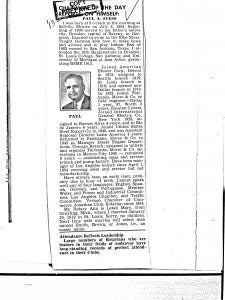
A. Suess and Galo W. Blanco. Pablo Alfredo Suess, member of the Latin American Club in 1913, was born on July 8, 1893 in Saltillo, Coahuila, Mexico. He had a very mobile childhood because he was always moving. In 1900, Suess moved to his father’s native land, Saxony, Germany. At the end of 1902, he moved to San Antonio, Texas. Suess attended St. Louis College in San Antonio and then transferred toMichigan in 1910. He obtained his Bachelor’s of Science from the University of Michigan in 1913 with a degree of Mechanical Engineering. Like other individuals from the Latin American Club here at Michigan, Pablo Alfredo Suess sometimes wrote his name differently. Sometimes he wrote his name as Paul Alfred Suess. His addresses on file for his time spent in Ann Arbor are 604 Madison St. from 1910 to 1911, and 617 Forest Ave. for the 1912-1913 academic term. Alumni files reveal that Suess was very successful in his career with many newspaper clippings and postcards from around the world. In 1939, Pablo Alfredo Suess lived in Rio de Janeiro, Brazil.Pablo Alfredo Suess died in his home at 511 Furr Drive, San Antonio Texas on August 20, 1988.


Galo W. Blanco was a member of both the 1913 and the 1916 Latin American Club. His full name was Galo Wenceslao Blanco. He was born on October 16, 1894 in San Juan, Puerto Rico. Born to affluent family in Puerto Rico, in 1910, Blanco was sent to the United States of America to attend school. He transferred from Washington and Jefferson College to the University of Michigan Ann Arbor in 1912. In 1915, Galo Wenceslao Blanco received both his Bachelor’s and Master’s degree in Chemical Engineering. After receiving his degrees from Michigan, Galo Wenceslao Blanco entered the war in April of 1918 as an Assistant Chemist. Blanco went on to receive his PhD from University of Wisconsin in Chemistry and Engineering in 1922. Galo Wenceslao Blanco held multiple addresses while he stayed on campus. From 1912 to 1914, he resided at 431 E. University Ave. From 1914 to 1915 his address was 410 S. Observatory St. His last on campus address was 201 N. Thayer St., which he resided until l917. Galo Wenceslao Blanco’s retired address was at 1701 South Bend Dr., Rocky River OH 4411. His wife’s name was Mildred, but she died in 1976. Together they had 2 daughters, Marion Louise Cook Blanco and Camille Blanco. Blanco had four grandchildren and 2 great grandchildren. Galo Wenceslao Blanco died in 1983 at age 88 of heart attack. He was fluent in French, German, Portuguese, Spanish, Italian, and English.
Even a brief survey of some of the men who were members of the Latin American Club allows us to draw some conclusions about Latina/o life at the University of Michigan in the early 20th century. Many of the students who were part of the Latin American Club had parents who were doctors, engineers, and politicians. Students from Puerto Rico, Mexico, Columbia, and Brazil were clearly affluent, given the significant resources required to study abroad. This is likely one of the reasons why there were very few Latinx students at the University of Michigan, because few families could afford to send their children to study abroad at such a prestigious university. Because of these circumstances, these early Latinx students had very different experiences than Latinos at the University of Michigan in present day. Many of the Latinos who attended the University in the early 20th century wouldn’t have to deal with financial issues or navigating through the struggles of experiencing college as a first-generation students. Although the Club LatinoAmericano held very different experiences from its members, it was an organization designed to better the advancement of Latinx students seeking higher education. At the same time, it was also a social club that allowed for opportunities and relationships to be built. The young men who belonged to the Latin American Club at the University of Michigan in the early 20th century paved the way for future generations of students of Latin descent to have a place on campus.
Works Cited
A Cosmopolitan Tradition – International Students – 2007.pdf