

We begin with the common notion of underrepresented and marginalized communities facing challenges in higher education access and educational success in the United States. In the state of Michigan, the University of Michigan possesses a large history of recruitment and retention programs implemented by different offices, schools, and even the students themselves. Over time, these specific programs die down due to lack of funding, faculty retirements, and students graduating.
Specifically, more programs arose during The Radical Years and The 1980s & Beyond. However, the first indicated recruitment initiative began with the University itself recruiting international Latin
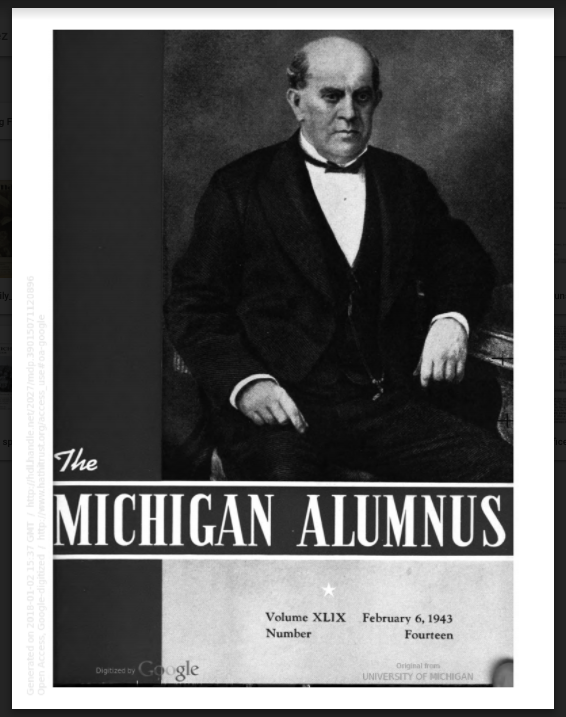
American students. The Michigan Alumnus states that the enrollment of Latin-American students was higher than any other school in the country (Fall of 1944) (Michigan Alumnus – Enrollment on the Rise Again, 1944 ). An estimated 150 Latin-American students resided at the University due to the Good Neighbor Policy and as a last resort compared to European universities. The Coordinator of Inter-American Affairs, the Institute of International Education, and the State Department have encouraged the enrollment through scholarships (Good Neighbor Policy) and having a foreign student counselor. According to the Michigan Alumnus, it was one of the few universities to sponsor and pay for a Counselor to Foreign Students, a large staff, and an International Center as well as offering specialized programs. These programs included the W.K. Kellogg Foundation’s Fellowships in Public Health, the Legal Research Fellowships in Inter-American Law, and the Wood Technology Fellowships in the School of Forestry & Conservation.
According to the Michigan Alumnus, Latin America has sent its students to Michigan as early as 1863 and had the largest enrollment in the country through most of the past 36 years (1907-1943) (Michigan Alumnus, February 6, 1943). They attribute this increase to the fact that the institution hosted the first Pan-American Congress and that representatives of South American countries visited Ann Arbor in 1889.
“With this as a premise, and against the background of a well-organized program established by President Ruthven for the further promotion of the University’s service to, and cultural relationships with, the Latin American peoples, the Alumni Association has set up the machinery by which it will place its alumni manpower and its organization at the disposal of both the University and the federal government in the furtherance of the aims announced.”
Michigan Alumnus, February 6, 1943, Page 241
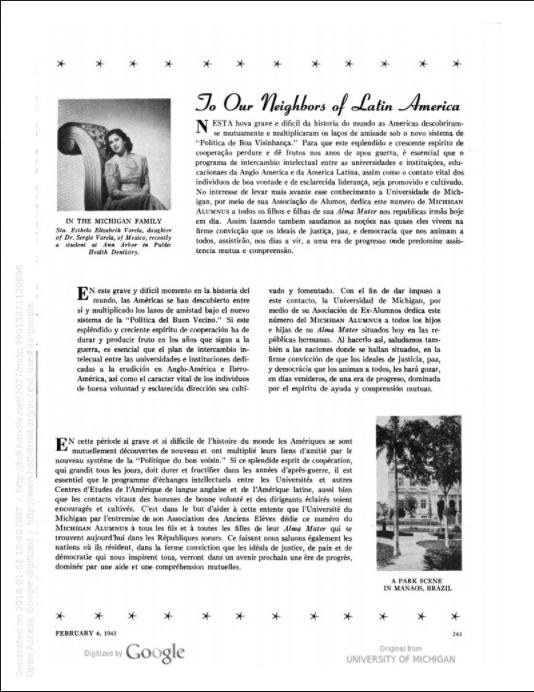
The first step was implementing a Committee on Inter-American Relations by Alumni Association President, Christian F. Matthews ( Michigan Alumnus, February 6, 1943). The committee consisted of Latin-American Michigan alumni, Michigan faculty/administration, and Michigan alumni with positions in Washington. Meanwhile, the University Committee on Latin American Relations set by President Ruthven and the University were able to recruit fourteen men from Chile for postgraduate study in the College of Engineering through the Kellogg Foundation grant. Their two most important objectives were to have a general plan for a system of scholarships and fellowships for Latin-American students and to develop ways to cooperate with government and agencies working for closer inter-cultural relations with Latin America.
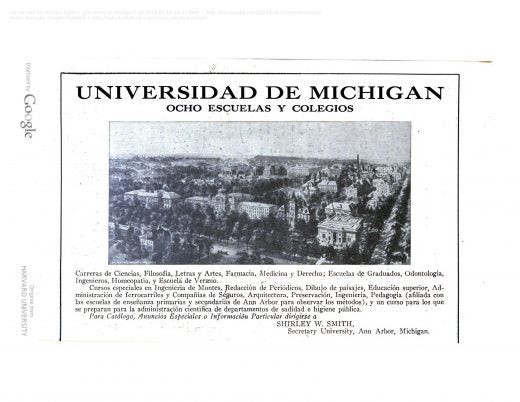
Michigan Spanish Ad in El Estudiante Latino-Americano
A Period of High Recruitment Initiatives
1960-1990
Among the most recorded programs, there are numerous implementations done by specific colleges, the administration offices, and the students. We see a trend of most recorded and more initiatives around The Radical Years through The 1980s and Beyond. Below are programs recorded in files at The Bentley Historical Library Archives. Although there are several, the list below does not include all recruitment and retention program since research is limited in classroom agendas.
1960s
The Opportunity Award Program (1964)
The Opportunity Award Program was initially started in 1964 to “increase the number of African-American students enrolled in the University and to device techniques/methods of maintaining these students once they were here” (Opportunity Award Program, 1969). The program based their admission on culturally and financially disadvantaged in-state minority students. These students generally had lower SAT and comparable high school performance with other freshmen. The Opportunity Award Program was hosted by the Office of Admissions, with counselors, recruiters, and coordinators running it. It consisted of financial support from the Office of Financial Aids based on Expected Family Contribution and the University Opportunity Award. Services offered were of academic, psychological, and personal & supportive nature.
The Opportunity Program (1965)
The Opportunity Program was a different program than The Opportunity Award Program. It was a program started in 1965 “to assist economically and culturally disadvantaged Michigan students through minority student recruitment and support” (Minority Student Survey- Opportunity Program, 1973). These students were enrolled into the program after admission to the university. They were able to increase financial aid and allocating this direct assistance to the students, as well as give them counseling, tutoring, and other supportive services. Although not stated anywhere, this program may have been an extension of The Opportunity Award Program but it has never been mentioned as being the same program in any source.
1970s
Minority Engineering Program Office (1970)
The Minority Engineering Program Office was founded in 1970 and participated in eight separate programs to expose 7-12th graders from underrepresented groups including American Indians, Blacks, Hispanics and Puerto Ricans to technical careers to prepare them for entry into the College of Engineering (Minority, Recruitment, Enrollment, Retention, and Graduation , 1987-88). These programs include the Detroit Area Pre-College Engineering Program (DAPCEP), Engineering Industrial Support Program (EISP), the Accelerated Students Potentially Interested in Engineering (ASPIRE), the Summer Kings/Chavez/Parks Program, the Summer Enrichment Program (SEP), and the Summer Apprenticeship Program (SAP).
Outstate Michigan Recruitment Activities (1974)
The Admissions Office made special efforts to recruit minority students from Flint, Saginaw, Grand Rapids, Kalamazoo, Benton Harbor, etc. (Minority, Recruitment, Enrollment, Retention, and Graduation, 1979). These special efforts consisted of workshops for students and parents to receive information on educational programs and services available at the University. This initiative was meant to promote an interest in applying for admission.
SAT Preparation Workshops (1974)
SAT Preparation Workshops were spons
ored by the Detroit Adjunct Admissions Office and helped students with “pre-test preparation, test-taking strategies, and score interpretation” (Minority, Recruitment, Enrollment, Retention, and Graduation, 1979). Practice SATs were taken to simulate the actual test environment and allow staff to gather information on each student’s demographics and scores. The program started off with fifty students and later expanded.
Career Day Programs (1974)
This program provided high school sophomore and juniors an orientation to the programs, services, and careers at the University (Minority, Recruitment, Enrollment, Retention, and Graduation, 1979). These career areas included behavioral sciences, business administration, applied and fine arts, communications, math and computer sciences, law, natural and physical sciences, engineering, and health sciences. These pro
grams were initially started in response to invitations from high school counselors in Cass, Chadsey, Finney, Pershing, Renaissance, Osborn, Southwestern and Western high schools.
College Board Minority Scholars Program for Community College Graduates (1974)
The College Board sends out information regarding outstanding minority community college graduates in Michigan and nearby states (Minority, Recruitment, Enrollment, Retention, and Graduation, 1979). Identified students received a letter of congratulations and recognition, with a guide on programs and services offered by the University.
Outreach for Health Professionals Education Project (1975)
The University received a grant from the Department of Health, Education, and Welfare to “encourage high school students from medically underserved areas (inner-city Detroit, the northern lower peninsula, and the Upper-Peninsula to pursue health careers with a long-term goal of having them return to their neighborhoods to practice”(Minority, Recruitment, Enrollment, Retention, and Graduation, 1979). High school counselors encouraged promising students to pursue health-related careers and the students were brought to Ann Arbor for a Medical School tour. After the grant expired, the Admissions Program maintained the program. Participating schools included Cass Tech, Central, Pershing, and Western.
Rackham Minority Visitation (1975)
This annual minority visitation program was sp
onsored by Rackham Graduate School (Minority, Recruitment, Enrollment, Retention, and Graduation, 1979). Academic departments participated to initiate minority student enrollment by using Rackham’s funds to plan activities for students invited on campus. These included a focus on the fields of biological, physical, and analytical social sciences. This program provided better enrollment outcomes since 74% of the visiting students enrolled to the University of Michigan.
Detroit Area Pre-College Engineering Program (1976)
The Detroit Area Pre-College Engineering Program (DAPCEP) was founded in 1976 and reached about 1,600 Detroit junior and senior high school students (One Year Later Commitment , 1987-88). It was a program designed to increase minority representation in engineering and technical fields. It sponsored intensive math and science classes, summer programs, industry tours, and tutorial services designed to give students exposure to STEM fields. The program also held a symposium for teachers and administrators to share its methods and progress made on DAPCEP’s National Science Foundation-funded (NSF) Project. DAPCEP also hosted a Summer Enrichment program, a 4-week residential experience for 9th-10th graders.
Chicano Orientation Program (Proposal) (1974-76)
This proposal was an initiative created by minority students for minority students Chicano Orientation Program. This was an orientation program for incoming Chicano students and was submitted by MeChA, a student organization. They would introduce Chicano students to educational and social facilities at the University. This proposal included speakers, events, workshops, student organization introductions, socials, and entertainment. In 1976, el Teatro de los Estudiantes performed at the Second Annual Conference on the Michigan Education and the Latino.
Migrant Program Recruitment Proposal / Migrant Admissions Program (1978)
Four-year institutions in the state of Michigan have progressively become better at recruiting Latinx students. Not only has the overall Latinx population increased in the state, but so have the number of students enrolling in colleges/universities. In specific, migrant programs have taken an initiative in recruiting migrant students and farmworking students who reside in Michigan. Today, such programs include the College Assistant Migrant Program at Western Michigan University and Michigan State University.
Back in 1978, Lydia Ortiz, an admissions counselor wrote a Migrant Program Proposal stating recruitment and retention efforts for Migrant Students at the University of Michigan (Migrant Program Recruitment Proposal, 1978). She stated that there was a Migrant Program roster that included a total of 100 Chicanos and Latinos admitted to the University in 1977. She then gave statistics on the amount of Michigan Latinos who came from the state of Texas, in specific from “the Valley”. Back then, the Board of Education by La Raza Citizens Advisory Committee stated that there was approximately 75,000 migrant agricultural workers in the state.
In this proposal, Lydia says “The proposed recruitment effort is to sponsor a Migrant Counselor Workshop session for all High School counselors and migrant agency personnel in
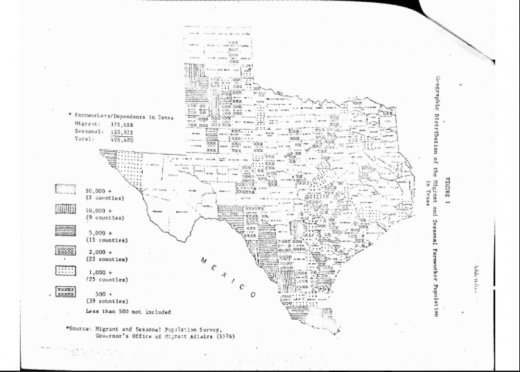
the Lower Rio Grande Valley area of Texas”(Migrant Program Recruitment Proposal, 1978). Migrant programs then included H.E.P (High School Equivalency, C.A.M.P (College Assistance Migrant Program), and M.A.P.P. (Migrant Attribution Prevention Program).
In the video below, Dr. Chahin talks about his experience as a migrant student and the recruiting initiatives that got him to the University of Michigan.
“They say necessity is the mother of invention, but we invented ourselves”.
– Dr. Jaime Chahin
Each One-Reach One-Student Contact Plan Program (1978)
This program offered minority students at U-M an opportunity to provide the Admissions Office a name of an acquaintance interested in attending the university (Minority, Recruitment, Enrollment, Retention, and Graduation, 1979). The office later followed-up with them through introductory letters and admissions applications to identified prospective students. Over 3,000 letters requesting names were mailed to minorities during Fall 1980 and about 60 names were received by January.
The Minority Prospective Scholars Program (1978)
First initiated in 1978, this program recruited academically excellent students, with a focus on recruiting out-of-state students (Minority, Recruitment, Enrollment, Retention, and Graduation, 1979). Candidates for this program were selected based on a Student Search Service through the College Board and applications on file in the Admissions Office. More than 2,000 students including 89 in-state students received Prospective Scholar letters along with a congratulating letter, an admission application, and the publication Minorities at Michigan. An estimated 15% of these students requested additional university information. Telephone calls were made to encourage them to apply and extend personal assistance. Detroit-area students were invited to a Prospective Scholars Reception in the Rackham Building (Detroit).
Interview Sessions Sponsored by the National Scholarship Service and Fund for Black Students (NSSFNS) (1979)
The University and other colleges participated in NSSFNS student interview sessions held in Atlanta, Chicago, Detroit, Philadelphia, and New York (Minority, Recruitment, Enrollment, Retention, and Graduation, 1979). About 3,000 high school students attended a session and this was an effective way to reach large numbers of minority students. At the time, visits to Atlanta and Cleveland initiated 100 student’s interest in regards to the University of Michigan.
Rackham Name Exchanges Program (1979)
The Rackham Graduate School depended on minority student name exchange programs because it was a very important recruiting mechanism for them (Minority, Recruitment, Enrollment, Retention, and Graduation, 1979). The University participated in three consortia and expected to receive information on over 1,700 minority students from these Committee on Institutional Cooperation, Committee on Cooperative Minority Student Recruitment, and the Western Name Exchange (consortia). Rackham also had efforts to develop a name exchange program with nine other Michigan institutions and participated in the Minority Student Locator Service (sponsored by the Educational Testing Service) to receive 10,000 minority student names taking the Graduate Record Examination.
The Annual Detroit Area Counselors Workshop (1979)
This initiative was designed to establish, maintain, and improve communication with high school and community college officials for the schools which provide most of the University’s minority students (Minority, Recruitment, Enrollment, Retention, and Graduation, 1979). Representatives from 14 Detroit-area high schools, Wayland County community college, and Highland Park community college attended the 1979-80 Counselors Workshop.
Rackham CIC (1979)
In 1979, five students were receiving fellowships through the Committee on Institutional Cooperation (CIC) which provided assistance to minorities in the social sciences (Minority, Recruitment, Enrollment, Retention, and Graduation, 1979). The CIC was funded by the Lilly Endowment, Inc. and the university received the second highest number of awards granted, out of the 25 fellowship awards. The fellowship was for two-years and provided full-tuition for an academic year and a stipend of $4,250. Recipients of social science programs were enrolled in any of the following programs: psychology, economics, history, and political science.
1980s
Rackham G*POP (1980)
In 1979, 15 students were receiving fellowships from the Graduate and Professional Opportunities Program (G*POP) under a federal grant to the University (Minority, Recruitment, Enrollment, Retention, and Graduation, 1979). The fellowships included $7,800 a year for minorities and women enrolling in certain health-related fields and analytical social sciences. Recipients have been enrolled in following programs: applied economics, biostatistics, computer and communication sciences and medical care organization. The total grant to the University also included an institutional grant of $24, 205 for recruitment efforts, supportive services, and tutoring directed at minorities and women.
Joint Writing Program (1985)
The Mackenzie High School/U-M Writing Program began in 1984-85 and encouraged young people to set goals and meet them through a college education(One Year Later Commitment , 1987-88). It partnered with Mackenzie High School through the Detroit Public Schools/University of Michigan Collaborative Committee. It was an outcome-driven writing program for high achieving high school 9th grade students so that they would develop their skills to score well on college admission essays. Fifty 9th graders were selected for an advanced curriculum emphasizing communication, critical thinking, and self-confidence skills. Their main objectives were to prepare students for their educational goals and to motivate them to be persistent and have self-confidence.
Martin Luther King / Cesar Chavez / Rosa Parks (KCP) Visiting Professors Program (1986)
The Visiting Professors Program was initiated by legislation and into place at U-M’s Ann Arbor campus in 1986 (Office of Minority Affairs’ Programs & Initiatives, 1987-91). The program provided support to unit and department visiting scholars of color to campus. The visiting professors represented a wide variety of fields, presented lectures, symposia, taught mini-courses, gave instructional concerts, and exhibited their works of art and research projects. A key component in this program was to have these scholarly professors interact with K-12, undergraduate, and graduate students as well as faculty, staff, and administrators. By 1991, there were 5 Visiting Professors appointed as U-M faculty.
King / Chavez / Parks College Program (1986-87)
The Martin Luther King/Cesar Chavez/ Rosa Parks College Day Program was two to four-week summer enrichment program (One Year Later Commitment , 1987-88). There was about 100 middle and high school students who participated in 1987. This program introduced them to engineering careers and the demands of a college environment. It was a six-year college prep model introduced at 6th grade (Office of Minority Affairs’ Programs & Initiatives, 1987-91). One day spring visitations were held in 7th grade, community college campus visits held in 8th grade, and then join the college club program in high school to learn about college/universities, the application process, and overall college preparation.
Wade H. McCree Jr. Incentive Scholars Program (1986)
In 1986, the President’s Council of State Universities of Michigan endorsed a state commitment of its member institutions to offer full-tuition, guaranteed scholarships to selected students in the program (Office of Minority Affairs’ Programs & Initiatives, 1987-91) U-M awarded 20 Incentive Scholarships from 1987-1989 and 25 Incentive Scholarships in 1990. Students were selected by the Detroit Public Schools. A committee of faculty, staff, and students were appointed to this program for development of other programs such as the summer initiative program and the alumni mentoring program. Both are extensions of the McCree Incentive Program.
The Historical and Predominantly Black College and University (HBCU), Hispanic Serving Institution (HSI), and Native American College Committee (1987)
The Office of Minority Affairs established the Historically and Predominantly Black College and University Committee in 1987 and later expanded it to include Hispanic Serving Institutions and Native American Colleges (Office of Minority Affairs’ Programs & Initiatives, 1987-91). The Committee meets to establish collaborative relationships, provide updates on progress of programs, and discuss strategies for further collaborations.
The Minority High School Research Program (1987)
This program offered summer apprenticeships in science research for promising high school students (One Year Later Commitment , 1987-88). The first six apprenticeships were awarded in 1987.
The Fall Minority Student Welcome Program (Fall Campus Visitation) (1987)
The Fall Minority Student Welcome Program was co-sponsored by the Orientation Office and the Office of the Vice President for Academic Affairs (One Year Later Commitment , 1987-88). Transportation and lunch were provided for high school seniors from selected schools who wanted to visit campus. About 1/3 of minority student who came in 1987 applied for admission.
Martin Luther King Jr. Symposium (César Chavez) (1987-88)
The Office of Minority Affairs participated in the coordination of The University of Michigan’s first Martin Luther King Jr., MLK Symposium in 1987 (Office of Minority Affairs’ Programs & Initiatives, 1987-91). In 1989, a host of events were scheduled and keynote speakers included Carrie Saxon Perry, Mayor of Hartford, Mayor of Connecticut, and Cesar Chavez, an activist and President of the United Farm Workers Union.
Committee of Recruiters: Recruitment Symposium (1988)
The Committee of Recruiters was formed to provide staff and faculty responsible for minority student recruitment an opportunity to meet and share information on upcoming recruitment events, discuss enhancement and maximization of recruitment efforts, share strategies, and to build a network (Office of Minority Affairs’ Programs & Initiatives, 1987-91). In efforts to expand the University’s concept of minority student recruitment, the committee planned and held a recruitment symposium in Chicago for two-consecutive years for students of color, counselors, and administration.
Students of Color Welcome Program (1988)
This program is designed to introduce incoming students to faculty, staff, and current students at the University (Office of Minority Affairs’ Programs & Initiatives, 1987-91). In 1990, the New Students of Color developed Collage 90, a program promoting more socialization.
Hispanic Association of Colleges and Universities (1989)
The University of Michigan through the Office of Minority Affairs is a member of HACA, the Hispanic Association of Colleges and Universities (Office of Minority Affairs’ Programs & Initiatives, 1987-91) HACUs purpose is to promote the institutional development of member colleges/universities and to advance postsecondary educational opportunities for Hispanic students.
1990s
Winrock Recruitment Fair (1990)
The Office of Minority Affairs participated in the Winrock Recruitment Fair held in Albuquerque, New Mexico in 1990 (Office of Minority Affairs’ Programs & Initiatives, 1987-91). Many Latino students were invited to complete applications to U-M. Former Governor of NM and U-M Alumni, Dave Cargo, worked with OMA to establish an Alumni sponsored recruitment event in New Mexico.
La Estudiantina (1990)
The University of Michigan, Eastern Michigan University, Michigan State University, Bowling Green University, and American Airlines sponsored the visit of La Estudiantina students from the Edcouch-Elsa High School in Edcouch, Texas (Office of Minority Affairs’ Programs & Initiatives, 1987-91). The 40 music students presented musical selections including Mexican traditional songs at the University. The students then toured the campus, participated in a class session, met with Latino students/staff/faculty, and were able to talk with the Office of Minority Affairs, Admissions, Financial Aid, and CSP Staff.
Commission on Minority Recruitment, Success, and Graduation (1990)
The Provost and Vice Provost for Minority Affairs co-chairs the Commision on Minority Student Recruitment, Success, and Graduation (Office of Minority Affairs’ Programs & Initiatives, 1987-91). The Commision identified barriers and developed strategies to enhance minority student recruitment, success, and graduation. They also address the issues of climate and curriculum.
Present
The PILOT organization was found by Richard Nunn, Evelyn Galvan, and other students in 2010 as a student-led organization and then extended its efforts to support (and recruit) minority high school students. This program created the Big House Program in the summer of 2012.
Gaining Early Awareness and and Readiness for Undergraduate Programs (GEAR UP)
The GEAR UP Program targets middle and high school students in Southfield and Ypsilanti School Districts to promote college-readiness. The program has followed the graduating Class of 2017 since 7th grade and gives them support, tools, and knowledge in regards to college/university admissions.
Michigan- Pursuing Our Dreams M-POD
M-POD is a Washtenaw Community College transfer program that offers assistance, support, counseling, mentoring, and guidance in the transfer process to the University of Michigan. The program connects students to resources that will help them successfully graduate.
Success Connects is a program designed to guide students through the first two years of their college experience with resources, peer mentorship, success coaches, and opportunities. They become an academic success partner their Junior and Senior year of college. This program is funded by the State of Michigan, King-Chávez-Parks Initiative, and the Office of the Provost.
Assisting Latinos to Maximize Achievement (ALMA)
ALMA is a recruitment, mentorship, retention, and informational orientation program created in 2001. This program stemmed from the Latino Welcome Initiative (LWI) created in 1999. It is sponsored by the Office of Admissions, the Office of Multi-Ethnic Student Affairs (MESA), Michigan Student Assembly, and the Trotter Multicultural Center.
Student Community of Progressive Empowerment (SCOPE)
SCOPE is a student organization serving undocumented and DACAmented students by providing a supportive community at the University of Michigan. The University of Michigan chapter was brought here from Texas State University by Juan Jaimes, a Ford School of Public Policy 2018 Masters Graduate, recruited to the University by U-M Alumni, Dr. Jaime Chahin.