Research
Active Galactic Nuclei
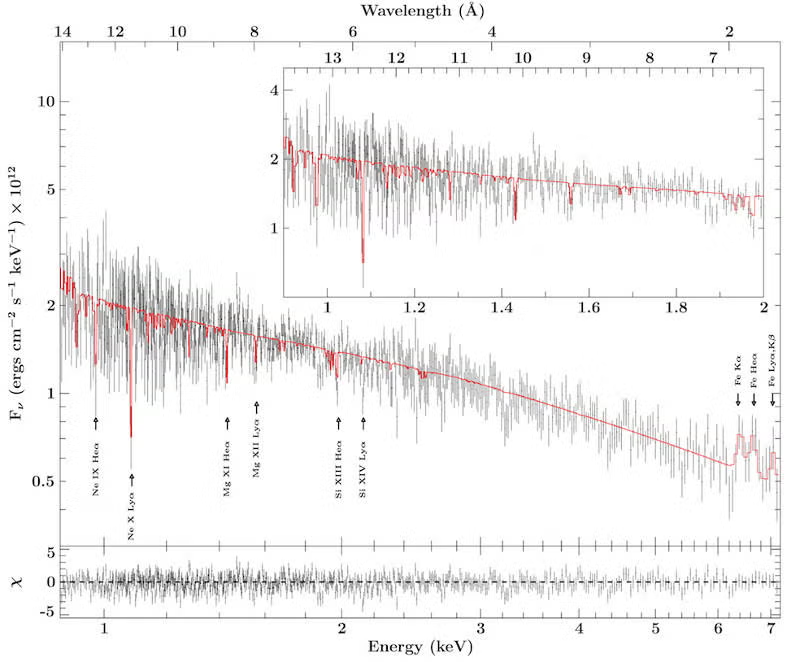
The centers of active galactic nuclei contain supermassive black holes, with masses of 106-109 solar mass, which actively grow by the accretion of surrounding material. Recent X-ray observations of nearby galaxies show the presemce of blueshifted absorption lines, which were interpreted as ionized gas outflows along the line of sight from the innermost regions of accretion disks. Over half of Seyfert I AGNs were found to have blueshifted absorption lines attributed to ionized outflows in the range of several hundred km/sec commonly referred to as warm absorbers. A considerable fraction of AGNs showed ionized absorbing outflows with velocities upto of 0.1 to 0.4 times the speed of light, so called ultra-fast outflows. We do not fully understand how ultra-fast outflows are launched from accretion flow around supermassive black holes. As a Postdoctoral Fellow at Harvard-Smithsonian Center for Astrophysics, Ashkbiz Danehkar has studied X-ray observations of ionized absorbing outflows in the Seyfert I galaxy PG1211+143 in a project supported by the National Aeronautics and Space Administration (NASA)/Chandra X-Ray Observatory (CXC). He used X-ray spectra taken with Chandra High Energy Grating Spectrometer. He carried out photo-ionization modeling of ionized outflows and detected the presence of an ultra-fast outflow with velocity of about 18000 km/s (about 6 percent of the speed of light). Using photo-ionization models, he derived the physical properties of ionized ultra-fast outflows ejected form the Quasi-Stellar Object PG1211+143.
Publications
A. Danehkar, M. A. Nowak, J. C. Lee, G. A. Kriss, A. J. Young, et al., The Ultra-fast Outflow of the Quasar PG 1211+143 as Viewed by Time-averaged Chandra Grating Spectroscopy, ApJ 853:165 (2018)
G. A. Kriss, J. C. Lee, A. Danehkar, M. A. Nowak, T. Fang, et al., Discovery of an Ultraviolet Counterpart to an Ultrafast X-Ray Outflow in the Quasar PG 1211+143, ApJ 853:166 (2018)
A. Danehkar, M. A. Nowak, J. C. Lee, R. K. Smith, MPI_XSTAR: MPI-based Parallelization of the XSTAR Photoionization Program, PASP 130:024501 (2018)
G. A. Kriss, J. C. Lee, A. Danehkar, A Search for H I Lyman α Counterparts to Ultra-Fast X-ray Outflows, ApJ 859:94 (2018)
Planetary Nebulae
Planetary nebulae are hydrogen-rich materials previously expelled by the asymptotic giant branch progenitor star. These ejected materials are fully ionized by hard UV radiations from its degenerate core. The photo-ionization process makes the visible nebula. The emission lines emitted by the ionized nebula carry important information about kinematic structures of planetary nebulae. The most of planetary nebulae show bipolar morphologies, and we have not yet fully understood how these morphologies are formed.
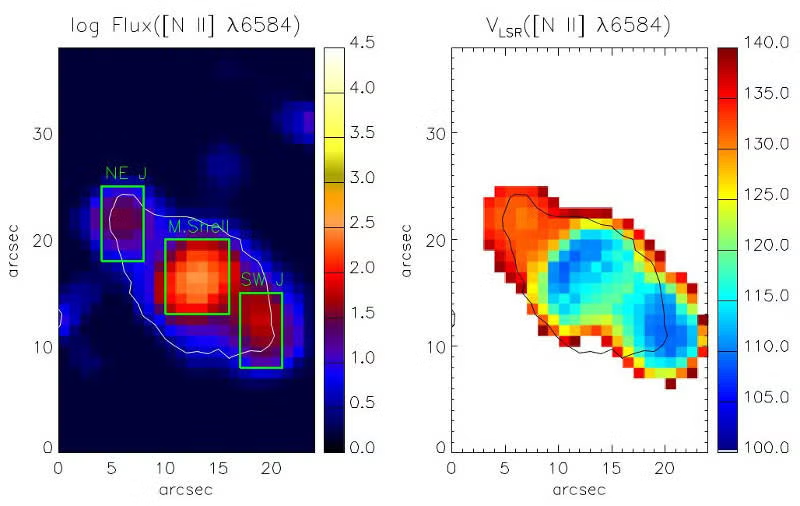
During his PhD study at Macquarie University, Ashkbiz Danehkar studied kinematic structures of planetary nebulae around Wolf-Rayet stars. He utilized an optical integral field unit (IFU) spectroscopy called the Wide Field Spectrograph (WiFeS) on the Australian National University 2.3-m Telescope to observe several planetary nebulae. Spatially-resolved kinematic observations of planetary nebulae allowed to disentangle 3D kinematic structures of planetary nebulae. He found that these planetary nebulae have bipolar morphologies. In some planetary nebulae, the velocity-channel maps reveal the presence of so-called Fast Low-Ionization Emission Regions (FLIERs), and previously unknown collimated bipolar outflows.
Planetary nebulae are also an important astrophysical tool to trace the composition of the interstellar medium in galaxies. Obtaining chemical elements of planetary nebulae reflect the composition of galaxies and the nucleosynthesis and mixing process occured in the asymptotic giant branch stars. As a PhD student at Macquarie University, Ashkbiz Danehkar determine temperatures, densities, and chemical elements of several planetary nebulae around Wolf-Rayet stars. He utilized the 3-D photoionization program MOCASSIN (MOnte CArlo SimulationS of Ionized Nebulae) to constrain the 3D ionization structure of planetary nebulae. His empirical plasma diagnostics and abundance analysis, together with 3-D photoionization modeling, were used to determine physical conditions and chemical abundances of several planetary nebulae. The IFU spectroscopic observations allowed to make spatially-resolved maps of density, temperature, and chemical elements within the nebula.
Publications
A. Danehkar, Q. A. Parker, B. Ercolano, Observations and three-dimensional ionization structure of the planetary nebula SuWt 2, MNRAS 434:1513 (2013)
A. Danehkar, H. Todt, B. Ercolano, A. Y. Kniazev, Observations and three-dimensional photoionization modelling of the Wolf-Rayet planetary nebula Abell 48, MNRAS 439:3605-3615 (2014)
D. J. Frew, I. S. Bojičić, Q. A. Parker, M. Stupar, S. Wachter, …, A. Danehkar, et al., The planetary nebula Abell 48 and its [WN] nucleus, MNRAS 440:1345 (2014)
A. Danehkar, Q. A. Parker, Spatially resolved kinematic observations of the planetary nebulae Hen 3-1333 and Hen 2-113, MNRAS:Letters 449:L56 (2015)
A. Danehkar, Discovery of Collimated Bipolar Outflows in the Planetary Nebula Th 2-A, ApJ 815:35 (2015)
A. Danehkar, Evolution of Planetary Nebulae with WR-type Central Stars, PASP 127:499 (2015)
A. Danehkar, Q. A. Parker, W. Steffen, Fast, Low-ionization Emission Regions of the Planetary Nebula M2-42, AJ 151:38 (2016)
A. Danehkar, Bi-Abundance Ionisation Structure of the Wolf-Rayet Planetary Nebula PB 8, PASA 35:e005 (2018)
Plasma Physics
Electron-acoustic waves are generated in several space plasmas such the Earth’s bow shock and the auroral magnetosphere where populations of electron with different temperatures are present, and propagate with the phase velocity as a function of electron thermal velocities. Electron-acoustic waves are also produced in laser-plasma laboratory experiments. In such a plasma, background electrons with a lower temperature support the inertial force behind electron-acoustic waves, while electrons with a higher temperature provide a thermal pressure to restore the electron-acoustic waves. The observations suggest that the hot electron population has a suprathermal distribution which can be described by a kappa-distribution function.
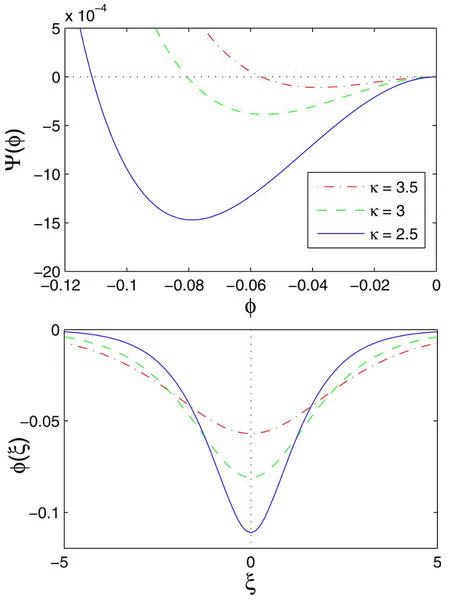
During his postgraduate study at the Queen’s University Belfast, Ashkbiz Danehkar investigated nonlinear dynamics of electron-acoustic waves in a plasma consisting of inertial background electrons and suprathermal hot electrons. He obtained a linear dispersion relation for describing linear electron-acoustic waves, and utilized a nonlinear technique to obtain a pseudo-energy balance equation with the Sagdeev pseudopotential, which was used to determine the existence domain for nonlinear electron-acoustic waves, and the dependence of electron-acoustic waves on various plasma parameters. His studies of electron-acoustic waves were also extended to other plasma environments such as electron-positron pair and electron beam-plasma interaction.
Publications
A. Danehkar, N. S. Saini, M. A. Hellberg, I. Kourakis, Electron-acoustic solitary waves in the presence of a suprathermal electron component, Physics of Plasmas 18:072902 (2011)
A. Danehkar, Electrostatic solitary waves in an electron-positron pair plasma with suprathermal electrons, Physics of Plasmas 24:102905 (2017)
A. Danehkar, Electron beam-plasma interaction and electron-acoustic solitary waves in a plasma with suprathermal electrons, Plasma Physics and Controlled Fusion 60:065010 (2018)
Theoretical Physics
The electric-magnetic duality is the well-known example of dualities in quantum field theories and string theories. Although Maxwell theory, which relates the electric and magnetic fields to each other, includes no magnetic monopoles, a symmetric formulation of Maxwell’s equations predict the existence of the magnetic monopoles analogous to electric charges. Under the electric-magnetic duality, there could be a field, which is dual to the graviton field, which might be a candidate for the inflationary dark energy. Tthe accelerating expansion of the Universe, as well as the observations from the Wilkinson Microwave Anisotropy Probe and the Planck Cosmic Microwave Background temperature measurements support the standard ΛCDM cosmological model, which contains only about 5 percent in ordinary baryonic matter, while 25 percent in non-baryonic cold dark matter and 70 percent in dark energy associated with the cosmological constant Λ.
During an early-stage research at the University of Craiova, Ashkbiz Danehkar used the antifield-BRST formalism to study the five-dimensional consistent interaction between a dual formulation of linearized gravity and background field (BF) model. It is known that the linearized Einstein-Hilbert action, which describes the Einstein field equations in general relativity, can be modeled by a BF gravity, so his theoretical study demonstrated that the dual linearized gravity can have consistent interactions with the BF gravity (in other word, the Einstein-Hilbert action) in 5 spacetime dimensions.
During his time at University of Craiova, Ashkbiz Danehkar also learned about cosmological perturbations in general relativity. He used 3 + 1 covariant formalism to study the evolution of the electric and magnetic parts of the Weyl curvature tensor, the so-called gravitoelectric and gravitomagnetic fields in the Ricci kinematic formulations and the Bianchi dynamic formulations. It is shown that the gravitomagnetic field is necessary to support the gravitational wave, while the gravitoelectric field is associated with the interacting property of graviton at the long-range distance (i.e. the Newtonian tidal force). Although the gravitomagnetic field has no analogy in the Newtonian theory, it is related to the finite speed of gravity in general relativity.
Publications
C. Bizdadea, E. M. Cioroianu, A. Danehkar, M. Iordache, S. O. Saliu, et al., Consistent interactions of dual linearized gravity in D=5: couplings with a topological BF model, European Physical Journal C 63:491 (2009)
A. Danehkar, On the Significance of the Weyl Curvature in a Relativistic Cosmological Model, Modern Physics Letters A 24:3113 (2009)
See Curriculum Vitae

