

Awards and Recognition
- NASA Earth and Space Science Fellowship (NESSF) (10% acceptance rate), 2018 – 2021
- US Permafrost Association (USPA), Permafrost Engineering Education Program (PEEP), 2024
- USC Viterbi School of Engineering 3 Minute Thesis Competition Finalist, 2023
- IEEE Geoscience Remote Sensing Society (GRSS) 2023 Chapter Excellence Award, 2023
- IEEE GRSS 2023 Student Prize Paper Award, (3rd place among 270 paper submissions), 2023
- IEEE Antenna and Propagation Society Fellowship (10% acceptance rate), 2022
- USC ECE Department, Ming Hsieh Institute Scholarship (top 6 Ph.D. candidates in the ECE department), 2022
- IGARSS 2022, Student Paper Competition Finalist, (top 10 among 220 paper submissions), 2022
- USC ECE Department, Ming Hsieh Institute, 10th Annual Research Festival, Best Poster Award, 2019
Education
- Ph.D., Electrical Engineering, USC (USA), 2017 – 2024
- M.S., Astronautical Engineering, USC (USA), 2020 – 2023
- M.S., Electrical Engineering, USC, (USA), 2017 – 2020
- B.S., Electrical Engineering, University of Tehran (Iran), 2012 – 2017
PhD Dissertation:
Physics-Based Models and Microwave Sensors for Mapping Soil Carbon in Arctic Permafrost using Long-Wavelength Radars
- Part I: Physics-Based Computational Radar Mapping of SOC in Arctic Permafrost
- Part II: Microwave Sensors for Dielectric Imaging of Arctic Organic Soil
Short bio:
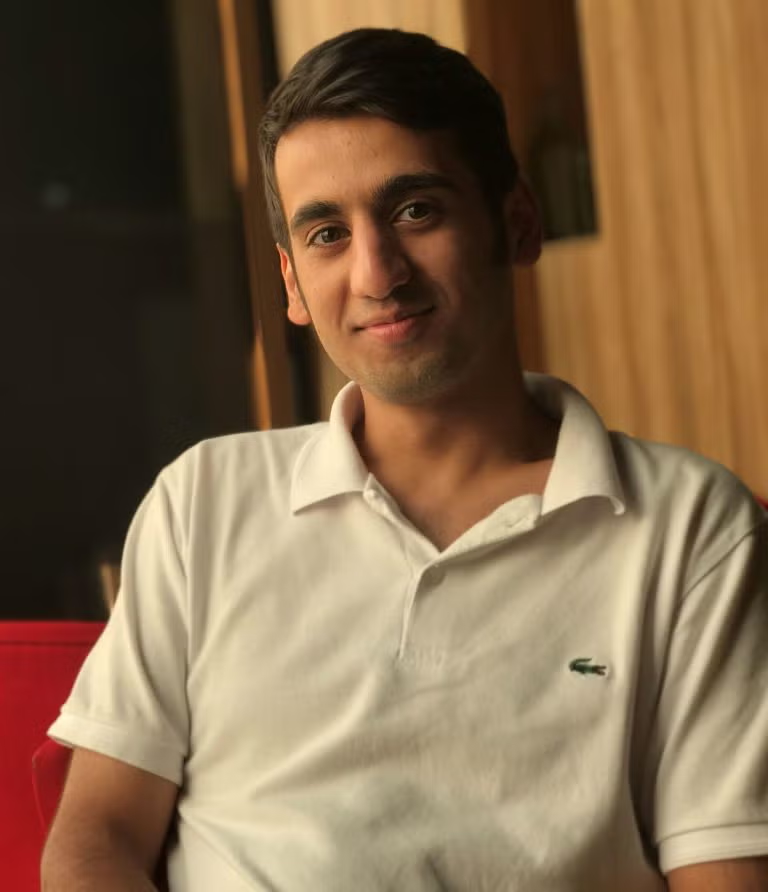
Kazem is a Postdoc research associate in the Hydrology, Land Use, and Climate Change lab, and he works with Prof. Jessica Fayne. His research primarily focuses on studying the role of vegetations and their dynamics in regulating the carbon fluxes across the Great Lakes region. Using various remote sensing techniques (eg, Sentinel-1/2 ) along with a wealth of carbon flux measurements provided by dozens of AmeriFlux eddy covariance sites around the Great Lakes region, he aims to develop a new framework that helps to monitor the CO2 and/or CH4 fluxes at a scale that was not resolved before!
Before starting the Postdoc in the Department of Earth and Environmental Sciences at UoM, Kazem completed his PhD in the Microwave Systems, Sensors, and Imaging lab at the Ming Hsieh Department of Electrical and Computer Engineering with Prof. Mahta Moghaddam at USC. Kazem’s work investigated the interdisciplinary aspects of microwave remote sensing and ecosystem ecology with a primary focus on the Arctic ecosystem. In his dissertation, he developed a new retrieval algorithm to characterize and map the arctic permafrost soil organic carbon using long-wavelength radars. This was done by developing new organic soil dielectric models via detailed measurement and modeling for highly organic Arctic soil, along with physics-based computational models that account for the interaction of electromagnetic waves with the random surface/subsurface of active layer soils while taking into account hydrological and biogeochemical processes that govern the permafrost landscape ecosystem. Complementing the algorithm developments, which were done for legacy measurement techniques (eg, PolSAR imaging), he works on advancing novel remote sensing technologies that enable new concepts of measurements and complex experimental setups. These works span designing new microwave imaging systems for non-destructive microwave imaging from subsystems to imaging algorithms of soils to new radar systems for various ecological applications.
Recent Papers
- Bakian-Dogaheh K et al., 2025 Coupled hydrologic-electromagnetic framework to model permafrost active layer organic soil dielectric properties Remote Sensing of the Environment
- Zhao Y, Bakian-Dogaheh K et al., 2024 Integrating multi-source remote sensing data for mapping boreal forest canopy height and species in interior Alaska in support of radar modeling Environmental Research Letters
- Bakian-Dogaheh K et al., 2023 A quad-band near-field antenna array for a multistatic microwave imaging chamber IEEE Antennas and Wireless Propagation Letters