
The Futures of Islamic Art History:
Remapping the Field
Part of the Getty’s Connecting Art Histories Initiative
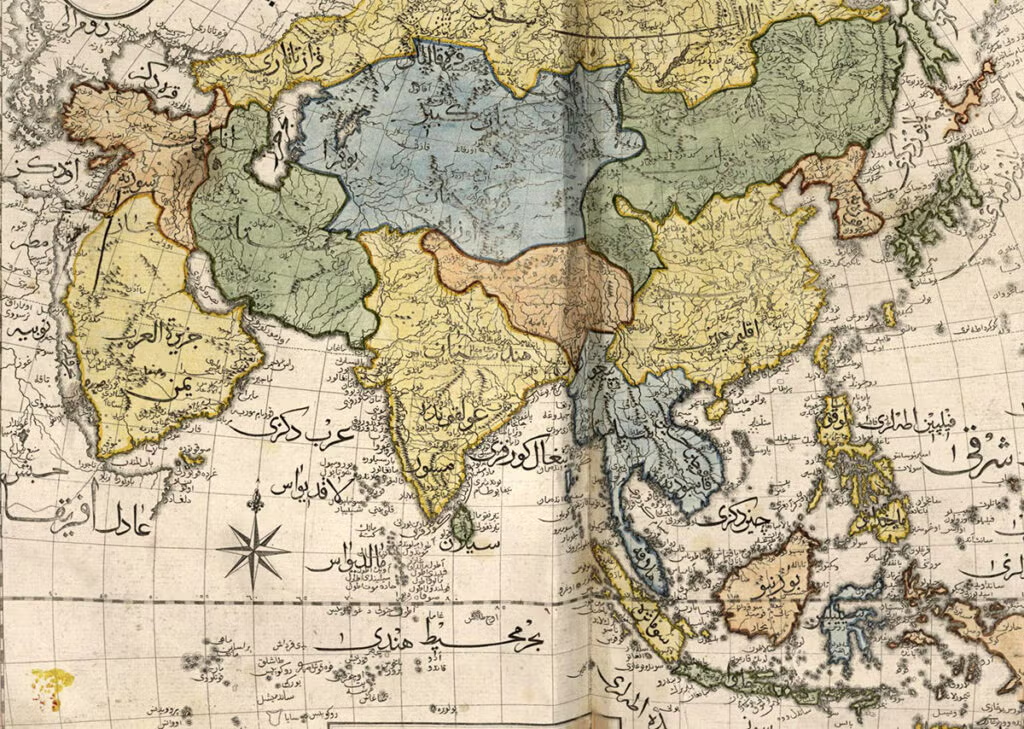
Islamic Art History, which is a relatively new academic field, has tended to privilege the study of “core Arab lands,” especially the Levant and North Africa, and the medieval period. In more recent decades, however, scholars have shifted their focus to Persian, Turkish, and South Asian spheres, but most research has tended to tackle the ‘high’ arts of mosques and palaces, illustrated manuscripts, and painting and calligraphy– all of which were typically sponsored by members of the royal and princely classes. While sub-elite and vernacular arts have increasingly captured the attention of some scholars, many objects still remain understudied in our received hierarchies and taxonomies, which place architecture and painting at the apex of erudite patronage and masterly production. Among such overlooked materials can be counted women’s embroideries, amulets and gems of various tribes and nomadic groups, photographs, posters, and prints, and diminutive coins and other ephemera. Our project on “The Futures of Islamic Art History: Remapping the Field” is firmly situated within the context of growing and democratizing the field of Islamic art history, which includes an expansion of geographies, a stretching of chronological brackets, a diversification of artistic and creative expression, and an unrestricted experimentation with various theoretical approaches, intellectual models, and technological tools to disseminate knowledge in a free and open manner. It also expands the temporal and geographical scope of Islamic art studies by incorporating materials, regions, and periods that are often overlooked in traditional discourse, such as Sufi (mystical Islamic) arts, Sino-Islamic artistic exchange, and Southeast Asian art.
This project is supported by the Getty’s Connecting Art Histories initiative and is co-directed by Christiane Gruber, Mehmet Ağa-Oğlu Collegiate Professor of Islamic Art History at the University of Michigan and Founding Director of Khamseen, and Mira Xenia Schwerda, Assistant Professor at Duke University and responsible for Research and Development at Khamseen. The project includes three travelling seminars to Istanbul (2027), Kuwait City (2028), and Kuala Lumpur (2029), which will bring together an international cohort of graduate students and early to mid-career scholars who will benefit from this network well beyond the project’s duration. The seminars will enable in-depth, intimate, intergenerational, and cross-cultural discussions on how to advance the field at multiple key moments: during preparatory online workshops, in-person during the three trips, and at a potential symposium at the close of the travelling seminars (2030). Besides group discussions, object presentations, on-site conversations, and the building of lasting international networks, the results of the travelling seminars will include filming of content that will be made accessible free of charge to international audiences on the website Khamseen: Islamic Art History Online. Launched in Fall 2020 at the University of Michigan, Khamseen is the first and only open-access scholarly platform dedicated to Islamic Art History. The project therefore combines in-person seminars, workshops, site visits, and museum work (including in storage) with digital dissemination of multimedia scholarship on the Khamseen platform. This aspect of the project increases further connectivity and openness, while also fostering continued intellectual exchange across linguistic and geographic barriers.