
Irene Promodh
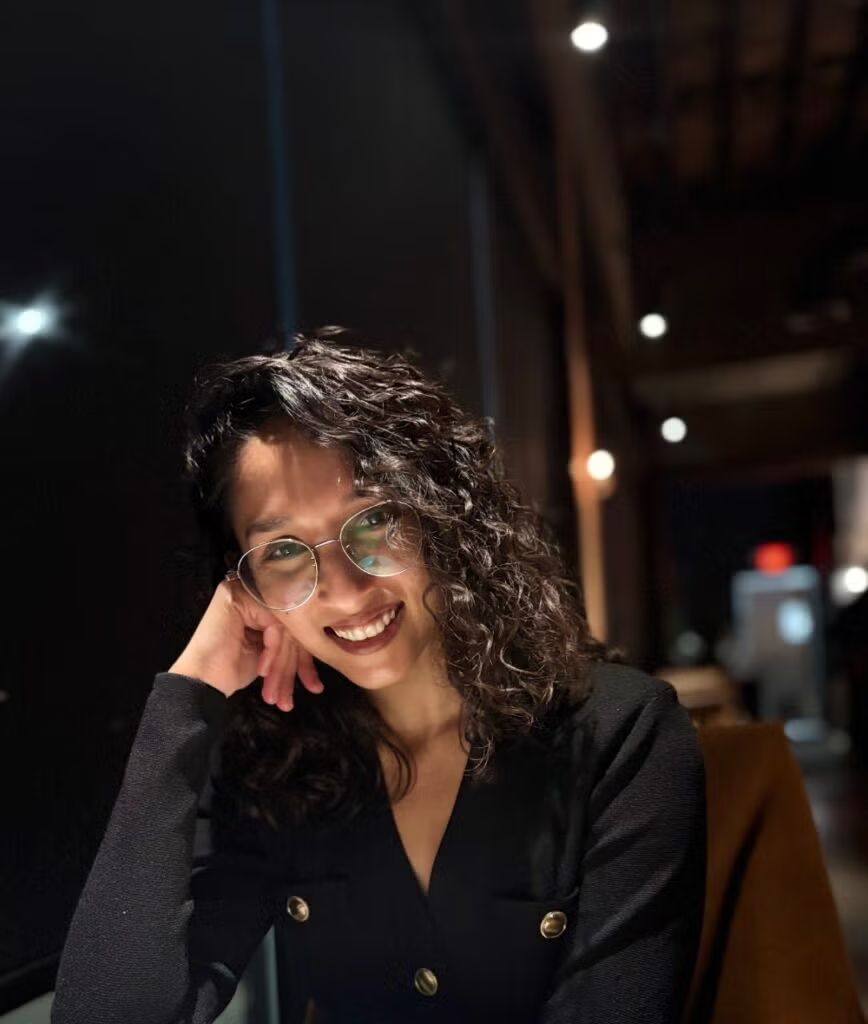
I am a Ph.D. Candidate in Sociocultural Anthropology at the University of Michigan. Born in Chennai, in the south Indian state of Tamil Nadu, and schooled between neighboring Kerala and the Arabian Gulf, I developed an early attunement to the shifting registers of value and hierarchy, aspiration and obligation, presence and absence that animate relational worlds stretched transregionally. Among the most intimate and hotly contested media through which migrant kin relations are negotiated is gold: a commodity-substance that moves largely in 22-karat form between the Arabian Gulf and south India as ornament, remittance, and inheritance. Yet its claims to universal value are routinely contested in Kerala within longer histories of refusal among those for whom its promissory logics of linear accumulation and generational continuity are untenable.
The dissertation takes gold not as its object but as a multi-scalar medium of anthropological inquiry. My work traces the economic, relational, and bio-metabolic regimes of gold that sustain transregional labor circuits connecting south India with the post-oil special economic zones (SEZs) of the Arabian Gulf. Kerala is India’s foremost consumer of gold in 22 karats, and India ranks among the world’s most intensive. Yet the precious metal arrives from variously obscure elsewheres, imported most heavily through the duty-free trade zones of the Gulf before reaching the retail and wholesale showrooms of Kerala. Drawing on 25 months of multi-sited fieldwork between the gold souqs of Dubai, Sharjah, and Doha and the gold-manufacturing districts of south India, I trace how vernacular expertise in the material properties of gold—karatage, weight, hallmarking, malleability—produces not a shared vocabulary of value but a field of incommensurable claims over the gold-wearing (and gold-absent) body.
It is within this field that my central ethnographic puzzle emerges: the historical refusal of gold among the Pentecostal-charismatics of Kerala, for whom the remittance, inheritance, and bodily adornment of gold constitute a corrupting genealogy of accumulation and worldly recognition they seek to rupture and repair. By placing Pentecostal-charismatic refusals in generative juxtaposition with the exclusions gold enacts on other bodies—the Dalit waste-worker who tracks lost value from the gold-dust discards of jewelry manufacturing, or the queer subject dispossessed from normative claims to kinship and inheritance—I examine what is at stake when a substance widely treated as the ground of universal value is revalued and ideologically upended in unexpected ways. Situated within and at the edges of gold commodity chains in the region, between south India and the Arabian Gulf, my research asks questions such as: What kinds of kinship does gold make possible and foreclose? What histories does a piece of gold—extracted, inherited, remitted, or newly bought—carry in south India, and what happens when those histories come undone? How does gold in a caste society oscillate between fungible commodity and marked substance, between liquid asset and porous matter? And in what ways does the refusal of gold by everyday actors scale from bodily practice to a political claim on the limits of value itself?
I tie together approaches in economic anthropology, science and technology studies, geography, history, and the anthropology of religion to track how everyday disputes over the value of gold bring into view broader struggles over fiscal legibility, moral integrity, and social recognition at the margins of modern South Asia and its migrant remittance economies across the sea.
My dissertation research has been supported by the Wenner-Gren Foundation, the American Institute of Indian Studies, and the Center for the Education of Women+, the International Institute, and the Global Islamic Studies Center at the University of Michigan. My undergraduate studies at Georgetown University’s branch campus in Qatar (GU-Q) were supported by the Qatar National Foundation.
My earlier work has been published in the Journal of Ethnic and Migration Studies, City & Society, Journal of Arabian Studies, and Comparative Studies in South Asia, Africa, and the Middle East. More recently, reviews of academic monographs have appeared in Material Religion, Journal of South Asian Development, and Journal of Asian Studies. Forthcoming work will be linked here.
I welcome the opportunity to meet and connect with scholars working at related intersections. I can be reached at iap [at] umich [dot] edu.