
Panorama of Jebel Barkal and pyramids from the south. Image: Gregory Tucker, 2018
Welcome to the Jebel Barkal
Archaeological Project webpage!
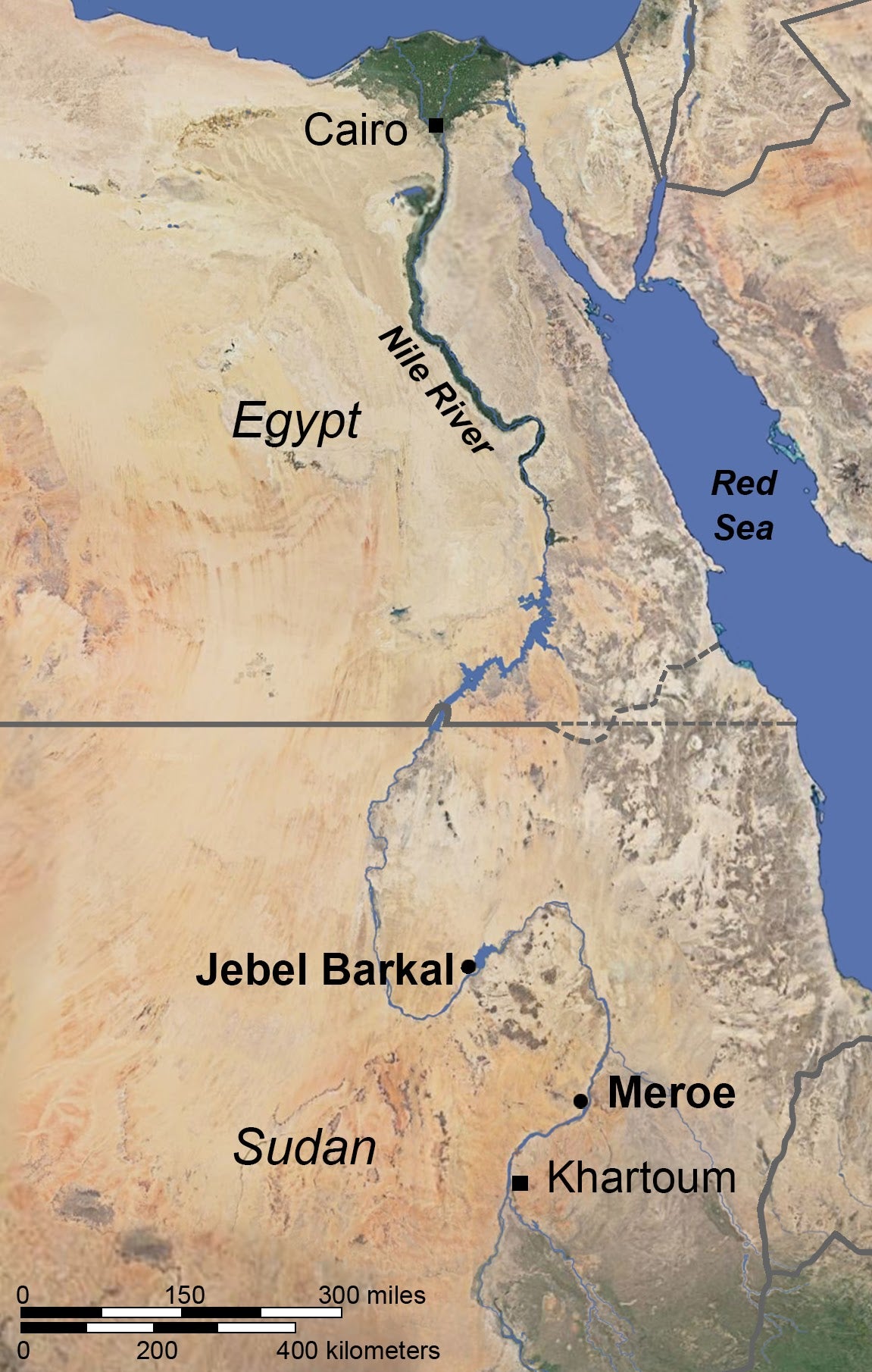
Occupying more than 100 hectares along the Nile in northern Sudan, Jebel Barkal is an extraordinary archaeological site preserving the remains of a capital city of ancient Kush: one of Africa’s earliest and most important empires. In Arabic, “Jebel Barkal” means “Holy Mountain,” and the site formed around a tall, dramatic sandstone outcrop that was sacred to ancient Kushites and Egyptians. At the base of this mountain was a succession of settlements, now covered by desert sands and sediment from the annual Nile flood. It was an important city in ancient Kush for more than 1000 years (800 BCE – 300 CE) and was also the southernmost outpost of the Egyptian empire when it had conquered Kush (1500-1069 BCE). In addition to the ancient city, the site is also home to the ruins of pyramid tombs, temples, and palaces. Because of its exceptional historical importance, Jebel Barkal is at the center of a UNESCO World Heritage area.
Currently, excavations of the Jebel Barkal Archaeological Project (JBAP) are directed by archaeologists Geoff Emberling of the Kelsey Museum of Archaeology at the University of Michigan and Sami Elamin of the National Corporation of Antiquities and Museums (NCAM), Sudan. Conservation is directed by Suzanne Davis, also of the Kelsey Museum of Archaeology, and Elmontaser Dafalla, of NCAM. Community engagement is directed by Tohamy Abulgasim and Rebecca Bradshaw, both University of Cambridge.
We have ensured that each research and managerial position on the project is held jointly by a Sudanese scholar and an international scholar. This pragmatic and, for Sudan, so far unique decision, demonstrates our conceptualisation of Sudanese and foreign colleagues as equal partners in planning and implementing the excavation and conservation work.
This deliberate move was designed to increase all members’ capacity for excavation, conservation, and site management at Jebel Barkal, to foster professional relationships and the exchange of knowledge between Sudanese and foreign team members, to improve project outcomes (including sustainability) and to equalise opportunities and benefits for team members.
Our project is an international collaboration involving scholars, staff, and students from Africa, the Americas, and Europe. It also engages a range of communities that have connections to the site, including residents of the nearby city of Kareima and the villages of Upper and Lower Jebel Barkal.
We invite you to explore this website to learn more about our work, and we welcome media inquiries. To learn how you can support our work, please contact project co-director Geoff Emberling.
Get real-life archaeology in your inbox!
A few times a month we send short updates on our work, related news, and events.
Latest Blog Post
- JBAP in action: on the radio, in the numbers, and in the newsThe story of our research keeps reaching new audiences, and the wider world of Sudan coverage has been busy, too. Here’s a round-up. On the radio: The World On 3 June, Geoff spoke with Carolyn Beeler on The World, a public radio program that has been running on the US public radio network for decades and… Read more: JBAP in action: on the radio, in the numbers, and in the news

