
Authors: Spencer Klein, Ava Osborn, Stephanie Oxenhorn, Lucas Ponsock, and Mike Seck
Abstract
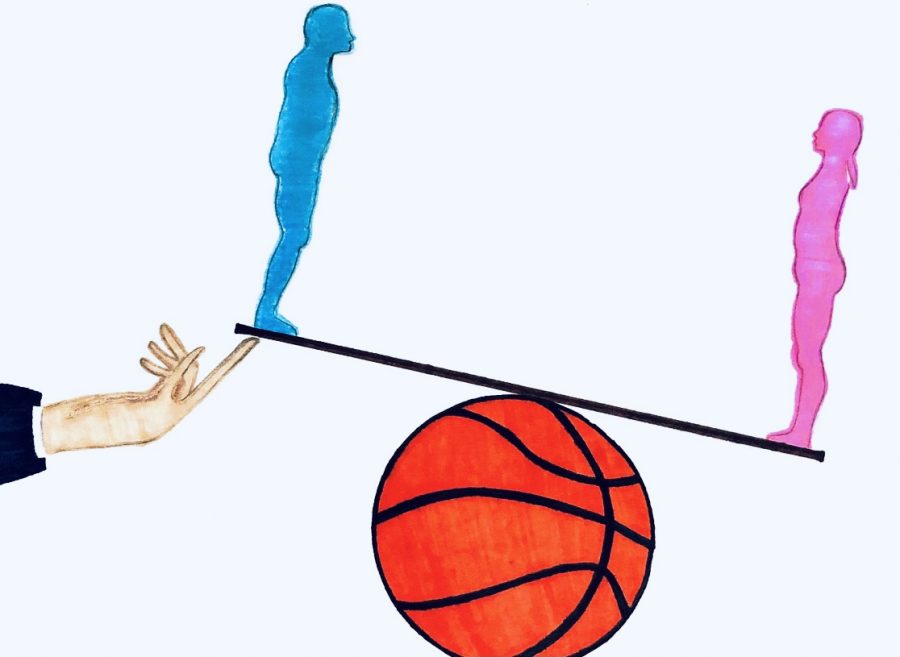
Narratives constructed by the media significantly shape societal perceptions of gender. Specifically within basketball, media has built distinct representations of the sport that differ across genders. This paper explores dominant gender ideologies in the media’s depiction of basketball and implications of the media’s involvement in the sport at collegiate and professional levels. Specifically, media coverage has furthered a gender gap in sports, creating disparities and undermining women’s achievements. First, the media prioritizes the airing of men’s basketball over women’s and uses discriminatory language, both creating gender stereotypes. Secondly, the industry itself is male-dominated because of institutionalized barriers, allowing male perspectives to shape and control women’s basketball narratives. Thirdly, the media uses its influence to frame differences for female athletes of color, perpetuating detrimental stereotypes that have repercussions extending beyond sport.
Significance
Narratives by Media are Presented in a Limited Way
In the current media landscape, narratives are crucial in shaping the public’s perceptions, opinions, and attitudes toward the relationship between gender and sports. However, these narratives are presented in a limited manner, leading to the reinforcement of stereotypes and the marginalization of women in the sport of basketball. One striking way that media narratives limit the representation of female athletes is through the frequent use of sexualized or ‘female-typed’ words (Mannion, 2016). According to Mannion (2016), the language used by the media describes the physical appearance or their gender rather than their athletic achievements. The language used by the media not only diminishes their accomplishments but also perpetuates stereotypes surrounding women’s societal role and their capabilities in basketball.
The lack of impactful role models for female basketball athletes further construes the narratives surrounding their sports abilities. Mannion (2016) highlights how the lack of role models inhibits younger girls from pursuing a career in basketball. Without proper representation in the media, young girls can fall victim to gender stereotypes, therefore halting their dream of becoming a professional WNBA player. Another significant consequence of the limited portrayal of female basketball players is the inability of female athletes to connect to other athletes through shared experiences. According to Cooky et al (2021), most women’s basketball coverage lacks substance and depth, using low ample game footage, subpar graphics, and little expert interviews. The lack of high-quality coverage and interviews restricts female basketball players’ ability to share their journey and their highs and lows with each other.
Finally, the construction of limited narratives by the media reinforces gender roles in society. Due to this marginalization, these media narratives perpetuate the idea that basketball is to be played by men, forcing women to resort to other undesired professions.
Existing inequities
In recent years, strides have been made toward bridging the gap between men and women in basketball. The WNBA has improved access to top-notch facilities, training programs, and competitive opportunities for their female players. However, many inequities still exist. In 2021, an online video went viral displaying the differences between the men’s and women’s training facilities during the NCAA March Madness tournament (Armato, 2023). When acknowledging this issue, the NCAA claimed there wasn’t enough space for better training equipment rather than admitting their wrongdoing in this scenario (Coleman, 2021). Female basketball players deserve better and shouldn’t have to take to social media to make their voices heard. Continuing, there are obvious pay disparities. The average WNBA salary is $113,295, while the average NBA salary is $9.7 million (Rogelberg, 2024), 40 times that of the highest-paid WNBA player. Similarly, endorsement deals for female basketball players tend to pale in comparison to those secured by male players. Stars in the NBA are able to earn many millions from endorsements with major brands, whereas top WNBA players struggle to secure similar lucrative deals. This exacerbates the broader issue of underrepresentation, as the lack of visibility and support contributes to a snowball effect. Less media coverage deters potential sponsors from investing in women’s basketball, perpetuating the cycle of inequality. Efforts to bridge this gap, such as increased media coverage, advocacy for equal pay, and systemic change remain imperative in fostering a more equitable landscape for female basketball athletes.
Discussion
Gender Ideologies
Historically, women’s sports, including basketball, have been overshadowed by their male counterparts, leading to stereotypes and misconceptions about female athletes’ abilities. Despite significant progress in challenging these stereotypes, gender ideologies persist in shaping how women’s basketball is perceived and valued. Gender ideologies have defined expectations for how people should express themselves, behave, and interact. These ideologies have been reinforced by narratives in the media, and by understanding these biases we can explore how social expectations and stereotypes are coded into media coverage and overall representation of basketball.
These large media outlets struggle with these narratives because female athleticism challenges gender norms. stereotypes and misconceptions about female athletes’ including the depiction of women as either maternal figures or sexual objects. Hanson (2012) explores this phenomenon, highlighting how media representations of female athletes frequently adhere to traditional gender norms, relegating women to roles that emphasize their sexuality or nurturing qualities rather than their athletic prowess. This is reinforced through the media’s use of language to describe female athletes.
One prevalent aspect is the language used by media outlets, which often emphasizes physical appearance or gender over athletic achievements, thereby diminishing the accomplishments of female athletes (Mannion, 2016). An example would be the language used by media outlets to describe Caitlin Clark. In past media, she has been described as bossy, arrogant, and a brat while her male counterparts are described as leaders, passionate and hard working. This language not only reinforces traditional gender roles but also perpetuates stereotypes about women’s capabilities in sports.
While gender ideologies remain, a major issue is women’s sports, there have been major strides to breaking these preconceived narratives and conceptions about women in basketball. One example would be a new term called ‘The Caitlin Clark Effect’ (McGuire, 2023) which is being used to describe how one player has changed preconceived narratives about a sport. This effect has broken preconceived narratives that no one watches women’s basketball, with a woman’s basketball game being one of the most watched college basketball games ever, both male and female. However, being a major step in the right direction, it does not come without push back. Some on social media still sexualize women basketball players and diminish their accomplishments. This can be seen in former NFL superstars Antonio Brown’s comments on the female basketball player (Dailymail, 2024).
Institutionalized Barriers
Barriers in sports media have undermined the representation of women in sports media through systematic policies put in place to institutionalize the underrecognition of women’s sports. Title IX of the Education Amendments Act of 1972 states:
No person in the United States shall, on the basis of sex, be excluded from participation in, be denied the benefits of, or be subjected to discrimination under any education program or activity receiving Federal financial assistance. (Title IX, 2021).
Despite being written into law, there is exclusion of female representation in women’s sports. The need for representation in women’s sports isn’t only about visibility and equity but authority and influence. Participants of a research study examining the insights of stakeholders in women’s sports advocated for “Policies and quotas… that support gender equity in administration and leadership… funding and public support for funding toward women’s sport… support of non-broadcast Olympic sports, [and] force diversification across leadership.” (Lebel et al., 2021). This lack of representation has lead to disparities in scholarship and endorsement opportunities especially at the collegiate level. If major brands and corporations are less likely to invest in a female athlete, then there are fewer opportunities to build up over these institutionalized barriers. This negative feedback loop is the primary source of women’s sports coverage disparities. This is especially highlighted in the case of women’s basketball, which has significantly gained popularity but still struggles to reach the same level of visibility as men’s basketball.
Even when present in sports media, coverage of women’s sports is often deeply rooted in gender bias and objectification. The female body is stereotyped and trivialized, often approaching “sexually-gratifying male voyeurism” (Ponterotto, 2014). An analylsis of the 1992 and 1996 Olympics revealed the denial of power for female basketball players compared to male basketball players through the use of less physically demanding adjectives during commentary (Higgs & Weiller, 2003). Reporters covered women’s sports using degrading comments about athletes’ bodies and judging whether they were physically able to participate in their sport. Words like “strong” and “aggressive” were used to describe male athletes 3 times as often as they were for women. (Mannion, 2016).
Recently, society has began to challenge traditional gender roles in female athleticism and feminist liberation:
U.S. society continues to accept myths regarding the supposed weakness of women’s bodies. Women’s displays of physical power are often prevented or undermined, typically centering on the concept of femininity. Increasing number of female athletes have not led to a true physical feminist liberation, one which would increase women’s confidence, power, respect, wealth, enjoyment of physicality, and escape from rape and the fear of rape. (Roth & Basow, 2004).
The reinforcement of discriminatory institutionalized barriers in women’s sports media coverage stems from cultural norms, stereotypes, and unconscious biases and require addressing systemic inequalities in not just women’s sports media coverage but society as a whole to create more inclusive and equitable institutions that support not just the visibility but the success and prevalence of women athletes.
Intersectionality
An important consideration for this discussion is the role of intersectionality in the media’s representation of female athletes, as gender ideologies and institutionalized barriers coexist with racial ideologies. Intersectionality is the idea that identities are complex, and therefore people’s positions and social identities in society are defined by a negotiation between all aspects of their identity, such as race, gender, sexual orientation, and more (Crenshaw, 1989). When using the lens of intersectionality, it can be seen that the narratives defining female athletes differ greatly across racial lines. Athletes of color often encounter invisibleness and unique stereotypes in the media, while white female athletes are often characterized by the media as talented, hardworking, and as leaders (Simien et al., 2019). The complexity of social identities have significant implications on the position and treatment of women in sport and broader society.
Differences in the media’s construction of narratives for female athletes along racial lines are particularly apparent in the context of basketball. A recent example of this can be seen in the media’s coverage of Angel Reese, a black female collegiate basketball player. In response to Reese coming forward about receiving death threats and hate following the basketball season, Emmanuel Acho, a host on a sports analyst show called “The Speak”, said that “Angel Reese you have self-proclaimed to be the villain…No one has sympathy for the villain” (Acho, 2024). In this segment, Acho argues that Reese’s competitiveness on the court justifies the hate she receives off the court. These comments about Reese reflect much larger issues regarding the stereotypes surrounding black females in sport; embedded in these comments are stereotypes that represent black female athletes as angry and aggressive (Simien et al., 2019). These stereotypes extend far beyond basketball, and characterize black female athletes similarly in other sports, an example being Serena Williams in tennis. These narratives are extremely harmful for black women as they work to perpetuate stereotypes that minimize their humanity, while simultaneously upholding systemic racism.
The importance of intersectionality in this discussion is that these stereotypes are unique to female athletes of color. This can be seen when drawing comparisons to the representation of white female athletes in the media. Within the same video, the same group of reporters discuss the success of Catilin Clark, spending the entire conversation reflecting on her talent, work ethic, and leadership capabilities; they focus none of the discourse on her similarly competitive sportsmanship. These distinct differences in the discourse show the critical role of considering intersectionality in the analysis of media representation of female athletes, as stereotypes and barriers are characterized differently across races. While these stereotypes are seen in sport, their effects extend to broader society, as they perpetuate narrow narratives of female athletes along racial lines and worsen existing power structures (Simien et al., 2019).
Key Takeaways
Ultimately, the media’s construction of basketball work to uphold systemic gender inequities in society, as their construction of narratives about women’s basketball contributes to pervasive stereotypes, limited professional opportunities for women in the industry, and detrimental framing differences for women athletes of color; these narratives have significant and far reaching implications, as they exacerbate existing inequities and fabricate a monolithic narrative of women.
About the Authors:
- Spencer Klein is a senior at the University of Michigan in the College of Literature, Science, and the Arts, majoring in Cognitive Science. He is pursuing a career in sports marketing and strategy, specifically focusing on the sports betting industry.
- Ava Osborn is a senior at the University of Michigan majoring in Economics with a minor in Business. After college, she is pursuing a career in marketing.
- Luke Ponsock is a senior in Biomedical Engineering and will be pursuing a career in clinical engineering with a focus on additively manufactured surgical plates and cutting guides.
- Mike Seck is a senior at the University of Michigan in the College of Literature, Science, and the Arts, majoring in Political Science. After college, he is pursuing a career in law.
- Stephanie Oxenhorn is a senior at the University of Michigan double majoring in Economics and Psychology. After graduating, she is pursuing a career as an analyst.
:max_bytes(150000):strip_icc():focal(539x0:541x2):format(webp)/Luke-Prokop-nhl-a03b9b62f41e485eafe70c751d000b6d.jpg)