
The lung is more than a respiratory organ–it is a dynamic sensory interface that continuously communicates with the brain. Our lab studies how signals originating in the lung are detected, encoded, and processed by neural circuits to regulate physiology and behavior. We aim to uncover how interoceptive neural circuits coordinate lung–brain communication across diverse contexts, including environmental exposures, pulmonary diseases, and neurological disorders. By defining specific lung-brain neural circuits, we seek to identify targets for precise neuromodulation therapies.
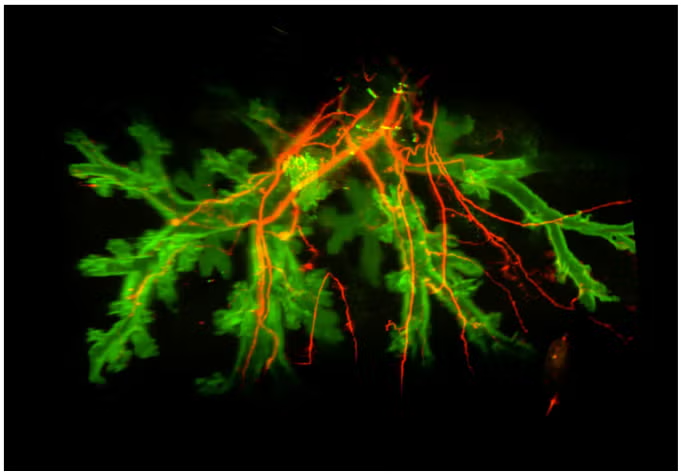
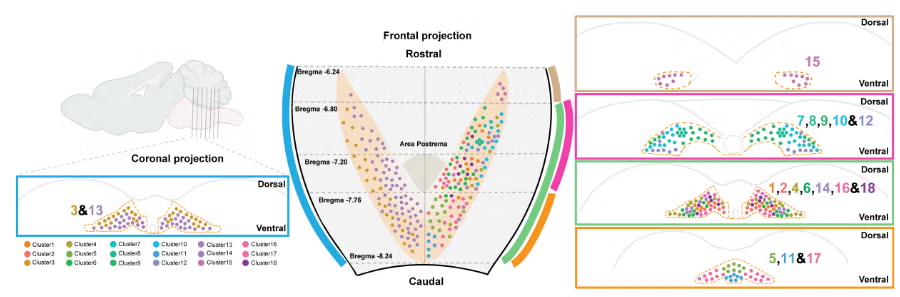
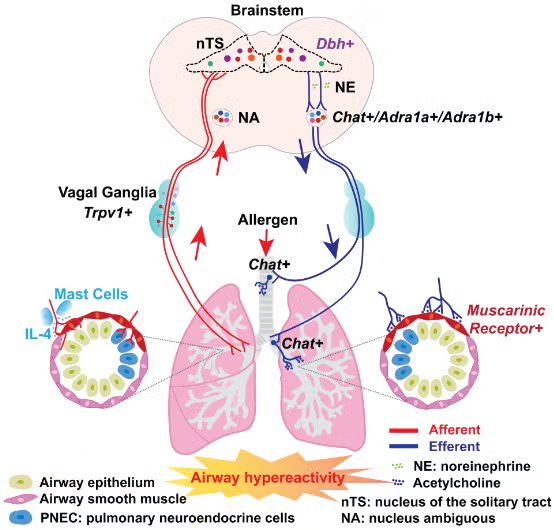
- Lung-to-Brain Communication
How does the brain sense what happens in the lung?
We investigate how various interoceptive signals—including allergens, inflammation, toxins, and environmental exposures—are transmitted from the lung to the brain. Our work focuses on defined brainstem and higher brain pathways that encode different peripheral signals with cell-type specificity.
- Central Control of Lung Function
How does the brain regulate airway physiology and disease?
We investigate how top-down neural circuits regulate lung mechanics and coordinate systemic responses. Our work focuses on identifying the molecular and functional specificity of these central circuits and identifying targets for precise neuromodulation therapies.
- Circuit Remodeling in Disease
How are lung–brain circuits altered in disease?
We examine how lung–brain neural circuits adapt or become dysregulated in pulmonary and neurological diseases. We aim to define how these perturbations reshape circuit activity and drive plasticity.
Publications (*equal contribution)
- Jendzjowsky N, Kuo C, Reznikov L, Chen Z, Li P, Prescott S, Liu Y, Seeholzer L, Tschumperlin D, Taylor-Clark T, Rajagopal J, Haber A, Noël A, Kotas M, Drake M, Pabelick C, Rosenblatt J, Mouradian G, Su Y, Gomez C, Lin Q, Lu Q, Mongodin E, Vuga L, Zhou G, Prakash Y. S., Sun X. Beyond Breathing: Lung as a Sensory Organ. Am J Resp Cell Mol Biol. 2026 (in press).
- Zhu Z.,Su Y., Sun X. Lung innervating Vip+ vagal neurons control allergen-induced responses. Cell Report. 2026. Link
- Pham B., Li Z., Talaba N., Stokes G., Wienhold M., Xu J., Su Y., Hernan R., Chung W., Sun X., and McCulley D. Mechanical Compression Causes Lung Hypoplasia in Congenital Diaphragmatic Hernia with GATA4 Genetic Variants. Am J Physiol Lung Cell Mol Physiol. 2026. Link
- Su Y.*, Zhu Z.*, Sun X. Lung innervating neurons in lung homeostasis and diseases. Physiology. 2025. Link
- Lee, S., Young, R., Chin, J., Dash, B., Sahi, J., Nantie, L., Su Y., Salamon R., Verheyden, J., Barr, J., Shin, J., Day, A., Vijayanand, P., Reyes de Barboza, N., Sun, X. Disruption of E-Cadherin in the Airway Led to Dysplastic Transitional Cells and Asthma-Like Phenotypes. Dev Cell. 2025. Link
- Kim, E., Wells BK., Indralingam H., Su Y., Verheyden J., Sun X. Allergen induces pulmonary neuroendocrine cell hyperplasia in a model of asthma. JCI insight. 2025. Link
- Su Y., Xu J., Zhu Z., Chin J., Xu L., Yu H., Dash B., Nudell V., Mayo E., Ye L., Nimmerjahn A., Sun X. Brainstem Dbh+ Neurons Control Allergen-Induced Airway Hyperreactivity. Nature. 2024. Link
- Su Y., Sun X. Neural circuit underlying asthma reinforces the lung’s role as a sensory organ. Nature. Research Briefings. 2024. Link
- Zhang H.*, Su Y.*, Qu Z.*., Zhang C., Ma S., Li X., Wang Y. Sonic hedgehog mediates high frequency-dependent deep brain stimulation for the correction of motor deficits in a Parkinson’s disease model. Neuroscience Bulletin. 2024. Link
- Devarajan A, Wang K, Shannon K, Verheyden J, Su Y., Sun X, Vaseghi M. Convergent Cardiorespiratory Neurons Represent a Significant Portion of Cardiac and Respiratory Neurons in the Vagal Ganglia. Front. Cardiovasc. Med. 2022. Link
- Su Y*., Barr J.*, Jaquish A., Xu J., Verheyden J., Sun X. Identification of lung innervating sensory neurons and their target specificity. Am J Physiol Lung Cell Mol Physiol. 2021. Link
- Zhang H.*, Zhang C.*, Qu Z.*, Li B., Su Y., Li X., Gao Y., Wang Y. STN-ANT plasticity is crucial for the motor control in Parkinson’s disease model. Signal Transduct Target Ther. 2021. Link
- Smith LC, Kallupi M, Tieu L, Shankar K, Jaquish A, Barr J, Su Y., Velarde N, Sedighim S, Carrette LLG, Klodnicki M, Sun X, de Guglielmo G, George O. Validation of a nicotine vapor self-administration model in rats with relevance to electronic cigarette use. Neuropsychopharmacology. 2020. Link
- Sun X., Verheyden J., Su Y., Barr J., Xu J. Mapping of the Neural Circuits that Control Intrinsic Lung Function. The FASEB Journal. 2020. Link
- Barr J*, Su Y.*, Sun X. Wheeze No More: Growing Out of Your Dopaminergic Nerves. Immunity. 2019. Link
- Su Y., Yuan Y., Feng S., Ma S., Wang Y. High frequency stimulation induces sonic hedgehog release from hippocampal neurons. Sci.Rep. 2017. Link
- Feng S*, Ma S*, Jia C*,Su Y., Yang S, Zhou K, Liu Y, Cheng J, Lu D, Fan L. and Wang Y. Sonic hedgehog is a regulator of extracellular glutamate levels and epilepsy. EMBO Rep. 2016. Link
- Feng S*, Li H*, Tai Y*, Huang J, Su Y., Abramowitz J, Zhu M, Birnbaumer L, and Wang Y. Canonical transient receptor potential 3 channels regulate mitochondrial calcium uptake. Proc.Natl. Acad. Sci. 2013. Link

