
Decoding microbial
communities across scales
Welcome to the Tai Lab in the Department of Biophysics at the University of Michigan, opening in January 2027!
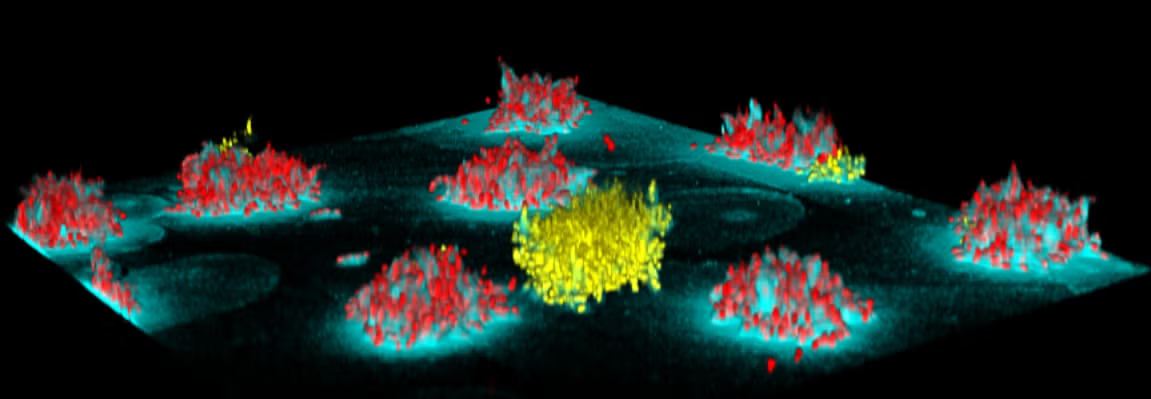
Microbial communities play important roles in health, industry, and the environment. Their behavior emerges from the interplay between biological regulation and physical interactions. How do individual cells make decisions, organize into communities, and respond to changing surroundings?
Using bacterial biofilms as model systems, our lab investigates how cellular behavior shapes community organization, function, and evolution. We combine microbiology, quantitative imaging, computational modeling, and ideas from physics and ecology to connect molecular and cellular processes with collective behavior.
Questions that drive our research
How do cells make decisions?
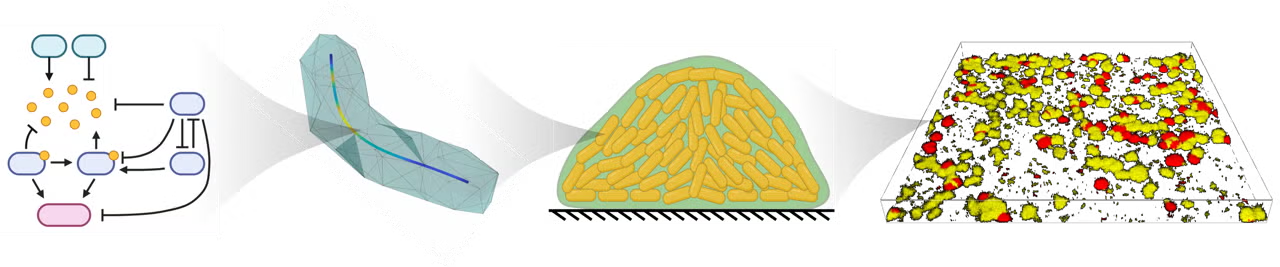
Even genetically identical bacteria can behave differently. We investigate how cells sense their surroundings and integrate signals to switch between physiological states, and how these decisions shape biofilm formation.
How do cells build communities?
As bacteria grow, they push against one another and produce a shared extracellular matrix. We investigate how cell shape, matrix production, and physical interactions determine the structure and mechanical properties of biofilms.
How do microbial communities interact with environments?
Microbial communities reshape their surroundings through physical and biological processes. We investigate how these environmental changes feed back on community organization, function, and ecological interactions across natural, engineered, and host-associated settings.