

Written by Amanda Jaworsky
While parking is not typically the first thing that people worry about when they drive somewhere, it can be a real hassle. Between being ticketed, towed, or having to pay high meter or garage prices, there are many factors at play within America’s current parking system. Furthermore, as more research is done, it becomes clear that parking in America is a deeply flawed system that could use a lot of improvement. Fortunately, there are solutions to some of these problems, and hopefully research that is turning to the demand-side rather than its historical emphasis on the supply-side will make it possible for the US to create more user-friendly parking systems.
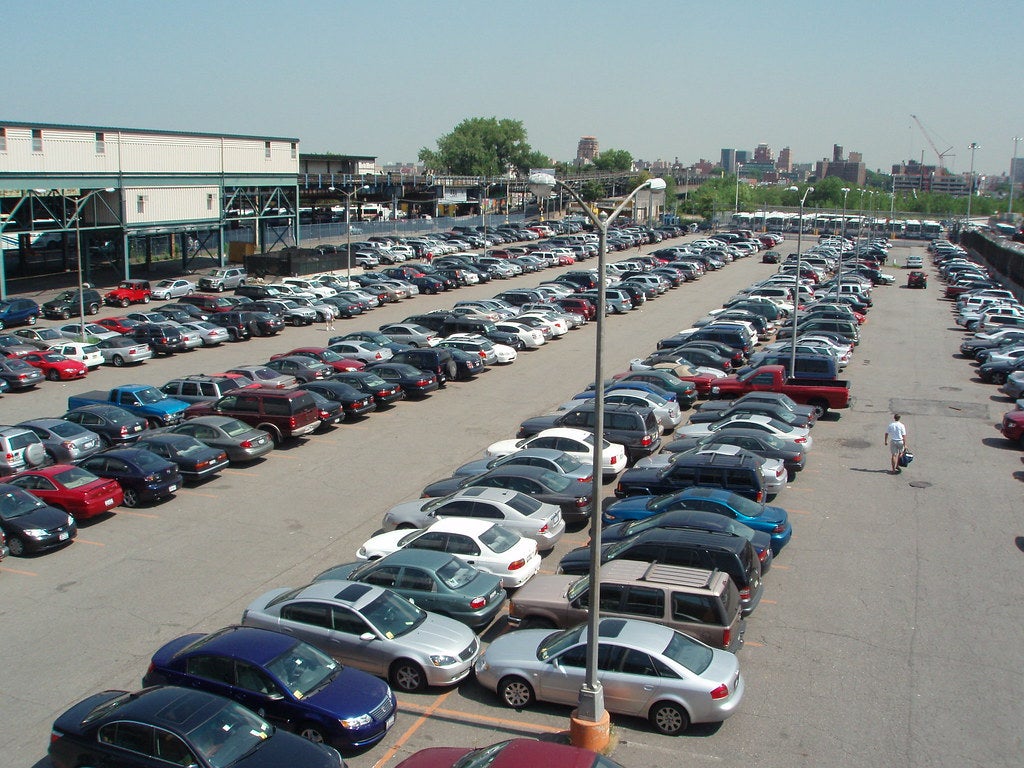
One of the most common complaints about parking is how expensive it can be, especially in big cities. While there are places in the US like Oklahoma city, where parking costs around $25 a month, big cities like New York can cost upwards of $700 a month (Cortright et. al, 2016). While it may seem like cities are greedy in their meter and garage pricing, this pricing can be a pretty truthful reflection of the high costs associated with the construction of parking spaces. These costs are in large part due to the sheer amount of space that is required for parking. Whether parking is alongside a street or in a lot, it takes up a lot of land. This is less true for garages, but considering the downtown real estate that they take up, the area is still notable. In fact, the area of land dedicated to parking spaces in the United States is at least, if not greater than, the size of the state of Massachusetts (Inci, 2015). This massive area coupled with the high price of land (a finite resource that is especially valuable in urban areas where parking is required) is the biggest factor in the expenses associated with parking. Furthermore, an enforcement of a “minimum” number of onsite parking spots is often used to ensure that there is enough parking available for residents, which is a common complaint in large cities and elsewhere. Despite the good intentions of these restrictions, they can raise the cost of development by a large margin as “the cost of parking, which drivers should arguably pay at the end of their trips, is instead paid by developers at the start of their projects” (Inci, 2015). Increased housing prices are also a side effect of these rules as investors attempt to offset the added cost of the onsite parking.
While the cost of paying for parking can be high, the cost of not paying can be much higher. In places like Chicago, the fine for an expired meter (which runs from $1.25 to upwards of $4 an hour) is $50. Considering how high meter costs are in some areas, it makes sense that tickets are expensive enough to offset the price and discourage people from just risking a ticket. However, in other areas, people argue that $50 is excessive and the same effect could be achieved for $25 instead (Baxter, 2010). It is also important to consider the spatial competition that exists in high population downtown areas; people rarely want to park more than a few blocks from their destination. This means that some lots and garages have a monopoly over a particular area and, as a result, can set a high monopoly price. Another, and more controversial, parking enforcement practice is towing. Towing is typically a concerted effort between a towing company and a municipality or business that contracts with them, although governments do sometimes own their own lots and towing trucks. While in some cases a predatory towing company is to blame for unfair practices, there are cities like Los Angeles and San Francisco that have recently come under fire for the way that their government towing practices target poor people (“How Towing Practices in California Punish Poor People,” 2018). Considering how difficult it can be to rescue a car from a tow yard while being vehicle-less, and how minor the cause can be for towing–like being parked in the same place for more than 72 hours–these concerns are definitely valid. On a more local level, being towed in Ann Arbor is both common and expensive. Speaking from personal experience, on top of the ticket cost, rescuing a car is around $250 and if not done within 24 hours this can increase daily.
Outside of pricing concerns, there are also problems that drivers don’t consider when they get into a vehicle. Cruising for parking is a heavily-researched phenomenon that incurs a number of costs on society. As individuals slow down to search for open spots, they contribute disproportionately to traffic congestion and may even increase the probability of accidents. Slow cruising also contributes to emissions, and is a waste of people’s time–shockingly, a 1980s field study found that on a 15-block district near UCLA, drivers collectively wasted around 100,000 hours in a year just cruising for parking (Inci, 2015). Though it may seem like a contradictory concept, it is also relevant to consider the costs that free parking can incur on the environment. While paying unfair meter, garage, or ticket prices can have impacts on their own, free parking is not always the great solution that it seems to be, and research suggests that free parking spaces can increase solo driving by 60% (Lovaas, 2016). What this means is that fair pricing, rather than no pricing is more advantageous. I myself can attest to this. On many occasions I have wanted to drive to work rather than walk but have been discouraged by the price of the meter–or the likelihood of getting a ticket. Though my legs did not appreciate this, I would like to think that the environment did.
Despite the somewhat inevitable nature of the situation, there are solutions to some of these problems. Something that has become more popular in recent years is the use of shared parking, which is when private companies or businesses, like hospitals, hotels, and apartment complexes offer up their parking spaces for public use while customers or residents are not present (Huanmei Qin et. al, 2018). This creates more parking spaces which can now be designated to multiple people throughout the day, which decreases cruising for parking spaces and increases the return on investment for developers that must build onsite parking. Increasing and improving public transportation and walkable cities is also a step in the right direction. In some cases, adding a bus route is simpler and cheaper than allocating and pricing parking. As research becomes more focused on the demand side, consumer opinion will hopefully be given more weight and America’s problematic parking can be improved, if not solved.
Bibliography
Baxter, Eric. “What Is the Average Cost of a Parking Ticket?” HowStuffWorks. HowStuffWorks, July 14, 2010. https://auto.howstuffworks.com/under-the-hood/cost-of-car-ownership/cost-of-parking-ticket.htm#:~:text=In%20the%20end%2C%20if%20you,and%20avoid%20the%20ticket%20altogether.
Cortright, Joe, Streetsblog, Daniel Baldwin Hess, Jeffrey Rehler, Alan Durning, and Angie Schmitt. “Comparing the Price of Parking across U.S. Cities.” Streetsblog USA, October 20, 2016. https://usa.streetsblog.org/2016/10/20/comparing-the-price-of-parking-across-u-s-cities/.
“How Towing Practices in California Punish Poor … – Wclp.org.” Accessed April 29, 2022. https://wclp.org/wp-content/uploads/2019/03/TowedIntoDebt.Report.pdf.
Inci, Eren. “A Review of the Economics of Parking.” Economics of Transportation 4, no. 1-2 (2015): 50–63. https://doi.org/10.1016/j.ecotra.2014.11.001.
Qin, Huanmei, Yingying Dun, Jinmeng Zhang, and Xiuhan Yang. “Analysis on the Impact of Floating Parking Fees on Parking Demand.” CICTP 2018, 2018. https://doi.org/10.1061/9780784481523.268.
Deron Lovaas. “Rethinking ‘Free’ Parking Policies.” NRDC, December 15, 2016. https://www.nrdc.org/experts/deron-lovaas/rethinking-free-parking-policies#:~:text=Indeed%2C%20case%20studies%20show%20that,solo%20driving%20by%2060%20percent!&text=Beyond%20exacerbating%20issues%20of%20pollution,transit%2C%20bike%2C%20or%20walking.