

Written by: Stella Malon
Upon opening a search engine, one cannot escape the world of Artificial Intelligence (AI) where there are numerous options like Google Gemini, ChatGPT, or even specialized chatbots to college campuses like U-M GPT. AI has the potential to answer our day to day questions, automate tasks, or produce entire pieces of work, all of which could be transformative to human productivity. At the same time, we see news reports circling the media stating: “employment across key tech industries has plateaued,” “college graduates are facing a tougher job market,” or “AI could affect the labor market in the next recession” (AI’s Impact on Job Growth, 2025, pp. 3-6). Many of these headlines are conclusions reached by some analysis of recent data for the short run impact of AI; in other words, the future is certainly up for debate. While some publications create extreme ends of the situation where humanity would gain access to every idea possible where the only constraint on society would be the laws of physics (“The Economics of Superintelligence,” 2025), others claim that this could be more of a short run impact where people can gain new skills and therefore adapt to AI-induced changes to the market in the long run (Zarifhonarvar, 2024). Surely many people would have not even predicted the possibilities of AI just 20 years ago, so should we let imaginations run wild about the long run now?
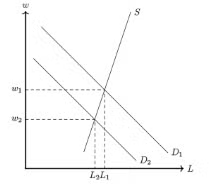
As for the short run, economists like Ali Zarifhonarvar (2024) expect there to be a likely decrease in demand for labor for specific routine jobs as AI and other related technology continues to develop. In response to a changing labor market, an important note is that any form of reskilling workers takes time, so there may be a temporary mismatch in the labor market between employee skills and needs of the companies; in sum, an inelastic supply of labor as shown in Figure 1 (Zarifhonarvar, 2024). Specifically, roles like paralegals, copywriters, data scientists, financial advisors, and more higher-skilled jobs could be impacted. Currently, the magnitude of this downward demand shift is unclear because companies are looking for ways to keep up with the changing technology to maximize their performance while also not making too quick of changes to their workforce. The market as a moving system is largely unsure of AI’s full potential and is responding accordingly as research develops.
Extreme hypotheticals and short term effects aside, many common answers to the question of how AI might affect the job market in the long run draw comparisons to the four major categorized parts of the ongoing Industrial revolution. Some even have named the AI revolution as the 5th Industrial Revolution. Jiang et al. (2025) at the International Economic Development Council (IEDC) point out that while many of these historical markers led to an initial disruption, they ultimately created new industries, redefined employee roles, and boosted economic growth. While economic growth was the result, certain roles may face a depressed labor market in the meantime. As an example, in the 1980s, jobs in industries like manufacturing or construction were lost due to automation. Murat Tasci, senior U.S. economist at J.P. Morgan, notes that during downturns in the business cycle, historically, this job loss has become more pronounced and cyclically driven, ultimately resulting in a jobless recovery for these industries (AI’s Impact on Job Growth, 2025). The current labor market could face a similar risk from AI as different industries like tech, finance, and other cognitive occupations are now being rivaled.
How will workers respond, and how have they responded to AI?
As AI is increasingly utilized by anyone from students to CEOs, it’s relevant to look at the change in productivity and creativity of humans. The Economist pulls from a Massachusetts Institute of Technology study that aimed to answer the research question of whether or not “the impressive short-term gains afforded by generative AI may incur a hidden long-term debt” (“How AI Changes the Way You Think,” 2025, p.65). In this study, researchers found that students who were asked to use AI to write their essay marked lower activity in parts of the brain associated with creative functions and attention. In response to this, a counter argument that can be made is that this process is similar to offloading some mental strain to simplify a process, like using a calculator for example. Opposingly, a worry that is stressed by psychology professor Evan Risko, is that offloading some mental processes is not the same as “offloading a thought process like writing or problem-solving” because prolonged use could create a dependency (“How AI changes the way you think”, 2025, p.66). This thought experiment can be applied to both students and everyday employees alike who are utilizing AI to perform day-to-day tasks or even to execute more strenuous tasks as AI becomes more efficient. Where the typical worker is now able to complete some tasks quicker due to AI, there could be a dependency forming, possibly harming workers and their desirable abilities. While it seems easy now to open up a chatbot to answer questions or generate ideas, could this harm personal productivity and creativity levels as a dependency may develop? If the answer is yes, humans truly could be replaceable in the job market.
There is an upside, nothing is set in stone. Humans have time to tailor their talents to work alongside AI to turn these worries into opportunities for growth and adaptation. The IEDC proposes a few solutions: government programs and corporate-led initiatives (Jiang et al., 2025). Both of these would involve workforce training and investment to best create a smooth transition into this new technology without causing polarizing effects. Of course, there is another ethical dilemma to decide how to balance these responsibilities and reskill current workers. To some extent economists claim that it is also an individual’s responsibility to make themselves marketable (Csunyó, 2025). Either way, tech companies and investors will continue to push the capabilities of AI.
In the long run, companies are looking to AI to increase productivity; however, if employees are relying on AI too heavily, this lack of creativity could ultimately harm overall productivity. Certainly, creativity is just one implication of AI on the labor market but it is something that can be addressed from the personal level up to the market level. So, it is up to companies and individuals to decide how they want to combat AI’s potential impact on the workforce and to what extent, specifically related to personal development. Leaders don’t want their employees or members to lack creativity but they also are juggling the changing market all at once, trying to get ahead of competitors with the opportunities that AI presents.
References
AI’s Impact on Job Growth. (2025, August 15). J.P. Morgan. Retrieved November 19, 2025, https://www.jpmorgan.com/insights/global-research/artificial-intelligence/ai-impact-job-growth
Csunyó, N. (2025). The Economic Impact of Artificial Intelligence and the Dilemmas Surrounding the Labour Market. Annals of the University of Oradea, Economic Science Series, 34(1), 18–30.
How AI changes the way you think. (2025, July 19). The Economist, 456(9457), 65-66. https://www.proquest.com/docview/3230934153/fulltext/D6566E48811F410DPQ/1?accountid=14667&sourcetype=Magazines
Jiang, S., Pena, Y., Gines, D., Lang, T., & Hwang, M. (2025). Artificial intelligence impact on labor markets: Literature review [PDF]. International Economic Development Council. https://www.iedconline.org/clientuploads/EDRP%20Logos/AI_Impact_on_Labor_Markets.pdf
Stockcake. (n.d.). Neon circuit grid [Photograph]. Stockcake. https://stockcake.com/i/neon-circuit-grid_3568553_1720823
The economics of superintelligence. (2025, Jul 26). The Economist, 456, 7-7, 8. https://proxy.lib.umich.edu/login?url=https://www.proquest.com/magazines/economics-superintelligence/docview/3232771285/se-2
Zarifhonarvar, A. (2024). Economics of ChatGPT: A labor market view on the occupational impact of artificial intelligence. Journal of Electronic Business & Digital Economics, 3(2), 100–116. https://doi.org/10.1108/JEBDE-10-2023-0021