

Written by: Nitya Wanchoo
According to many Americans, tipping culture has gotten out of hand in the post-pandemic era. In fact, about 72% of adults in the United States say that tips are requested in more places today than they were 5 years ago (DeSilver & Lippert, 2023). This number seems plausible; tip screens are now common at movie theater concession counters, airport newsstands, and even doctors’ offices (Morrison, 2022). However, workers are noticing that tips are decreasing in value as customers grow tired of the constant requests. (Casselman, 2024)
Historically speaking, tipping dates back to the post-Civil War Reconstruction period. Saru Jayaraman told TIME Magazine that slaves were limited in opportunities after they were freed. Those who did not work in the fields ended up as service workers such as waiters or barbers where they would not be paid by their employers, but would instead work for the small tips provided by guests. “These industries demanded the right to basically continue slavery with a $0 wage and tip,” Jayaraman says (Greenspan, 2019). Since then, tipping has evolved into a societal norm. The basic idea is that a customer will leave an additional amount of money at the end of a service as a token of gratitude to a service worker for a job well done. What is most interesting, however, is that service quality rarely drives tipping. (Azar, 2020)
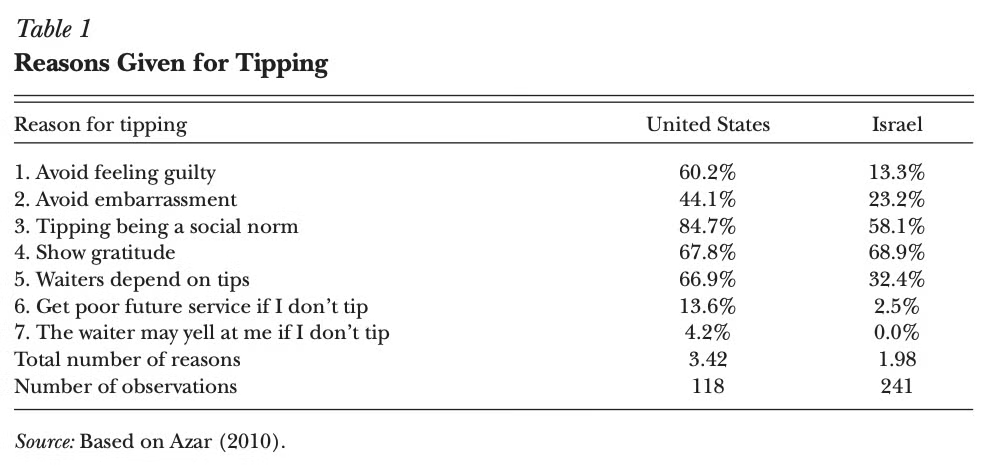
What started off as tips for those in the service industry has turned into a much larger monster. This is due, in large part, to the pandemic which accelerated the adoption of contactless digital payment methods. “These tablets have become ubiquitous, and so have the tip requests. At a time when the prices of many goods and services are already far higher than they used to be due to inflation, we’re paying even more again to the workers who provide them” (Morrison, 2022).
There is a psychological element to this change in tipping culture as well. Digital tablets make it harder to not tip since a transaction is not marked as completed until the buyer makes an explicit tipping choice. Tapping the “No Tip” button is an independent decision, making customers less likely to avoid tipping by way of ignorance. Meng Zhu, a Johns Hopkins professor, says that the act of asking people to leave a tip is enough to nudge them into doing so, especially when they have already started a transaction. “Let’s say you already shopped at a restaurant or coffee shop. You’re already committed,” she said. “When they ask you for something else, you’re more likely to comply because you want to be consistent with your earlier decision” (Morrison, 2022).
The default tip amounts are typically 15%, 20%, and 25% and this set of options often leads a consumer to choose the middle choice – 20%. But some businesses have caught on to this tendency, and have increased these defaults to 20%, 25%, and 30%. Those that choose a custom tip end up tipping more than they usually would have, and the bulk of people who do not want the hassle continue to choose the middle option – now 25% (Eyal, 2022). Other platforms have “smart tipping” suggestions, which switch from percentages to dollar amounts based on a certain threshold for purchases. “That’s how you might get a suggestion to leave an extra $3 for a $3.75 chocolate croissant, which is effectively an 80% tip” (Morrison, 2022).
DoorDash is experimenting too. They have since implemented a feature that warns customers that orders may take longer to arrive if they do not tip in advance. This pushes customers to preemptively tip, whereas the standard up until now has always been to tip after a service has been provided (Wooten, 2024). Overall, a study finds that the digital tipping interface in platforms such as Square has increased the proportion of tipping by 38% (Huet, 2014).
This phenomenon where tips are higher than ever before has been coined “tipflation”. People are also using the term “tip creep” to describe more businesses requesting tips (Picchi, 2023), and “guilt tipping” to describe when customers tip because they feel obligated to pay the difference to provide employees with a sufficient income. These unexpected tip asks at every corner are accompanied by “tip fatigue” (Rojas, 2024). A Bankrate survey found that about 66% of Americans view tipping negatively and roughly 30% of respondents believe tipping culture to be “out of control” (Kelton, 2025). Michael von Massow, associate professor at the University of Guelph, wrote that “At the very least, tip fatigue means customers are leaving interactions that involve tipping with negative feelings, but at the worst, tip fatigue could cause customers to tip less or stop altogether” (Picchi, 2023).
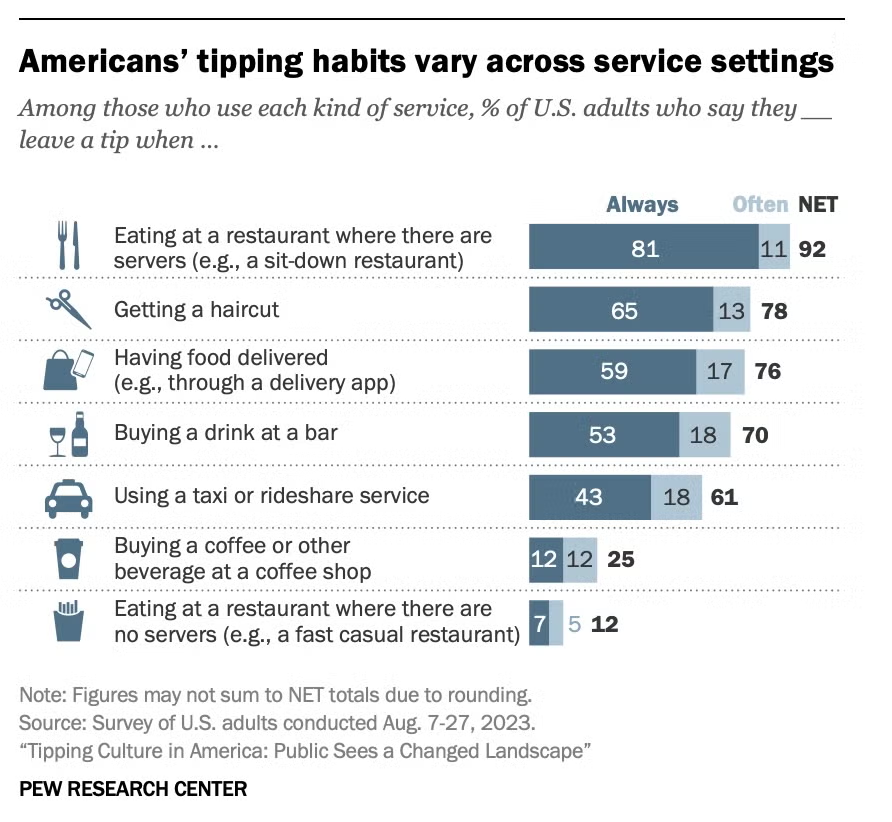
Tip requests have snaked their way into more transactions than ever before, including self check-out counters, leaving consumers reluctant to tip and confused about how much to leave. In the past, the relationship between service and tips were clear but in recent times it has become more murky. “Only about a third say it’s extremely or very easy to know whether (34%) or how much (33%) to tip for different types of services” (DeSilver & Lippert, 2023).
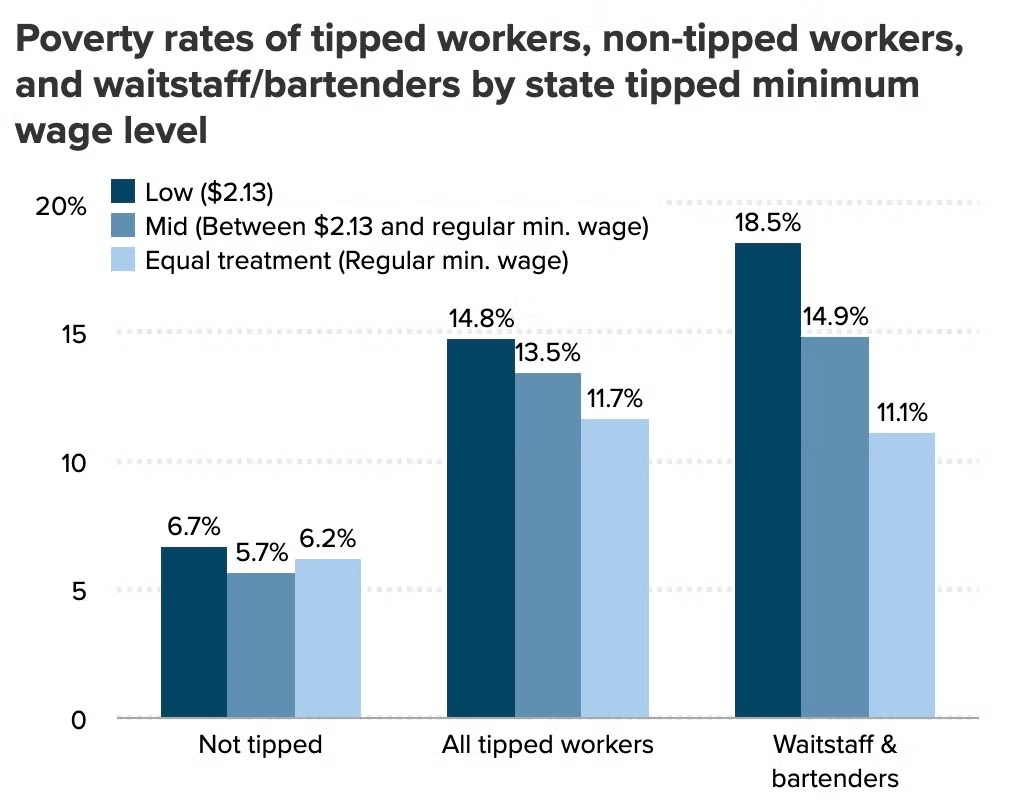
Though people are tired of tipping, it remains. In all but eight states, employers can legally pay service workers who receive tips a “subminimum” wage, which can be as low as $2.13 per hour. Economists estimate that at least 5.5 million workers are paid on that basis, which can have serious economic consequences when abused (Smith, 2022). The poverty rates in states where the wage floor is lower for tipped workers is much higher as compared to states where tipped workers are paid a regular minimum wage, as shown by the graph below. (Gould & Cooper, 2018). “The more wages become tip-based, the more fragile your life is,” said Amanda Cohen, a chef and restaurant owner in New York City who is a critic of tip-based pay. “And I’m not quite sure why you would force more people into that system” (Casselman, 2024).
A solution is unclear as getting rid of optional tips has its fair share of difficulties. Most notably, businesses do not want to raise their prices because they fear that doing so will scare off customers. And, they do not want to shoulder the additional costs of paying all servers full wage either. Restaurants and shops that do not allow tips often find themselves losing employees to competitors who do. They would need to pay workers more to keep them, but would not be able to do so without raising prices. Michael Lynn, a Cornell University professor, says “Asking for a tip is a way of raising prices on the people who are willing or able to pay without raising prices on everyone else” (Casselman, 2024).
Ultimately, American tipping culture showcases the ever growing gap between what workers need to earn and what consumers are willing to pay. Now, with digital prompts and lower base wages for service workers, tipping has become more confusing than ever before. For now, Americans remain stuck in the tipping trap, navigating a system that everyone relies on but nobody likes.
References
Azar, O. H. (2020). The economics of tipping. Journal of Economic Perspectives, 34(2), 215–236. https://www.aeaweb.org/articles?id=10.1257%2Fjep.34.2.215&
Casselman, B. (2024, August 31). Has the spread of tipping reached its limit? Don’t count on it. The New York Times.https://www.nytimes.com/2024/08/31/business/economy/tipped-workers-taxes.htmlThe Budget Lab at Yale+1
DeSilver, D., & Lippert, J. (2023, November 9). Tipping culture in America: Public sees a changed landscape. Pew Research Center. https://www.pewresearch.org/2023/11/09/tipping-culture-in-america-public-sees-a-changed-landscape/ Pew Research Center
Eyal, N. (2022, March 5). How technology tricks you into tipping more. Psychology Today. https://www.psychologytoday.com/us/blog/automatic-you/202203/how-technology-tricks-you-tipping-more Psychology Today
Greenspan, R. E. (2019, August 20). ‘It’s the legacy of slavery’: Here’s the troubling history behind tipping practices in the U.S. Time. https://time.com/5404475/history-tipping-american-restaurants-civil-war/ TIME
Huet, E. (2014, February 27). Tech tip about tips: Make consumers press a button. SFGATE. https://www.sfgate.com/restaurants/article/tech-tip-about-tips-make-consumers-press-a-button-5271447.php SFGATE
Kelton, K. (2025, June 4). Survey: “Out of control,” “Pay employees better” and other things Americans say about tipping. Bankrate. https://www.bankrate.com/credit-cards/news/tipping-culture-survey/ Bankrate
Morrison, S. (2022, October 7). Why tip requests on touchscreen tablets are everywhere (and make us feel guilty). Vox. https://www.vox.com/recode/2022/10/7/23389885/square-toast-tipping-retail-tipflation-guilt Vox
Rojas, J. (2024, December 9). Tipping culture has evolved since the pandemic and many consumers have “fatigue,” CSUN prof says. CSUN Newsroom. https://newsroom.csun.edu/2024/12/09/tipping-culture-has-evolved-since-the-pandemic-and-many-consumers-have-fatigue-csun-prof-says/ CSUN Newsroom –
Smith, T. J. (2022, October 13). Battle over wage rules for tipped workers is heating up. The New York Times. https://www.nytimes.com/2022/10/13/business/economy/tipped-wage-subminimum.html Labor Education Program
Wooten, J. (2024, July 15). The economics of tipping. Monday Morning Economist. https://www.mondayeconomist.com/p/tipping Monday Economist
Picchi, A. (2023, January 27). How “tipflation” and “tip creep” are sparking a backlash: “I don’t feel obligated” to tip. CBS News. https://www.cbsnews.com/news/tipping-backlash-inflation-who-should-get-tipped/ CBS News
Gould, E., & Cooper, D. (2018, May 31). Seven facts about tipped workers and the tipped minimum wage. Economic Policy Institute. https://www.epi.org/blog/seven-facts-about-tipped-workers-and-the-tipped-minimum-wage/