
Current research on the public architecture of Notion focuses on the Bouleuterion (Council House), an important building in the history of Greek architecture. It is one of the largest known Hellenistic bouleuteria (30.5 X 24.3 m), notable for its transparent design and construction system. It is also one of the best-preserved buildings at Notion, and, when excavated and conserved, will form an important focal point for visitors.
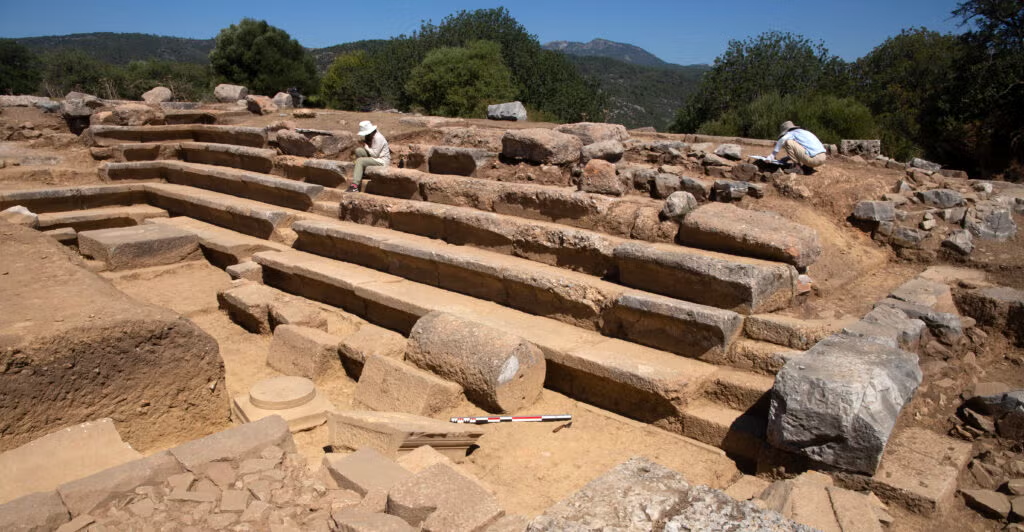
The Bouleuterion is built into the slope that leads down to the east from the northeast corner of the Agora. Its basic features are an east-facing U-shaped auditorium, and a broad corridor enclosing the auditorium on its north, west, and south sides. The building had a seating capacity of approximately 500 persons. As such, it was the largest roofed structure at Notion. The primary function of buildings of this type was to serve as the meeting place for the Boule (city council), but they also functioned as all-purpose cultural centers, used for concerts, poetry recitals, and public speeches.
Before the beginning of the current project, the Bouleuterion remained unexplored except for a 4 X 14 m trench dug on the north side of the auditorium by the Ephesus Museum in 1994 and a small trench dug by illicit excavators in the winter of 2013/2014. Current work began in 2023 and consisted largely of cleaning for the purposes of architectural documentation. Continued excavation in 2024 revealed an altar in the center of the orchestra, flanked by the inscribed base of a statue of Augustus. To the east, a podium was discovered built partly out of reused blocks up against the back wall of the orchestra; on top of the podium was a stage building consisting of a single Doric aedicula (columnar bay) whose fallen remains were found lying at the base of the podium.
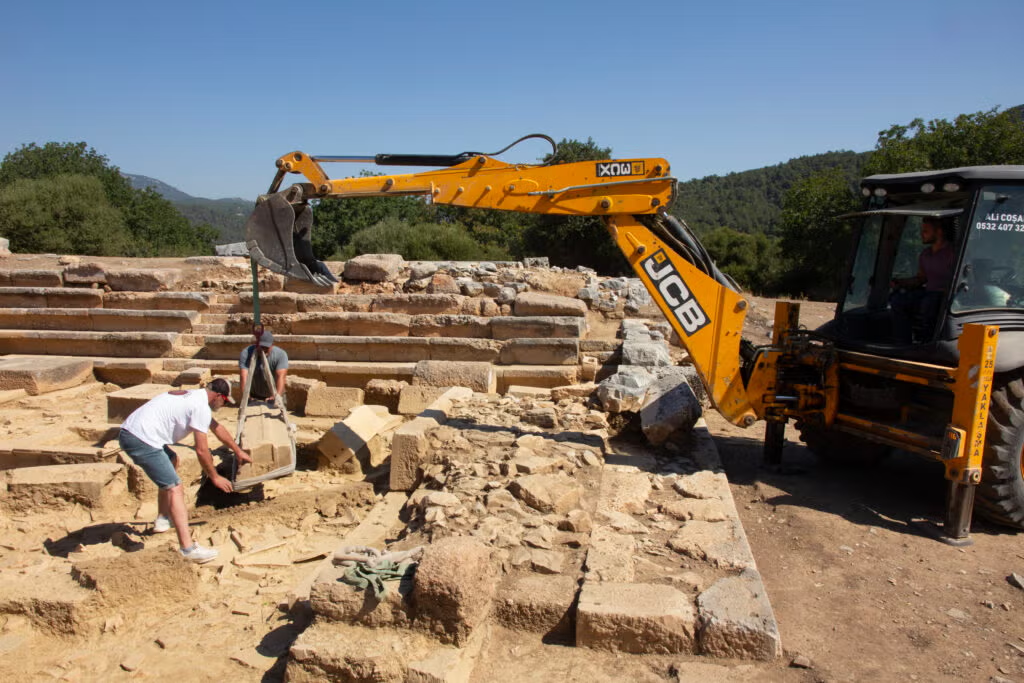
In 2025, a dedicatory inscription was revealed on the entablature (lintel) block of this aedicula (read and translated by Mustafa Adak):
ὁ δῆμος καθιέρωσεν Σέξτον Ἁππολήιον τὸν ἀνθύ-
πατον, εὐεργέτην μὲν γεγονότα πάσης τῆσ ἐπαρχήας, ἀτοῦ δὲ σωτ-
ῆρα καὶ κτίστην
The people consecrated (a statue of) the proconsul Sextus Appuleius,
benefactor of the entire province, and their (the people’s)
savior and founder.
Sextus Appuleius was a powerful and well-connected Roman public figure (a nephew of the Emperor Augustus), who served as proconsul (governor) of the province of Asia in the mid- or late 20s BC; he is the subject of numerous honorific inscriptions from cities throughout the province, including an inscription accompanying a columnar statue monument at nearby Claros, which also names him as founder. It was not uncommon for Greek cities in Asia Minor to honor Roman officials as benefactors, especially after the end of the Roman civil wars, but to call the honoree savior and founder was exceptional.
The inscription suggests that the aedicula of the stage building framed a statue of Appuleius. As already noted, the podium on which the aedicula stood was constructed of reused blocks, possibly all from a single monument. The altar in the center of the orchestra also seems to have been moved to the Bouleuterion from another location. The statue of Augustus was at least roughly and may have been exactly contemporary with the monument to Appuleius. It is therefore possible that all the projects were elements of a single building program, and that Appuleius was honored as the sponsor of that program. It is also possible that Appuleius’s benefactions went beyond that of a single building. A new temple of Athena was built at Notion in the Augustan Period, and the two houses currently under investigation, may have been rebuilt at the same time.
It seems natural to connect such an undertaking with the end of the Roman civil wars and the reign of Augustus, who is known to have promoted ambitious urban renewal programs at nearby cities such as Ephesus and Aphrodisias, a comparison which illustrates the different trajectories possible for west Anatolian cities in this period. At both Ephesus and Aphrodisias, the Augustan period initiated an era of growth and prosperity that lasted for many generations. At Notion, by contrast, the efforts represented by the renewal of buildings and building complexes such as the Bouleuterion and Temple of Athena and the renovation and reconstruction of private houses in different parts of the city ultimately failed, inasmuch as the city was largely abandoned soon after. Why was the urban renewal of Notion so short-lived? The answer may lie in its proximity to the de-facto provincial capital of Ephesus—a much larger and more important place—only 15 km away. Ultimately, it is possible that in this time and place, the lure of the big city proved to be stronger to the inhabitants of Notion than the attractions of the old hometown.

