

In a previous insight, we explored when Revelers are most likely to be on the app. But being active is one thing; deciding who gets a swipe right is another. This week’s insight digs into when Revelers loosen up—and when they get choosy.
A Quick Tour
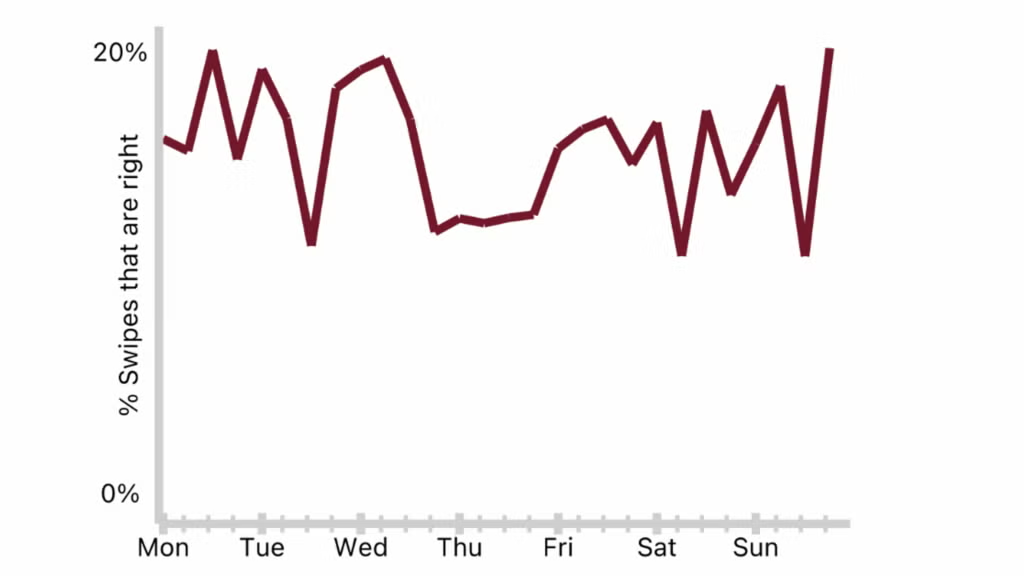
This graph shows when Revelers are most likely to swipe right—that is, to signal interest in a potential match.Each day is broken into four chunks of time:late nights (midnight to 6AM), mornings (6AM to noon), afternoons (noon to 6PM), and evenings (6PM to midnight).* The colored bars help highlight patterns across times and days of the week; they’re for emphasis, not statistical significance.
Men Swipe Right Twice as Often as Women

The biggest takeaway? Men swipe right far more often than women do. On average, men swipe right about 43% of the time, while women do so only 14%. This difference fits with what researchers have found before: women tend to be more selective in dating, while men are more liberal with their “yeses.”1,2 Men and women may also tend to use apps differently. Men often cast a wide net, swiping right in hopes of getting as many matches as possible..3,4 Women, meanwhile, tend to be more deliberate, focusing on a smaller set of profiles.
But there’s more to it than individual preference. These patterns may reinforce themselves. Because women match with most of the men they swipe right on, they may hold back, swiping right only when they feel strongly. Men, on the other hand, often get fewer matches—so they swipe right more frequently, trying to boost their chances.
Women’s Selectivity More Variable Over Time
Women’s swiping patterns also change more over the course of the week than men’s do. Men stay fairly steady, but women show bigger swings depending on the day and time.
Take graduate women: they’re least picky on Saturday mornings and most selective on Thursday nights. Across the day, they swipe right the least in late night hours and the most in the mornings and afternoons (see the pink and yellow highlighted peaks in the graph below). At first glance, that’s surprising. Research shows people tend to lose self-control as the day goes on, making more impulsive decisions at night.5,6 But maybe the “default” for graduate women is to swipe left. If that’s the case, it could actually take more focus—and the kind of energy you have earlier in the day—to decide to swipe right.
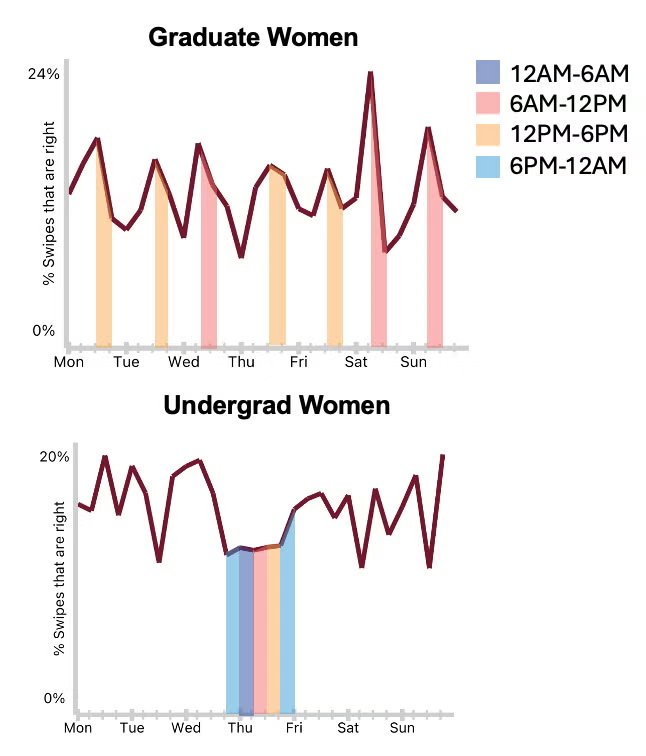
Undergraduate women tell a different story. They’re more likely to swipe right earlier in the week, but their interest dips from Wednesday evening into Thursday night (see the highlighted dip in the graph above). Why? One possibility is that they’re more open to making matches at the start of the week, but grow choosier as their weekend plans take shape. That’s just a hunch, though. More data will help us understand what’s happening.
Have thoughts on this week’s insight or my digest post? Suggestions for new insights? Burning questions about data you’d like us to address? Email us as [email protected].
— Revel Insights Team
Note: The statistics reported in this post are based on a snapshot of all active user profiles taken on September 3rd, 2025. To preserve confidentiality, we do not report on categories with fewer than 50 users. At this time, the nonbinary gender category falls below that threshold and is therefore omitted from Insight reports. Also, our current pool is overwhelmingly heterosexual, so these results mostly reflect their behaviors and preferences. As our community grows, we’ll be able to explore and report on patterns across different orientations.
*To calculate the percentage of swipes, we counted the number of times Revelers swiped right, left, or up in each four-hour chunk throughout the week. We then divided that quantity by the total swipes and multiplied by 100.
- Bilton, N. (2014, October 29). Tinder, the fast-growing dating app, taps an age-old truth. The New York Times. https://www.nytimes.com/2014/10/30/fashion/tinder-the-fast-growing-dating-app-taps-an-age-old-truth.html
- Schacter, D. L., Gilbert, D. T., & Wegner, D. M. (2009). Psychology. Macmillan.
- Abramova, O., Baumann, A., Krasnova, H., & Buxmann, P. (2016, January). Gender differences in online dating: What do we know so far? A systematic literature review. In 2016 49th Hawaii International Conference on System Sciences (HICSS) (pp. 3858-3867). IEEE. https://doi.org/10.1109/HICSS.2016.481
- Berkowitz, D., Tinkler, J., Peck, A., & Coto, L. (2021). Tinder: A Game with Gendered Rules and Consequences. Social Currents, 8(5), 491-509. https://doi.org/10.1177/23294965211019486 (Original work published 2021)
- Chung, J. H., Ahn, D., & Choi, Y. S. (2025). Miracle in the evening: Explaining the boundary condition of consumer’s self-control on purchase intention of near-expired products. Journal of Retailing and Consumer Services, 82, 104125. https://doi.org/10.1016/j.jretconser.2024.104125
- Yang, S., Wang, Y., Li, Z., Chen, C., & Yu, Z. (2022). Time-of-day effects on (un) healthy product purchases: Insights from diverse consumer behavior data. Journal of Business Research, 152, 447-460. https://doi.org/10.1016/j.jbusres.2022.07.058