
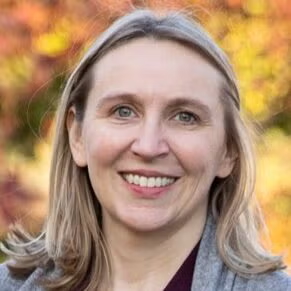
Patricia (Trisha) Wittkopp
Principal Investigator
Professor Wittkopp’s studies of evolution and development in Drosophila started during her undergraduate research with Dr. Greg Gibson at the University of Michigan (B.S. 1997), and continued during her doctoral work at the University of Wisconsin with Dr. Sean Carroll (Ph.D. 2002). From 2002-2005, Professor Wittkopp studied the evolution of gene expression as a Damon Runyon Cancer Research Postdoctoral Fellow with Professor Andy Clark at Cornell University. Coming full circle, the Wittkopp lab was officially founded at U. Michigan in August 2005. She is the Deborah G. Goldberg Distinguished University Professor of Ecology and Evolutionary Biology and Molecular, Cellular, and Developmental Biology and an Arthur F. Thurnau Professor. She served as Chair of the Department of Ecology and Evolutionary Biology from 2020-2023, the LSA Associate Dean for Natural Sciences from 2023-2025, and the inaugural LSA Associate Dean for Research and Graduate Education from 2025-present.
Professor Wittkopp has been selected as a Guggenheim Fellow, a Fellow of the American Association for the Advancement of Science (AAAS), an Alfred P. Sloan Research Fellow, and a Damon Runyon Cancer Research Foundation Postdoctoral Fellow. She has received the Friedrich Wilhelm Bessel Research Award from the Alexander von Humboldt Foundation, the Margaret Dayhoff Mid-Career Award from the Society of Molecular Biology and Evolution, and a Basil O’Connor Starter Scholar Research Award from the March of Dimes. Her research, teaching, mentorship, and service have been recognized by the University of Michigan with the John Dewey Award, the Faculty Recognition Award, the Work/Life Champion Award for Supervisors, the Excellence in Education Award, the Class of 1923 Memorial Teaching Award, and the Henry Russel Award.
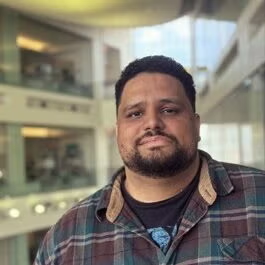
Erick X. Bayala
Postdoctoral Research Fellow
Erick considers himself an Evo-Devo-Cell biologist with a deep interest in microscopy, nature, gaming, and art. He completed his B.S. at the University of Puerto Rico-Humacao campus. He then went to the University of Chicago and earned his Ph.D. in Integrative Biology. During his Ph.D he studied the developmental mechanisms underlying butterfly color patterning and pigmentation in the lab of Dr. Marcus Kronforst. In addition to pigmentation, he also developed tools to investigate butterfly embryogenesis more widely. Erick joined the Wittkopp lab in October of 2022 after being awarded an NSF Postdoctoral Research Fellowship in Biology. As part of the Wittkopp lab, he is working across different stages of Drosophila development, investigating questions regarding expression dynamics, patterning, and morphogenesis within and outside pigmentation phenotypes. He plans to lead his own research lab in the future, investigating the developmental and cellular processes that give rise to complex structures, shapes, and patterns in animals. Erick’s favorite Pokémon is Swampert.
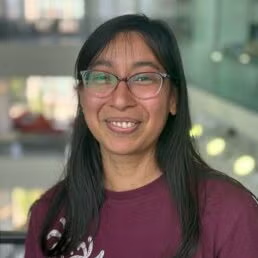
Taslima Haque
Postdoctoral Research Fellow
Taslima is a postdoctoral research fellow in the Department of Ecology and Evolutionary Biology at the University of Michigan, Ann Arbor. Her research focuses on how populations adapt to different environments and the molecular mechanisms that underlie these processes. She earned her doctoral degree in Plant Biology from the University of Texas at Austin in Dr. Thomas Juenger’s lab, where she investigated the molecular mechanisms leading to local adaptation of a perennial grass model, Panicum hallii. She joined the Wittkopp Lab in May 2023 to pursue her interest in studying gene expression evolution. Using yeast and Drosophila as model systems, she tests various evolutionary hypotheses to gain deeper insight into the complex relationship between genotype and phenotype. Taslima plans to lead a research group in the future, where she will integrate population genetics and machine learning within a unified framework to investigate how regulatory variants shape genotype-phenotype-fitness landscape.
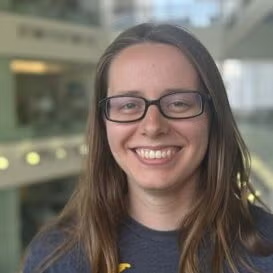
Rebecca McAvoy
MCDB Graduate Student
Rebecca earned her B.S. dual degrees in Neuroscience and Biology with an area of concentration in Cell Biology and Molecular Genetics from Indiana University, where she used Drosophila to study glial cell-cell communication in the lab of Dr. Dan Tracey. She joined the Wittkopp Lab in March 2023, continuing her rotation project studying the genetic variation impacting expression and how it relates to transcription factor binding. Rebecca is a trainee on the CBTP T32 NIH training grant geared for preparing trainees to pursue industry post-graduation. Rebecca’s favorite Pokémon is Giratina.
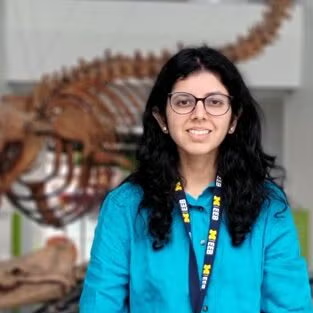
Ayushi Dasgupta
EEB Graduate Student
Ayushi completed her B.S in Zoology from the University of Delhi and a M.S in Reproductive Biology & Clinical Embryology from AIIMS Delhi. Her master’s research explored how conserved ovarian genes and insulin signaling pathways regulate reproductive longevity in C. elegans. Her research interests span genetics, behavior, and evolution. She joined the Wittkopp lab in October 2022 as a research lab tech, following which she joined the lab as a graduate student in fall of 2023. Her current work focuses on how pigmentation genes shape mating behavior and chemical signaling in Drosophila.
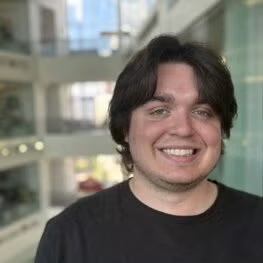
Mark Ayers
Undergraduate Assistant
Mark is an undergraduate research assistant currently majoring in biology at the University of Michigan. Mark started in the Wittkopp lab in June of 2025, after receiving the Arnold and Mabel Beckman undergraduate research scholarship. He is primarily interested in genetics, with a particular interest in developmental biology. In the Wittkopp lab, Mark has been diligently working on two projects. One aims to provide a map of Drosophila americana’s genome along with exploring a possible link between microbiome and phenotype. He is excited to continue developing critical interdisciplinary skills and learning more hands-on techniques. Following graduation, he hopes to go to pursue a PHD and continue to focus on research.
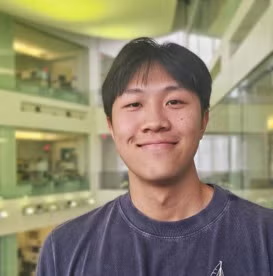
Daniel Wang
Undergraduate Assistant
Daniel is an undergraduate researcher and a rising senior majoring in Biology, Health, and Society at the University of Michigan. After completing a summer research internship at the Van Andel Institute, he joined the Wittkopp Lab in August 2025 to further explore his interest in developmental biology. In the lab, Daniel investigates how changes of gene expression influence pigmentation and other phenotypic traits in Drosophila. His current project focuses on studying patterns of protein expression over different stages of pupal development, combining biological mechanisms with hands-on techniques. Daniel plans to deepen his understanding of developmental biology by pursuing a senior research thesis. Following graduation, he hopes to attend medical school while continuing genetics-focused research.
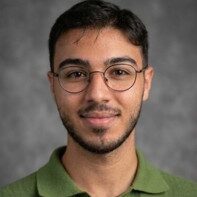
Adel Kamel Kaddoumi
Undergraduate Assistant
Adel K. Kaddoumi is an undergraduate researcher at the University of Michigan pursuing a Bachelor of Science in Pharmaceutical Sciences. A graduate of the Anglican International School in Jerusalem and an International Baccalaureate Diploma recipient, he developed an early interest in understanding how biological systems function—and what drives disease at the molecular level. His research focuses on the genetic basis of phenotypic evolution, integrating molecular and developmental biology with genomics. Adel plans to pursue a career in medicine, with a particular interest in cardiothoracic surgery, where he aims to bridge research and hands-on patient care.
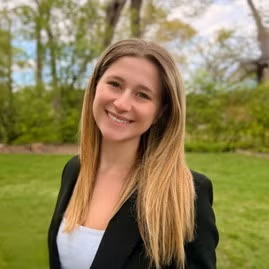
Natalie Finnegan
Undergraduate Assistant
Natalie M. Finnegan is an undergraduate researcher at the University of Michigan and a sophomore studying Biology, Health, and Society with a minor in. With a longstanding interest in the intricate mechanisms through which organisms regulate gene expression, she joined the Wittkopp Lab in Fall 2025. As part of the lab, Natalie is developing her skills in laboratory techniques while collaborating with her colleagues on projects investigating regulatory systems in both Drosophila and yeast. After graduation, Natalie hopes to pursue higher education and enter the medical field, combining her passion for understanding biological systems with her interest in applying that knowledge to patient care.
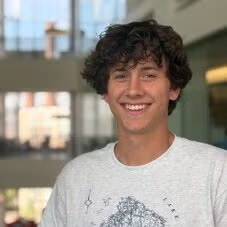
Sam Teppo
Undergraduate Assistant
Sam B. Teppo is an undergraduate researcher at the University of Michigan pursuing a double major in Biology, Health, and Society and Psychology. His previous work with the Chicago Department of Public Health, focusing on mosquitoes as disease vectors, helped develop his interest in molecular biology, genetics, and data-driven scientific research. In the Wittkopp Lab, Sam is gaining hands-on research experience studying the genetic basis of phenotypic evolution through molecular biology and genomics. After graduation, he hopes to pursue a master’s degree in Public Health to apply his interests in biology, epidemiology, and research.
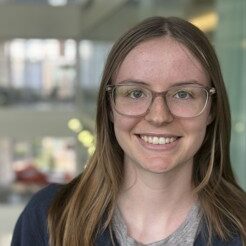
Zandra Curley
Undergraduate Assistant
Zandra is a rising senior double majoring in Biology and Earth & Environmental Sciences. She is broadly interested in the complex interactions between organisms and their environment and has enjoyed exploring this theme through past and concurrent projects involving Plio-Pleistocene Florida mollusks and the experimental evolution of pathogenic fungi. In the Wittkopp Lab, she is excited to learn more about genetic and molecular biology techniques and how they are applied to better understand the evolution and development of classic study systems. In the future, she hopes to continue with research and plans to strive for a PhD in a related field.