
Plenary Lecture
Sustainability Spurs Innovation
Dr. Scott Moravek
PPG Industries

Abstract:
Trends in sustainability and changing regulations result in an ongoing evolution of customer needs. New technology or new approaches are often needed to meet these evolving needs, presenting both challenges and opportunities to the coatings industry. A number of examples of technology innovations developed to address such needs will be shared including methods of reducing energy required for cure and approaches for removing materials of concern.
Biography:
Scott has a BS in Plastics Engineering Technology from the Pennsylvania State University and a PhD in Polymer Science and Engineering from the University of Southern Mississippi where he was a member of the Storey Research Group. After graduate school, Scott joined PPG, where he is currently a Senior Research Associate and has over 17 years of industrial R&D experience in coatings and related technologies. He has contributed to numerous new or improved technologies across a range of automotive, refinish, protective and marine, and industrial applications. Scott is an inventor on over 25 granted US patents in addition to international versions thereof.
Keynote Speaker
Principles and Applications of Organic Electrosynthesis
Professor Shannon S. Stahl
UW-Madison Department of Chemistry
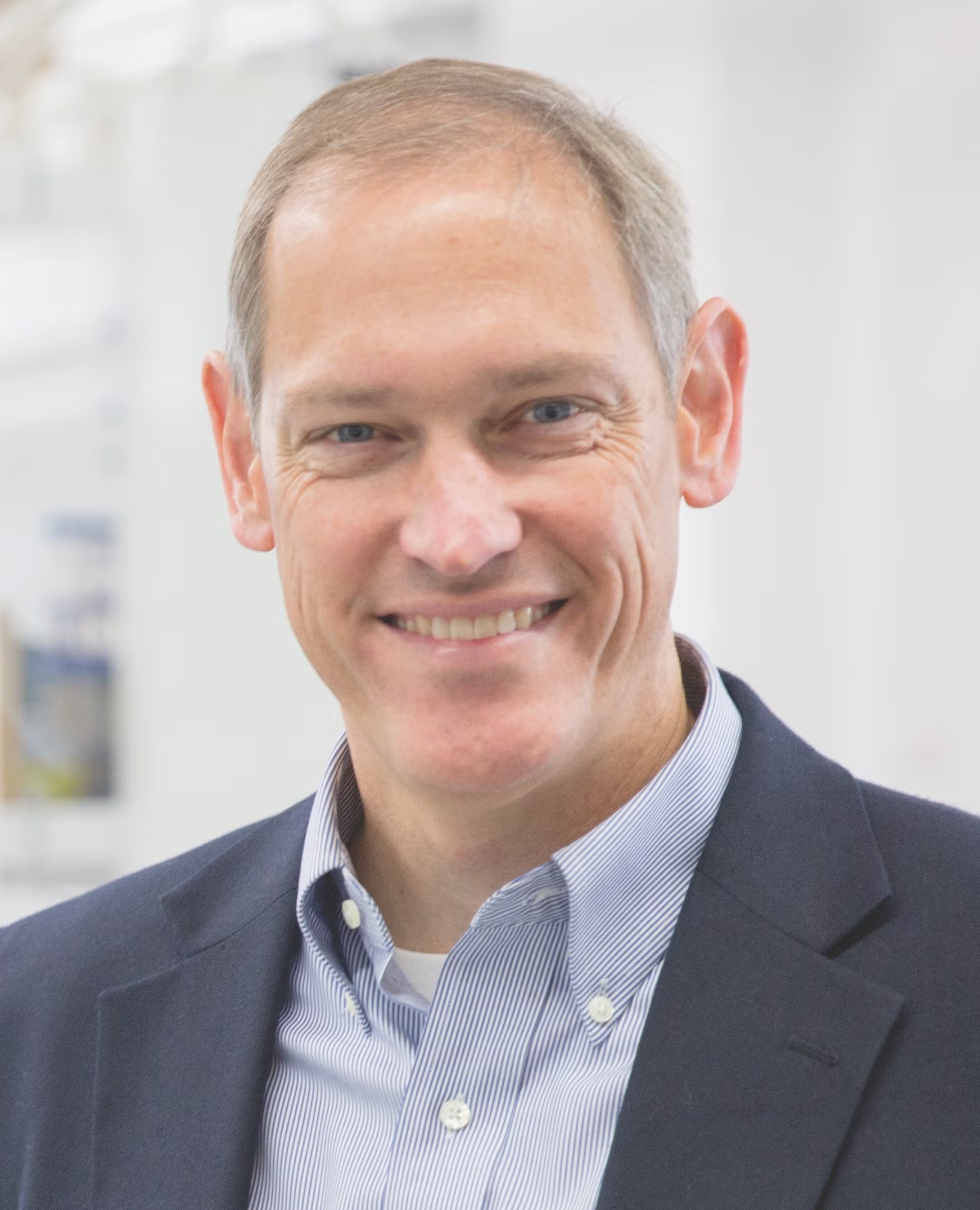
Abstract:
Electrochemistry presents unique opportunities for chemical synthesis, but it also faces challenges that hinder widespread adoption by organic chemists and industrial practitioners. Fundamental thermodynamic and kinetic concepts that are well established in the field of electrochemical energy conversion have important implications for electrochemical synthesis. This talk will feature a series of vignettes from our group’s exploration of electrochemical synthesis, including the role of electrochemical mediators to overcome overpotential limitations often encountered in electrosynthesis and development of new electrochemical oxidation and reduction reactions. Oxidation methods include the development of oxygen-atom-transfer reactions that use water as source of oxygen atoms. Examples include the preparation of sulfoxides from sulfides, epoxides from alkenes, and N-oxides from aromatic nitrogen heterocycles. Reduction methods have prioritized Ni-catalyzed cross-electrophile coupling reactions, with the goal of understanding the fundamental principles that govern reactivity and selectivity that could enable adoption of these methods in large-scale applications.
Biography:
Shannon S. Stahl is the Steenbock Professor of Chemical Sciences in the Department of Chemistry at the University of Wisconsin-Madison. He obtained his B.S. in Chemistry from the University of Illinois at Urbana-Champaign in 1988. He earned his PhD in Chemistry from Caltech in 1997, working with Prof. John Bercaw, and he conducted postdoctoral research at MIT from 1997–1999, working with Prof. Stephen Lippard. At UW-Madison, Stahl and his research group have studying redox catalysis, with an emphasis on aerobic oxidation and electrochemical reactions. Applications include chemical synthesis, biomass conversion, and energy storage and conversion. He co-edited, with Dr. Paul L. Alsters (DSM), Liquid Phase Aerobic Oxidation Catalysis (Wiley-VCH), highlighting applications and opportunities for aerobic oxidation in industrial chemical synthesis, and he has developed an online short course on Organic Electrochemistry with Prof. Mohammad Rafiee. His work has been recognized by the ACS Award in Organometallic Chemistry, the Mitsui Chemicals Catalysis Science Award, the US EPA Presidential Green Chemistry Challenge Award and the ACS Award in Affordable Green Chemistry. He is a member of the American Academy of Arts and Sciences and the National Academy of Sciences.
#Karle2026
CONTACT
Srijita Dutta
[email protected]
Yulia Rakova
[email protected]
Thank you to our primary sponsor!