

Research
Research overview
Within the Ledvina lab we are interested in the fundamental question of how organisms defend themselves against the multitude of pathogens encountered throughout their lifespan. Specifically, we seek to understand bacterial immune systems. Over the last several years it has been demonstrated that bacteria possess a multifaceted immune system composed of diverse pathways geared towards defending against viral pathogens called bacteriophage (phage) as well as bacterial pathogens called predatory bacteria. Excitingly, components of bacterial phage defense pathways are structurally homologous and functionally analogous to proteins in the human immune system providing us the opportunity to study aspects of immune signaling conserved across the tree of life. The Ledvina lab seeks to define the mechanisms underlying immune signaling in bacteria as well as determine the breadth of the bacterial immune system.

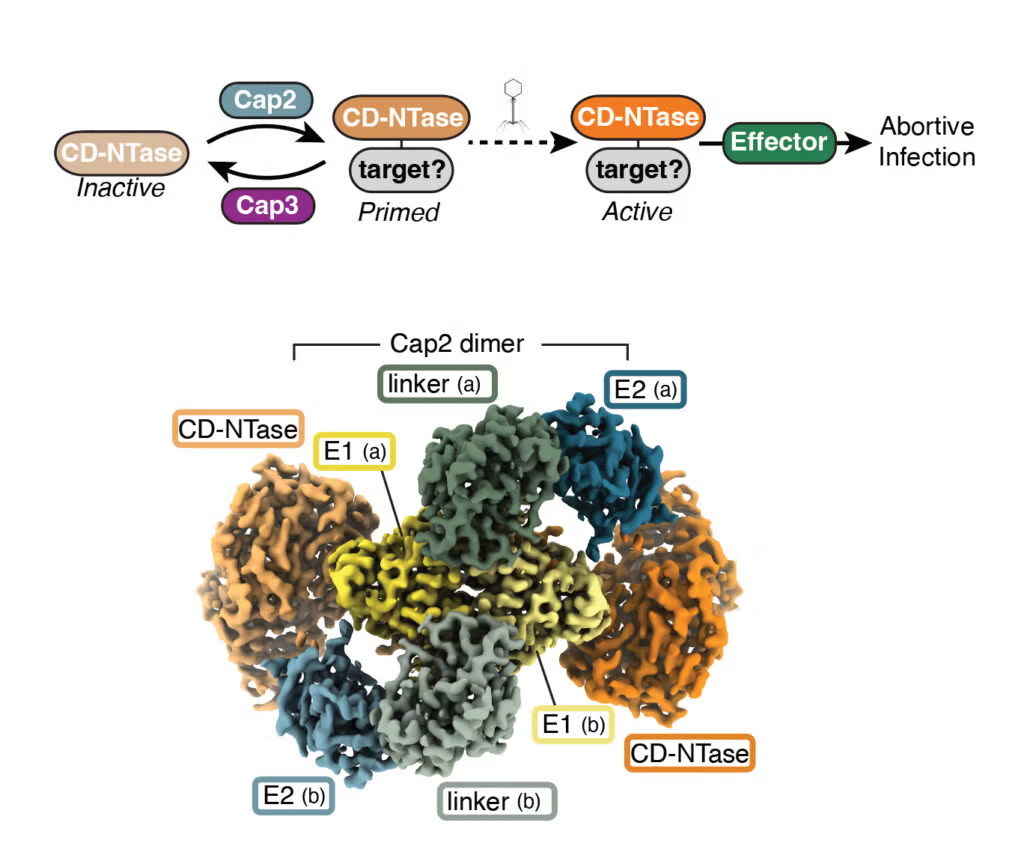
The origins of innate immune pathways: insights from phage defense
We recently discovered that bacteria regulate their immune system components similarly to how humans do – using ubiquitin conjugation. Within eukaryotes E1 and E2 enzymes mediate ubiquitination, the process of covalently linking ubiquitin to a target. We determined that bacteria use E1-E2 fusion proteins to promote antiviral signaling by conjugating a key signaling enzyme (bacterial cGAS) onto an unknown target. This is the first demonstration of E1-E2 enzymes acting on non-ubiquitin like substrate opening up exciting lines of future investigation. Additionally, as part of this work, we identified 6 potential phage defense pathways that contain E1 and E2 domains. This project seeks to continue determining the role of E1 and E2 proteins in phage defense as well as characterize addition proteins within these systems.
Bacterial warfare: how to stop other bacteria from making you its meal
Our primary understanding of the bacterial immune system has focused on phages. However, within nature, bacteria face a wide range of threats including neighboring bacteria, amoeba, extracellular toxins, and predatory bacteria. Thus, we hypothesize that the bacterial immune system has multiple branches capable of defending against this array of threats. To initially address this, we turned to Bdellovibrio bacteriovorus, a predatory bacterium which, as part of its lifecycle, invades and kills bacterial hosts. By combining high throughput screening with genetic approaches, we discovered that the functional amyloids generated by E. coli and Pseudomonas, defend against predatory bacteria. Amyloids are highly durable protein fibers composed of extended β-sheets that are best known for their role in neurodegenerative diseases such as Alzheimer’s, Parkinson’s and Huntington’s. We hypothesize that physical shields are a bacterium’s first line of defense with amyloid proteins playing a key role in immune systems across life.
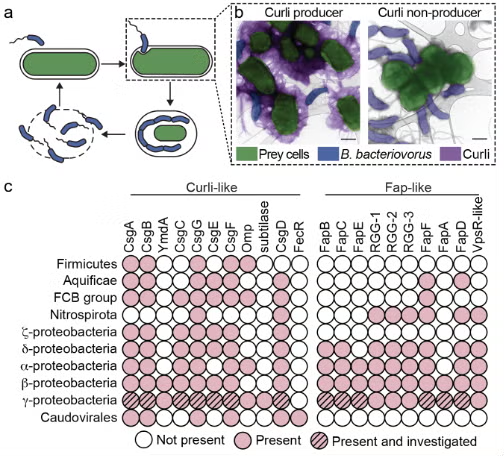

Exploring wild strains for novel defense (ExpND)
Our work and the work of countless others has demonstrated that studying the bacterial immune system not only uncovers novel biochemistry but also fuels biotechnological advances (i.e. RM-systems and CRISPR). In order to continue making these advances novel components of the bacterial immune system need to be uncovered. We use the platform developed by Dr. Ledvina termed ExpND to survey diverse pathogens and hosts to define the composition of the bacterial immune system. ExpND combines a collection of wild bacteria with diverse genetic screens to rapidly identify the genetic determinants of defense against a pathogen of interest. Importantly, this is an unbiased approach which tests for functional resistance at each step facilitating rapid identification of new defense pathways. Use of bacterial predators with diverse lifecycles as well as unique threats will allow us to uncover defense systems that act both intra- and extracellularly as well as in specific cellular compartments.
The Ledvina Lab
University of Michigan MCDB Department Biological Sciences Building Ann Arbor, Michigan

Proudly powered by WordPress