Finding a large brewery —one where maize beer was made in volume — would be exciting, and just such a discovery was made in the North Central Canchón of Structure D at Cerro Azul.
Chicha or maize beer — also known as aqa, jora, or azua — was used by the Andean elite to keep their workers happy and to entertain important visitors. One 16th-century document records that Cristóbal Payco, leader of the northern Peruvian community of Jequetepeque, asked the Spaniards for permission to continue to provide chicha to his men in return for their work. Payco explained that commoners obeyed the nobles because the nobles gave them drink. He said If the caciques [local leaders] did not give drink to the Indians to work this land and to others to plant the fields of the community, they would not do it (Juan de Betanzos 1551).
In Andean society, supplying large amounts of beer was considered an act of generosity, even when the relationship between donor and recipient was asymmetrical or hierarchical. Such “generosity” served to mask the fact that the provider was high-status, while the recipient was not only low-status but obligated to do the work. Abundant documentation shows that Andean leaders who provided liberal quantities of beer attracted sufficient labor to work. In fact, studies suggest that many parts of the Andean economy depended on the masking of inequality with hospitality.
The chronicler Bernabé Cobo stated that the inhabitants of Peru’s North Coast drank chicha from gourd bowls, rather than the ceramic or wooden keros known from so many highland sites. Abundant mates have been found at coastal sites, including Cerro Azul.
Cerro Azul’s Brewery
The large residential compound designated Structure D covered 1640 m2. This compound, the residence of an elite family and its support staff, included a kitchen that also served as a brewery. The chicha produced in Structure D could have been used to entertain elites from other compounds at Cerro Azul, and to reward the countless fishermen who filled up the storage rooms at the site.
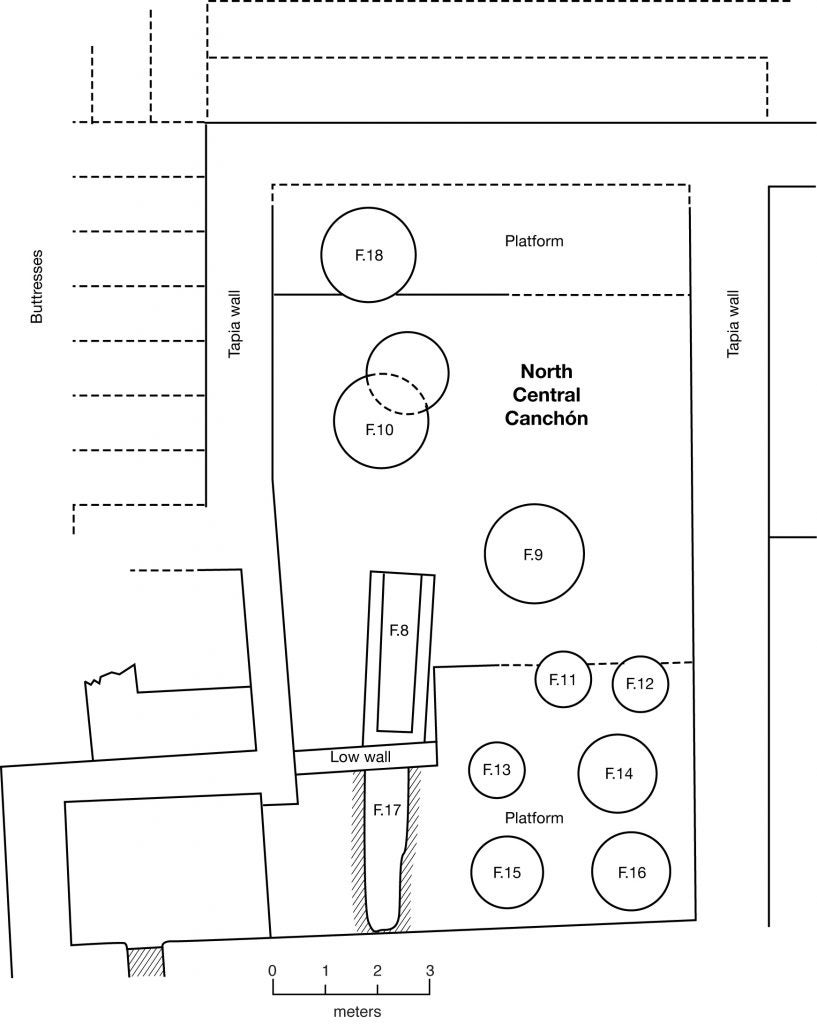
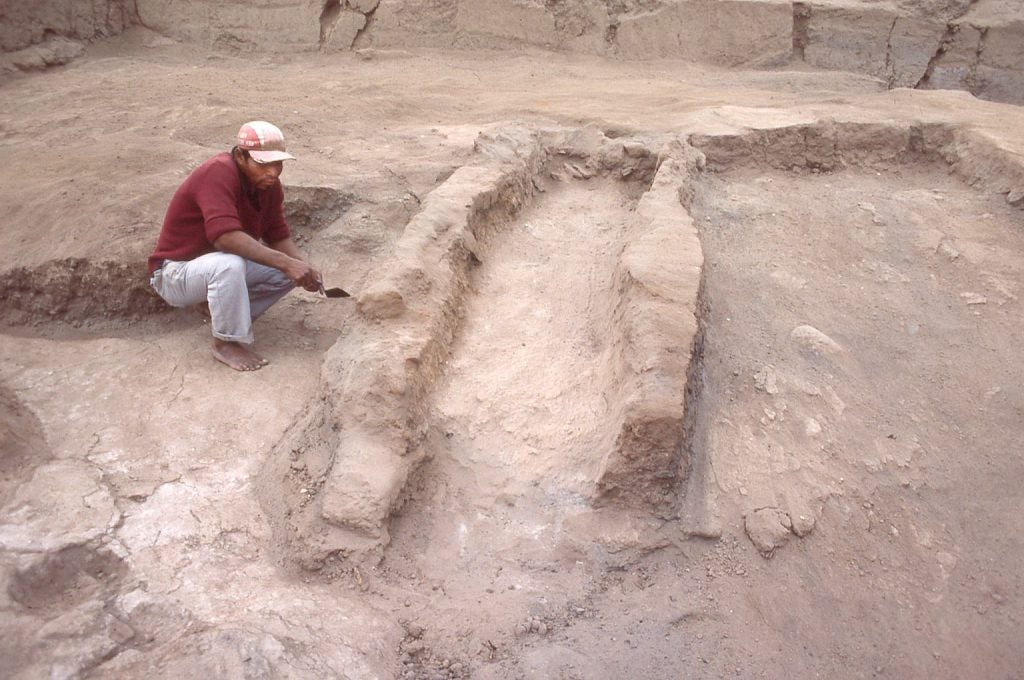
The brewery, which covered 110 m2 of floor space, featured two hearths shaped like narrow trenches. That shape lent itself to setting large vessels in a line, supported by the opposing walls of the hearth trench. One of the two hearths was filled with white ash; the second was filled with densely packed layers of gray and white ash. When Marcus excavated this second hearth trench it still contained the basal portions of cooking vessels, one of which included the residue of sprouted maize kernels. The fuel used in the hearths consisted of discarded wood and cane, including caña brava (Gynerium sagittatum), a wooden weaving sword (kallwa), and broken wooden posts that appeared to be willow (Salix sp.). (For more information, see “A World Tour of Breweries” [2009] in Andean Civilization: A Tribute to Michael E. Moseley, edited by J. Marcus and P. R. Williams, pp. 303-324, UCLA Cotsen Institute).


Marcus found several implements that could have been used to grind the maize for chicha. Three tunaukuna (handstones for grinding) were found inside a storage jar. One discarded grinding slab was found on the floor of the North Central Canchón; another was found in a storage jar. A likely “stirring stick” was also found nearby.
Many of the large storage vessels were so deeply set into the floor of the brewery that their shoulders were virtually at floor level; the largest of these vessels were likely formed and fired in situ. Storage vessels fell into four standard sizes: the largest could have held almost 2000 liters, the next in size 700 liters, the next 500 liters, and the smallest roughly 125 liters. These four sizes correspond generally to four Quechua categories, with the largest called hatun maccma; the next largest, urpu; the next, iteco; and the smallest, puyñu.
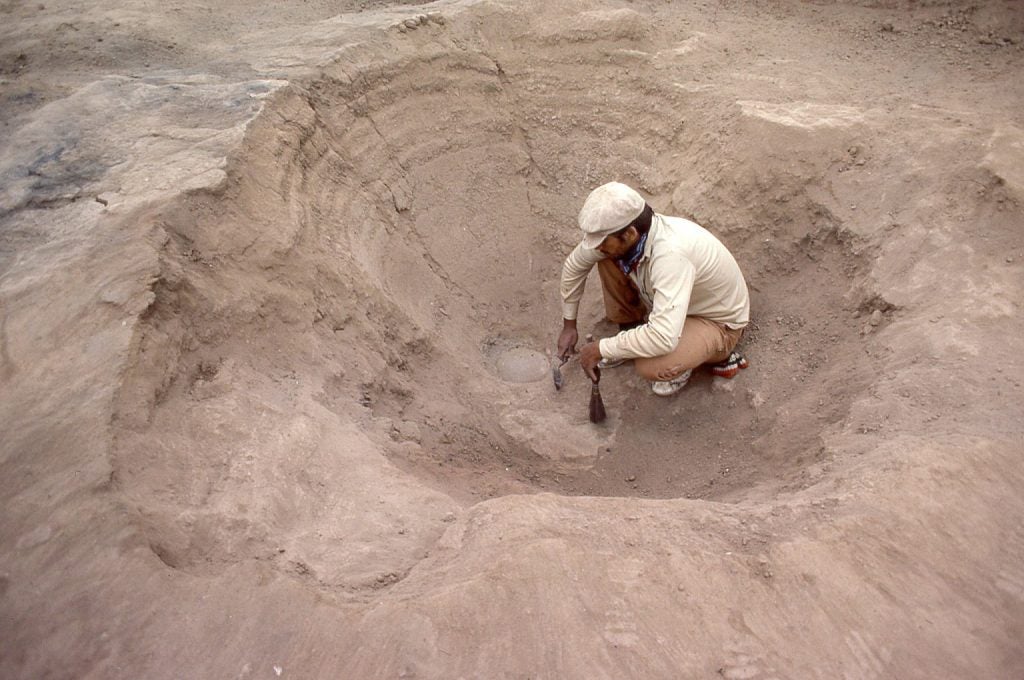
Had all the storage vessels in the brewery been in use simultaneously, their total volume would have been at least 5000 liters (1321 gallons). If only half the vessels were filled at one time, their total capacity would still have been 2500 liters (660 gallons).

We can estimate how many people the Cerro Azul brewery could have served by referring to John Gillin’s 1947 ethnographic study of the Peruvian town of Moche. Gillin estimated that each person there probably consumed three liters of chicha at a given beer-drinking event. If we apply this figure to Cerro Azul, it suggests that the elite living in this one residential compound could have entertained somewhere between 800 people (if the half-capacity 2400 liters were produced) and 1650 people (if the full capacity of 5000 liters were produced).

Copyright © 2021 University of Michigan Museum of Anthropological Archaeology (UMMAA)