
萬里之外的中國形象
清政府展品與新奧爾良世界博覽會
China’s Image Across the Seas
The Chinese Government Collection
and the New Orleans World’s Fair
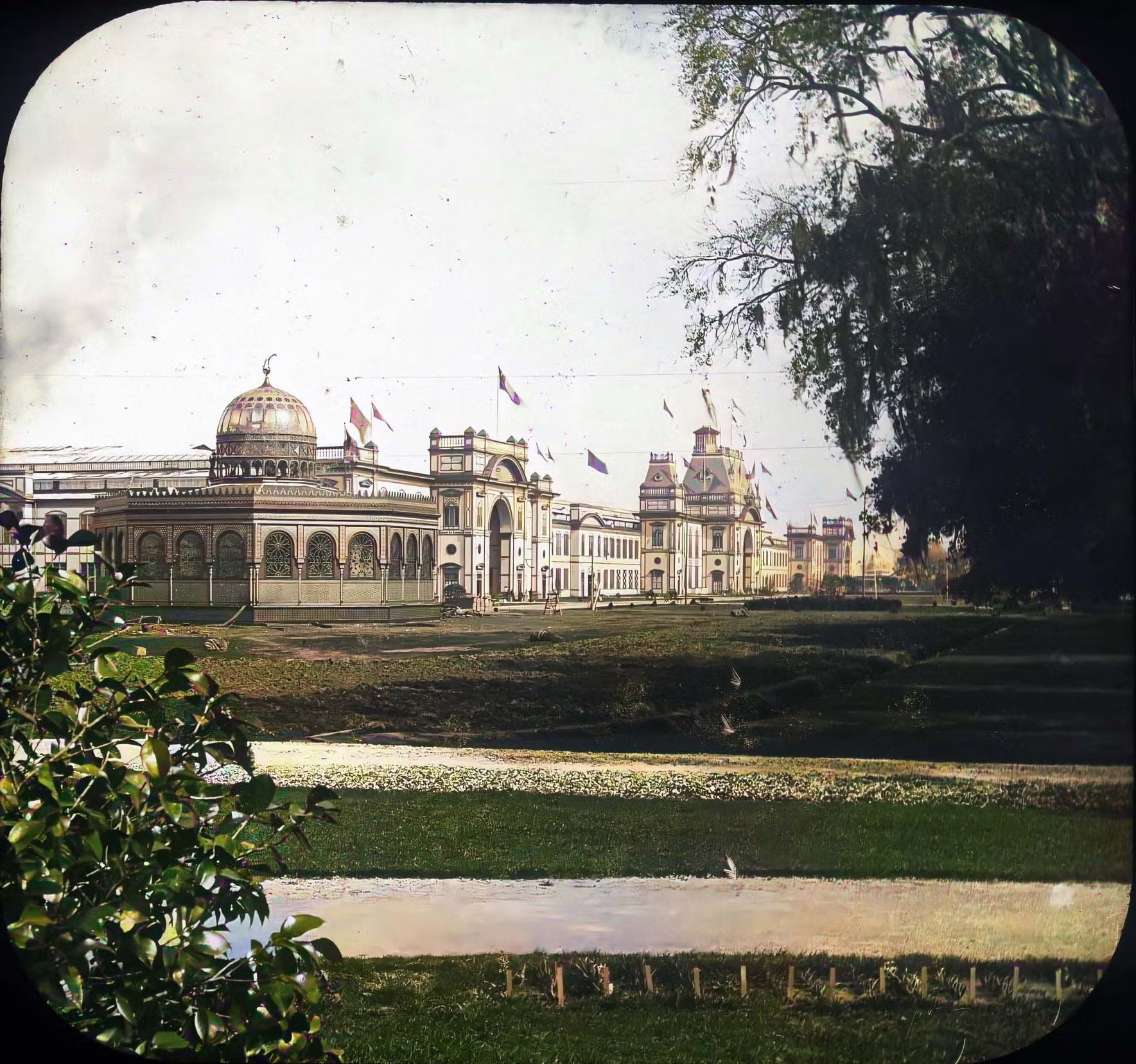
Colorized Glass Magic-Lantern Slide of the 1884–85 World’s Industrial and Cotton Centennial Exposition. Kenneth Speth’s Personal Collection. Original image created by The Centennial Photograph Company. Link.
On this page
棉業百年慶典:新奧爾良世界博覽會
Cotton Centennial: The New Orleans World’s Fair
The World’s Industrial and Cotton Centennial Exposition, also known as the 1884 World’s Fair in New Orleans, was held from December 1884 to May 1885. In the late 19th century, New Orleans was one of the most important cities in the American South, serving both as a center of steamboat transportation and as a major port of global trade. Proud of their economic achievements, American Southerners hosted a massive international exposition of global cotton industries and machinery, including non-European participants such as China, Japan, and Siam (Thailand). The collection organized by China in particular reflects the difficult position of the late Qing government during a historical period in which Euro-American powers such as Britain and the United States dominated the global order.


Chinese furnishings in Room 4018, Museum of Anthropology, 1932-34. Catalog Number BL006256. Bentley Historical Library: Bentley Image Bank. https://quod.lib.umich.edu/b/bhl/x-bl006256/bl006256. University of Michigan Library Digital Collections.
After the fair closed, Sir Robert Hart, the Inspector General of the Chinese Maritime Customs Service (the CMCS) and the director of the Chinese collection at the exhibition, donated the Chinese collections to the University of Michigan. Sir Hart chose U-M because of his personal friendship with University President James B. Angell.
The Chinese Government Collection became a cornerstone of the University’s early cultural collections and was displayed in the University Museum from 1885 to 1923. However, once it was installed, no single individual was tasked with its care, and the collection gradually became neglected. Responsibility for the collection was transferred to the Museum of Anthropology when it was created in 1928. Since the collection was no longer exhibited, it faded from public view and public consciousness. With this digital exhibit, we hope to bring it back to public attention and breathe new life and interest into a collection that is nearly 150 years old.
展覽導航
Exhibition Navigation




延伸思考
Beyond the Collection
The Chinese Government Collection can inform us about a broad range of historic and contemporary issues. These collections are more than historic objects preserved by the University of Michigan. They are an untapped resource that can help us better understand the people, institutions, and international interactions across the Pacific world in the late 19th century, all of which laid the foundations for the global order in which we live today.
The collection illustrates the changing society of late Qing China before the dramatic political revolutions of the 20th century. The late 19th century was a time of transition for both the United States and China, during which people’s daily lives were rapidly changing through globalization, international trade, and modern transportation. The textiles, ceramics, banners, and other materials in the collection offer insights into how people understood the changing world in which they lived.


At a local level, the collection reveals the complicated process of assembling an international exposition. The Chinese Maritime Customs Service (CMCS; 中國海關總稅務司) was an important governmental agency in late Qing China, responsible for maritime customs administration and foreign trade regulation. The agency was heavily shaped by Sir Robert Hart and other administrators who were not born or raised in China. The CMCS was also in charge of organizing Chinese participation in overseas exhibitions, which included the joint efforts of foreign officers, Chinese craftsmen, merchants, and specialists from different fields. Although many of these individuals left few archival records, their work helped to present an image of China to international audiences in New Orleans.
From the perspective of U.S.-China relations, the collection reveals the complexity of representation in the context of cultural exchange and interpersonal encounters. The CMCS organized China’s representation at dozens of international expositions, introducing China into a newly emerging global order shaped by Euro-American power. However, this image of China was also shaped by institutions, diplomatic networks, and cultural expectations that were not fully under Chinese control. Thus, the Chinese Government Collection offers both a way to explore the cultural representation of China and an opportunity to consider how international audiences understood China.
A hundred and forty years later, these perspectives and complex issues still carry contemporary relevance. The Chinese Government Collection inspires exploration and new conversations about cultural communication, international cooperation, and the understanding of people across different political and social boundaries.
管理員致辭
About This Exhibition
This exhibition was written and designed by Frank Zijie Wang 王子杰.
The idea for an exhibit was first proposed to me by Debing Su 苏德冰, longtime media representative for the Kenneth G. Lieberthal and Richard H. Rogel Center for Chinese Studies at the University of Michigan (LRCCS) and China Specialist for Michigan News. Debing reached out to me in 2019, wanting to learn more about the Chinese Government Collection. From there, along with Pär Cassel, Associate Professor of History, we developed an exhibition plan and secured funding from the LRCCS. Unfortunately, the 2020 COVID Pandemic derailed the plans for a Fall 2020 opening and we never recovered our momentum. Debing left the University in June 2023. In October 2023, Debing died in a tragic accident while traveling in Ecuador. Frank Zijie Wang’s work is an outgrowth of that project and was also informed by previous work conducted by Carla Sinopoli, Curator Emeritus. This exhibition is dedicated to Debing Su’s memory.
Jim Moss
Collections Manager