
展臺上的美國南方:新奧爾良與棉花百年博覽會
The South on Display: New Orleans and the Cotton Centennial
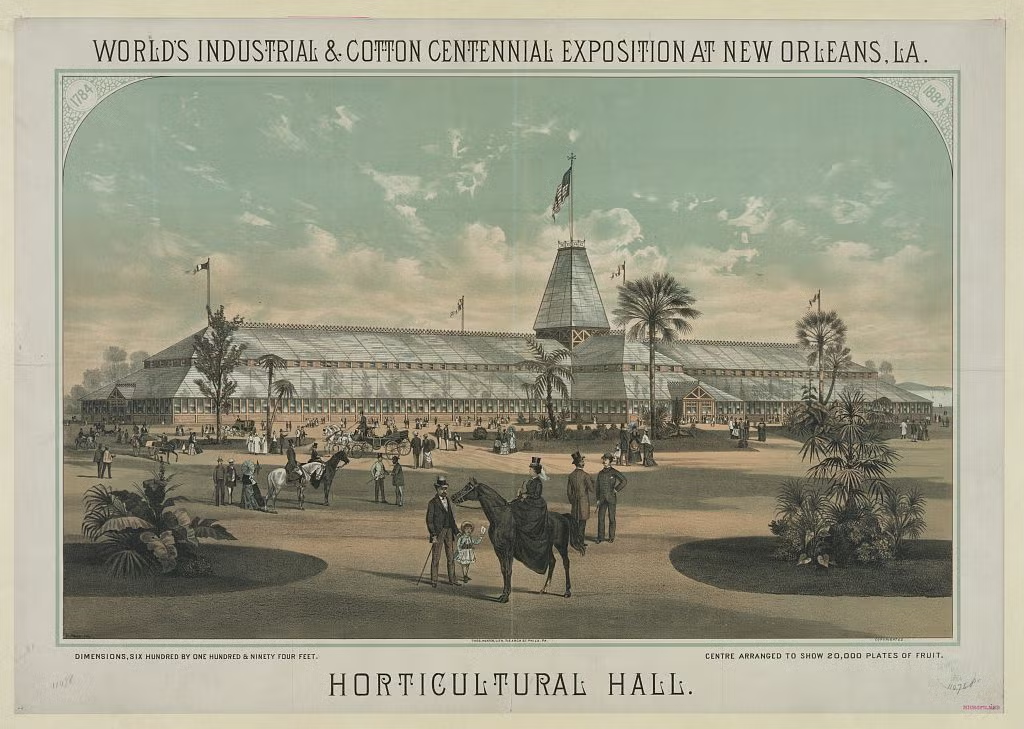
Hunter, Thomas, Lithographer. Horticultural Hall. World’s Industrial & Cotton Centennial Exposition at New Orleans, La. / H. Arms, del.; Thos. Hunter, lith., Phila., Pa. Louisiana, New Orleans, 1884. Philadelphia: Thomas Hunter, Lithographer, 715 Arch Street. Tinted lithograph. Library of Congress. https://lccn.loc.gov/93503154.
On this page
建設“新南方”:十九世紀八十年代的新奧爾良
Building the New South: New Orleans in the 1880s
The 1880s were a period of social and industrial transition in the American South. The Civil War (1861–1865) had brought an end to slavery, followed by Reconstruction, a period of political integration and reform. However, Reconstruction was short-lived. Through the Compromise of 1877, white Southern Democrats – many of them former Confederates – accepted the presidency of Republican Rutherford B. Hayes. In return, Hayes withdrew federal troops from the Southern states, marking the end of Reconstruction and the beginning of a new era of racial segregation. Redeemers, primarily white Southern Democrats, quickly filled the political vacuum by taking control of state governments and promoting their vision of the “New South.” They restricted the rights of African Americans and built a new segregated society across the Southern states.
At the same time, industrial expansion and growing international connections reshaped urban life across the nation. Massive construction projects on railroads and telegraphs connected people on an unprecedented scale. As travel and communication became easier, Americans also became increasingly interested in learning about other regions of the country and the wider world. This curiosity was fed by a series of international exhibitions, starting with the Centennial Exhibition in Philadelphia in 1876. However, most Americans still understood the world through a Euro-American centered perspective.
Currier & Ives. The city of New Orleans, and the Mississippi River Lake Pontchartrain in distance. Louisiana United States New Orleans Lousiana, ca. 1885. New York: Published by Currier & Ives. Photograph. https://www.loc.gov/item/90715980/.
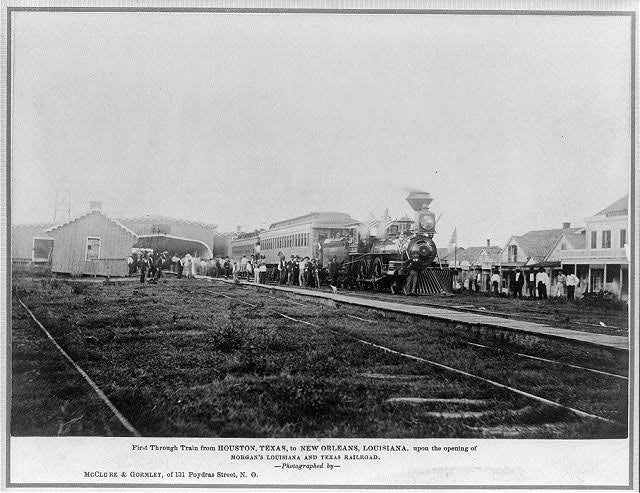
New Orleans was a city that remained old-fashioned in many ways. From the mid-19th century, the city prospered through its cotton trade and was powered by commercial connections across the American South through the Mississippi River. After the Civil War and the early Reconstruction era, people from the South viewed the city as representing both modern industrial life and agricultural tradition. The city was indeed changed by the arrival of modern technology. Railroads linked New Orleans with surrounding regions, while the city itself served as a major transportation hub within a growing inter-national network. The port of New Orleans was a center of maritime trade with Latin America, adding to the city’s multicultural lifeways. River transportation, expanding railroad systems, and the economic benefits of a developed port together built undeniable geographic advantages for New Orleans. However, criticism about the city’s management in the late 19th century also pointed out that it was highly corrupt, politically conservative, and slow in infrastructure construction. The city was proud of its long-lasting name as “the Queen City of the South,” while it moved slowly in real investment and economic innovation.
“Major” Edward A. Burke was the director-general of the Cotton Centennial Exposition and one of its most important advocates. A former Confederate officer, Burke entered the cotton business during Reconstruction and later became Louisiana’s State Treasurer. Burke was an influential figure in the ring politics of Louisiana, where former Confederate officers largely controlled the region’s politics. His influence also spread into journalism. His New Orleans Times-Democrat became a center of racial politics and a tool for attracting investment for his personal business interests in Central America. As director-general of the exposition, Burke used his political and business connections throughout Louisiana to advance the project and secure investment, which included a $1 million loan from the U.S. Congress. Burke’s involvement in the fair elevated his public perception and led to his re-election as State Treasurer in 1884. However, with cost overruns, low attendance, and poor management, Burke resigned as director-general three weeks before the fair was forced to close early on June 2, 1885. In 1889, only a year after leaving office as State Treasurer, Burke was accused of corruption and fled to Honduras. His controversial career reflected the close relationship between Southern politics, the cotton economy, and the ambitions that shaped the Cotton Centennial Exposition.
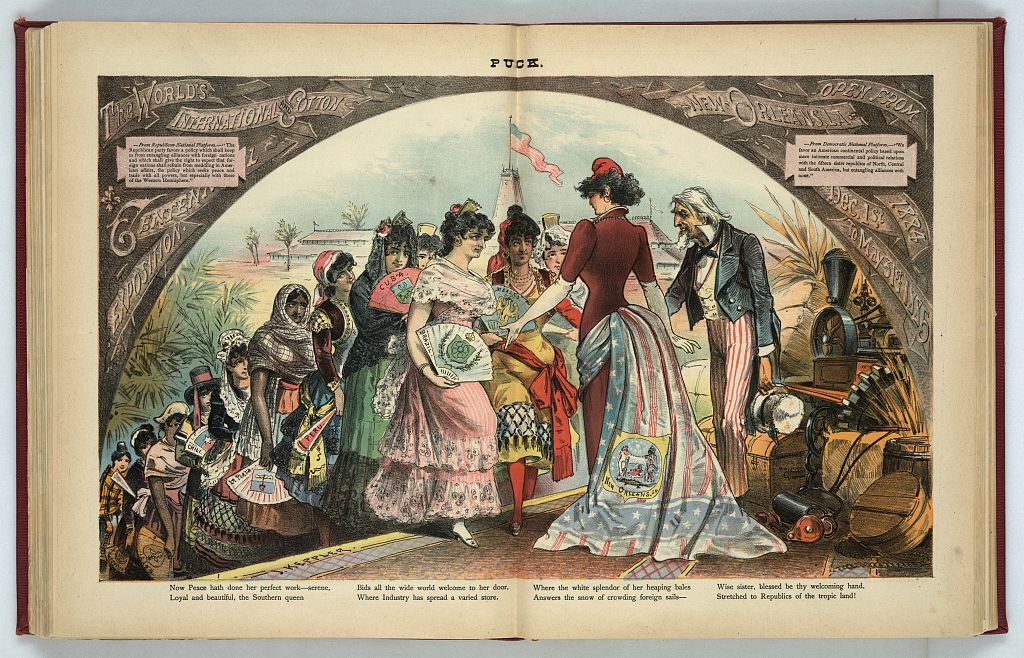
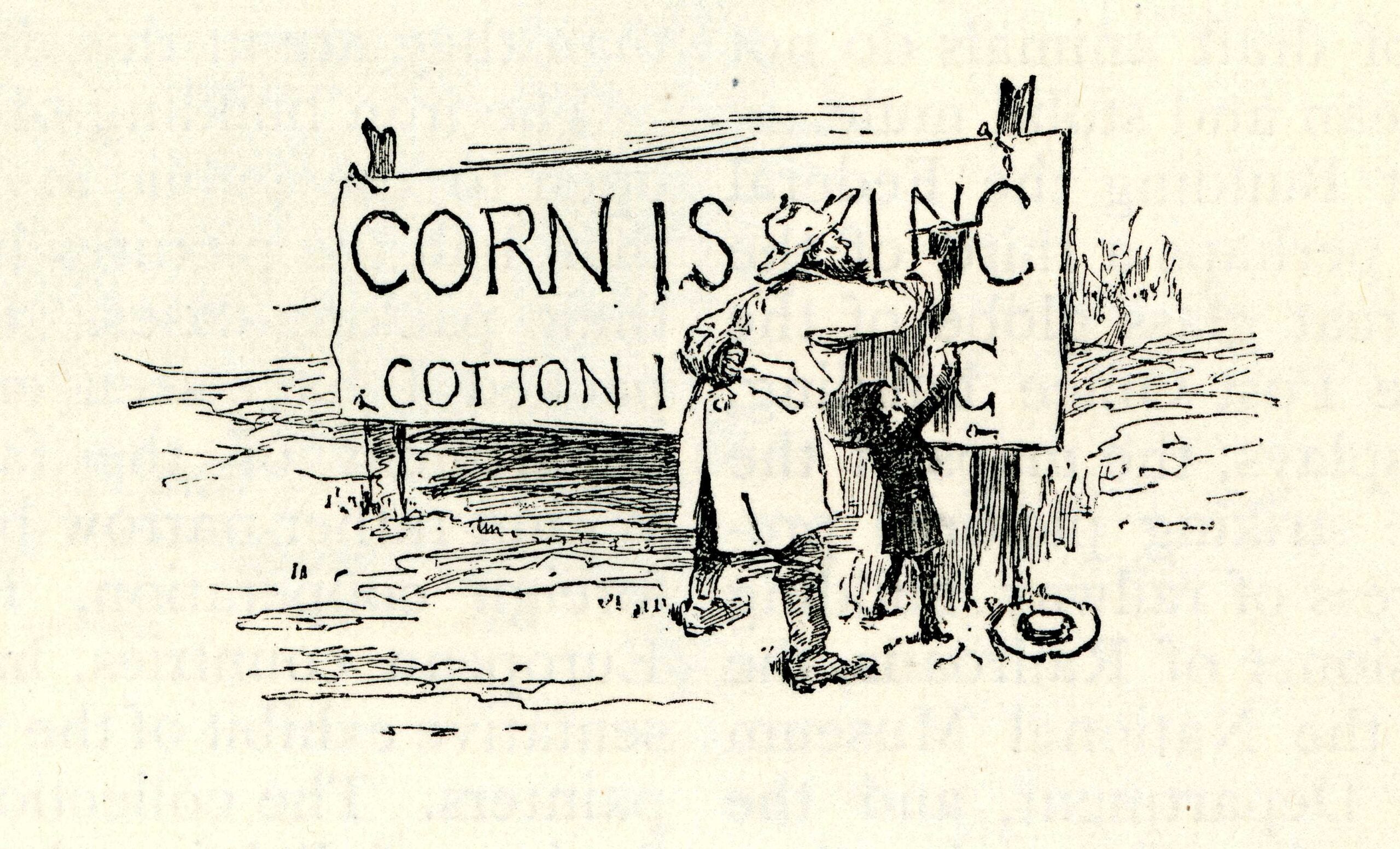
The exposition was held in the name of cotton, but the products presented by American states were not limited to cotton. In May 1885, artist Edward Windsor Kemble published an illustration titled “Corn is King, Cotton is King” for the exposition in The Century Magazine. This image suggested that the supremacy of King Cotton was being challenged by corn in many Southern and Western states. While Cotton remained the agricultural foundation of the American South, the loss of slave labor significantly shifted the economics of this labor intensive crop. Conversely, machinery, railroads, and industrial development provided new opportunities for Southern cotton to reach wider markets.
The Cotton Centennial Exposition had multiple meanings for the city of New Orleans and the state of Louisiana. First, the event heavily emphasized cotton production, industry, and the economic development of the American South. Second, it was the first international gathering of goods and products in New Orleans’s history, and also the first international exposition held in the American South.
American Southerners placed high expectations on this event. The Cotton Centennial Exposition differed from the Philadelphia Centennial Exposition of 1876. The Philadelphia fair presented the nation through a broad story of independence, industry, and progress. The fair in New Orleans borrowed the same language of progress, prosperity, and national pride, but it interpreted the nation through a Southern and post-Reconstruction lens. The Cotton Centennial was not simply a replication of the Centennial Exposition in Philadelphia. Southerners and the state of Louisiana wanted to show the nation from New Orleans, a city closely tied to cotton, river commerce, maritime trade, and commercial connections across the American South and Latin America. They hoped the exposition could draw global attention to the U.S. Southern states and show that the South still had value and mattered after the Reconstruction era. In this sense, the exposition was a public display of New Orleans’s ambition to represent both the South’s memory of cotton and the imagined future of the New South.
Bird’s-Eye View of Government and State Exhibits from Main Building, 1884-85. Historic New Orleans Collection. Original image created by The Centennial Photograph Company. 1982.127.19.
以紀念百年棉業爲題的“世博會”
The Cotton Centennial as a “World’s Fair”
Foreign participants enriched the diversity of the Cotton Centennial Exposition. Twenty-one foreign countries and their colonial possessions contributed exhibition spaces to the fair. Due to New Orleans’s position as an international port, Mexico and Latin American countries played an especially significant role. Mexico, for example, occupied the largest foreign exhibition area in the Main Building and carefully classified its wide range of national products. Most foreign contributions combined commercial and educational goals. They showed U.S. audiences what their countries were producing, while also trying to convince investors what could be accomplished with additional investment.
Three Asian countries, China, Japan, and Siam (the former name of Thailand until 1939) held spaces in the Main Building, where they shared the same exhibition privileges as other participating powers, including European colonizers and their protectorates. For these Asian participants, the exhibition offered a valuable opportunity to present their products, cultures, and achievements to an international audience. China’s exhibition was shaped not only by the foreign commissioners of the Chinese Maritime Customs Service (CMCS), but also by Chinese participants themselves. Figures such as Teh Ah-Kew, also known as Zheng Anqiu, and Wang Chunli played important roles in organizing and arranging the Chinese objects on display. Their contributions helped shape how China was represented to visitors, offering a glimpse into the lives, skills, and cultural traditions of its people.

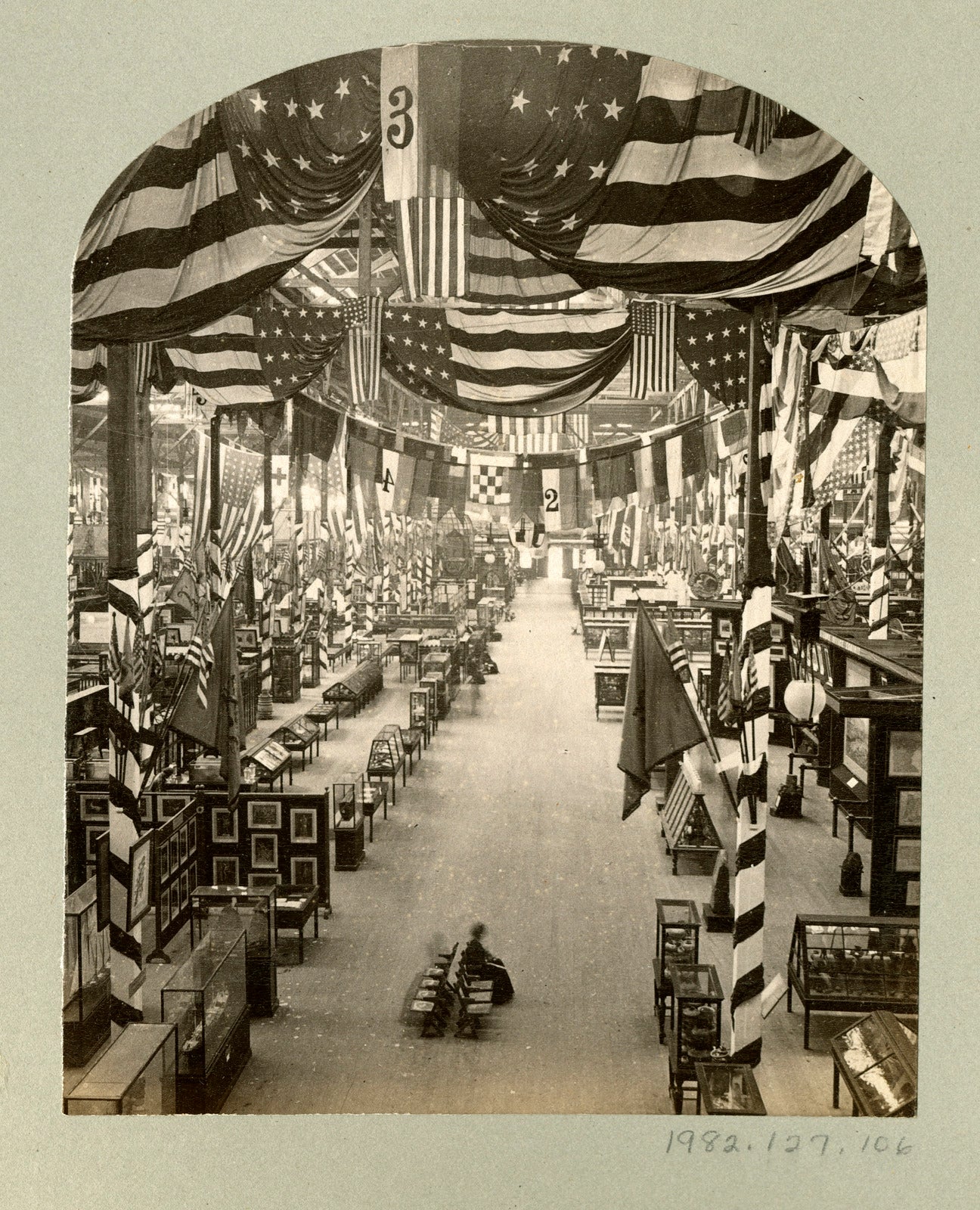
Participants came to the Cotton Centennial Exposition with a range of ambitions and agendas. For American Southerners and the state of Louisiana, the fair was a chance to project a renewed image of the postwar South to national and international visitors. For many Latin American countries, New Orleans offered an important gateway for attracting foreign investment and strengthening commercial ties. China’s participation, however, responded more directly to the exposition’s title and invitation, due to its own economic history with cotton. The Chinese displays featured products that could be broadly grouped into cotton textiles, ceramics, bamboo goods, and items of national representation, such as banners and flags. Together, these objects highlighted recognizable features of Chinese culture and industry, while also revealing how commissioners of the Chinese Maritime Customs Service shaped China’s overseas image for the exposition’s international audience.