

Yueling Li and Christiane Gruber
Synopsis:
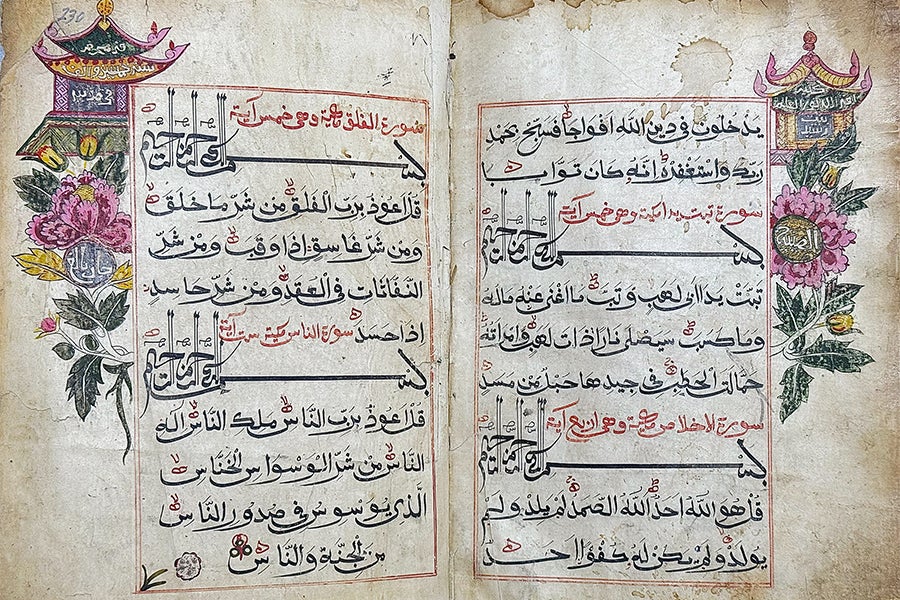
In this short talk, we present a beautiful Chinese Qur’an held in the Dar al-Athar al-Islamiyyah in Kuwait, which was written by a female calligrapher in Beijing in 1050 AH / 1640 CE. We focus on the manuscript’s richly illuminated ornaments and its colophon in particular to show how this manuscript provides us with important clues about devotional practice and Qur’anic production in a premodern Sino-Muslim setting, itself a religious and cultural arena that was elastic enough to incorporate a range of traditional Chinese motifs—including hipped pavilions, peonies, and lotus flowers—within the decorative program of Qur’ans.
Worksheet:
A worksheet for this video is available here.
Also visit the Khamseen Worksheets page here.
Selected References:
Chiem, Kristen. “Painting, Peonies, and Ming Loyalism in Qing-Dynasty China, 1644–1795.” Archives of Asian Art 67, no. 1 (2017): 83–109. 
Curtis, Emily Byrne. Chinese-Islamic Works of Art, 1644-1912: A Study of Some Qing Dynasty Examples. London: Routledge, 2020.
Fraser, Marcus. “Beyond the Taklamakan: The Origins and Stylistic Development of Qur’an Manuscripts in China.” In Fruit of Knowledge, Wheel of Learning: Essays in Honour of Robert Hillenbrand, edited by Melanie Gibson, 180–199. London: Gingko, 2021.
Jaschok, Maria and Shui Jingjun. The History of Women’s Mosques in Chinese Islam: A Mosque of Their Own. London: Routledge, 2000.
Kadoi, Yuka. Islamic Chinoiserie: The Art of Mongol Iran. Edinburgh: Edinburgh University Press, 2009.
Stanley, Tim. “China. Qur’ans of the Ming Period.” In The Decorated Word: Qur’ans of the 17th to 19th centuries, edited by Manijeh Bayani, Anna Contadini, and Tim Stanley, 12–21. London and New York: Nour Foundation in association with Azimuth Editions and Oxford University Press, 1999.
Citation:
Yueling Li and Christiane Gruber, “A Woman’s Calligraphic Touch: A Sini Qur’an made in Beijing in 1050 AH / 1640 CE,” Khamseen: Islamic Art History Online, published 11 November 2025.
Yueling Li is a doctoral student in the History of Art Department at the University of Michigan. She studies the material and artistic dialogues between China and the Islamic world in the early modern period. Her research interests include the production and circulation of ceramics, traditions and developments of Sino-Islamic calligraphy and manuscripts, and the (trans)materiality of inscriptions. She has held research positions at the Dar al-Athar al-Islamiyyah and Tareq Rajab Museum in Kuwait as well as education positions at various institutions, including the Fine Arts Museums of San Francisco. At Khamseen, Yueling serves as Co-Coordinator of the Dunhuang Project, to which she also contributes scholarship and provides Chinese translation.
Christiane Gruber is Mehmet Ağa-Oğlu Collegiate Professor of Islamic Art History and Former Chair in the History of Art Department at the University of Michigan as well as Founding Director of Khamseen: Islamic Art History Online. Her scholarly work (available here) explores medieval to contemporary Islamic art, including figural representation, depictions of the Prophet Muhammad, manuscripts and book arts, architecture, and modern visual and material cultures. Her two most recent publications include The Praiseworthy One: The Prophet Muhammad in Islamic Texts and Images and The Image Debate: Figural Representation in Islam and Across the World, and her public-facing essays have appeared in Newsweek, The Conversation, New Lines, Jadaliyya, and Prospect Magazine, among others. Her current research projects include eco-Islamic art and architecture as well as the visual culture of the Nation of Islam.