
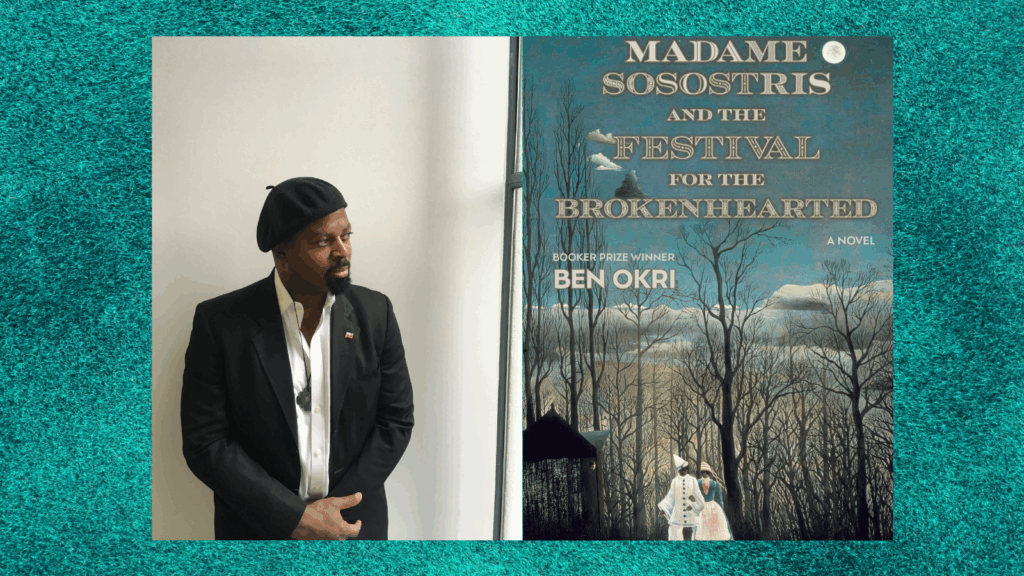
Ben Okri is a playwright, poet, novelist, essayist, short-story writer, anthologist, and aphorist. He has also written film scripts. His works have won numerous national and international prizes, including the Booker Prize for Fiction. His books include the eco-fable Every Leaf a Hallelujah, the play Changing Destiny, the genre-bending climate fiction Tiger Work, the poetry collections A Fire in My Head, Wild, Mental Fight, and An African Elegy, and the novels The Last Gift of the Master Artists, The Age of Magic, Dangerous Love, and Astonishing the Gods. In 2023 he received a knighthood for services to literature
Kaya Purchase (KP): The character of Madame Sosostris has a history of being reworked by great writers. There was Auden’s Sesostris, the Sorceress of Ecbatana, and then T.S. Eliot’s manifestation in ‘The Wasteland’. What was it about this character that so interested you?
Ben Okri (BO): First of all, she’s got a great name, right?
It was her prophetic role in ‘The Wasteland’ that really interested me. Eliot worked with the novelistic version and made this narrow column of prophecy and irony out of her. I needed a figure like that for the complicated story I was trying to tell about our broken-hearted times, times of war, of the failure of our politics, of the loss of all manner of institutions and rights. In my last book, Tiger Work, there’s a whole section of a long poem that is called ‘The Broken.’ I’m slightly haunted by this concept of brokenness. However, I didn’t want it to be an obviously political thing. I wanted it to be embedded in relationships, so that it doesn’t look like I’m talking about something bigger but of course, I am, because it’s an elusive text.
I also like the fact that Madame Sosostris works with the Tarot card. I’m interested in the Tarot, not for reasons of divination but because it holds stories and archetypes.
KP: Speaking of the novel for Publisher’s Weekly, you said, “The main challenge of the writing was a certain brevity and swiftness, […] a lightness of touch.” Why was brevity and lightness necessary for this particular novel?
BO: The deeper the things you talk about, the less you must seem to be doing so. This needed to be a deceptive text. I wanted something that you read and it feels like you’re just drinking water but then the water intoxicates you and you don’t know how, so you go back and reread it and it’s different. I love working on material like that but it’s very hard, because you have to have the courage to be simple, to be clear. That’s very rare. Everyone is trying to show off so badly, because we’re all nervous and insecure, but to speak clearly is the true challenge. The ego has no place in a good piece of writing. It’s the greatest enemy.
KP: So what was that process like for you? Did you start with a much longer, denser novel and then stripped it back?
BO: There were a lot of drafts! I’d be almost ashamed to admit how many. There were a lot of places where the language was, I felt, so beautiful and I had to disentangle it and take away all the knots and make it really plain. Undoing one’s own mind was the hardest thing.
KP: I appreciated the way you employed quintessential English stereotypes, such as whiskey, grandfather clocks, the Athenaeum, to paint a picture of your protagonists as privileged members of the establishment. It felt quite playful and I wondered whether you had fun writing this novel.
BO: Yes, it was a playful novel. My work’s always been playful. People just seem to take me too seriously. Really, I should say, they don’t take me seriously enough.
I wanted to use tropes that people were familiar with and then decentre them. The book was about pulling people away from their established earth and putting them on fluid ground. Nothing quite reveals us than when we’re on fluid ground. I had a couple of elements in my mind I was working with. One was definitely water, because of The Tempest and A Midsummer Night’s Dream. These are all fluid texts. Things are constantly blurring one into the other, people are not quite who they thought they were. I think that’s one of my favourite areas to work with: people who are compelled to reveal themselves.
KP: This novel felt like a gentle critique of the western world’s rigid concept of reality, specifically Western literature’s fixation on realism, which dates back to the Victorian era. The popularity of the realist form in the nineteenth century can be linked to the language and psychology of the Empire and European colonialism’s rejection of the spiritualism and mythologies of the colonised. Your work has always embraced the fluid and ambiguous and to me, Madame Sosostris represents this fluidity and ambiguity. Do you agree?
BO: Political power needs things to be fixed, because how do you know your wielding power if it cannot be quantified and measured? You want to measure the territory you are conquering, how much your powers encompass the world. Power needs fixity in order to do its work. My fiction is about undoing the very notion of that kind of power at all. That kind of power is actually an illusion, a bind, a trap. It’s a manhole, a sinkhole, a swamp. Take Madame Sosostris: do we know in the book who she really is? There are points where I refer to Madame Sosostris when it is clearly not Madame Sosostris, so the whole idea of the book itself is one big game of language, appearance and possession. It’s the idea of her that is so powerful. When you juxtapose that idea against political power, then you have something very interesting. You have myth versus power, imagination versus power and in the middle somewhere you have love.
KP: You’ve mentioned Shakespeare’s fluidity. Do you think Shakespeare is proof of a time when English literature wasn’t so fixed and grounded in the real?
BO: Shakespeare was in touch with the really old England. He was probably the last great writer in this country who had a soul in both places: Old England and Elizabethan England, which in itself was rich in ambiguity. The Elizabethans were much more comfortable with different kinds of mutability. The presence of magic was constantly at the back of the Elizabethan mind and perception of the world. Whoever Shakespeare was, he was in touch with much more than politics and history. I think of the presence of the fairies in A Midsummer Night’s Dream. They play a mirroring role to the forms of power, almost as if they exist as power’s shadow or counterpoint. There is a world above and a world below and each one uses a different kind of power. Shakespeare was interested in where these worlds come together and give rise to new kinds of stories. That’s the world I grew up in. I feel an affinity with Shakespeare, because I grew up with half my soul in the old African world and half in, well, you know what.
KP: I like the mirrored structure of Madame Sosostris and the Festival for the Broken-hearted, which is in homage to Shakespeare, but also feels appropriate because this is a novel about confronting the self. In The Famished Road you employ a circulatory structure which, like mirroring, is just a form of repetition. Why did mirroring feel like a wise choice for the structure of this novel?
BO: Mirroring and masking are incredible devices for revealing. We can’t begin to contemplate something until it is doubled in some way. All singularity of perception ends up destroying itself for lack of understanding or destroying others for the same reasons. Mirroring and masking and this circulatory narrative you talk about, they’re the secret techniques of storytelling. In the old tortoise stories that I grew up with, they go up to Heaven for a feast and the feast they have there is just a mirror of the feast they have on Earth. Stories take you to another plane and mirror things and suddenly we see everything clearly.
KP: The characters of Madame Sosostris and the Festival for the Broken-hearted have power and occupy influential roles in society: a politician, a journalist, a financial investor, Beatrice is the head of a board of various charities. But then they are each forced to confront truths about themselves and their personal lives. If you had the power to reveal to the influential people running this world an uncomfortable truth about themselves, what would it be?
BO: That it’s a complete illusion. They’re dealing with water. You hold water and what do you hold? It goes through your fingers. One day they will die, and another person will take their place. Reality will go on without them, unaffected. At the end of the day, their power really is powerlessness. Shakespeare and Tolstoy told us this. All the great writers saw this. Empires are just water, just air. They’re here, then they break down and they’re gone. It’s an illusion, a kind of madness really, a hallucination.
KP: That’s partly why climate change isn’t taken seriously because governments and corporations prioritise the present, rather than the future. That sustainable, circulatory way of engaging with things has been lost.
BO: Climate change is problematic to deal with in terms of writing about it in a way that is deeply convincing because it means fundamentally changing the way people see reality. Even if you could succeed in doing this, I’m not so sure you would want to right now, because that could give rise to a tremendous amount of instability. We have to be careful about how we alter people’s perceptions, because if you alter them too quickly, it can cause terror and panic and uncertainty. I think the poetic way of working with it is the right way, where you percolate slowly. Poetry works with your mind as your mind tries to grasp the complexity of things. It gives you vision that is clear but not so devastatingly clear that it shuts the mind down. Too much truth poisons the mind of people. That’s why you need all the various indirect forms.
KP: Is that your attitude to the relationship between literature and politics in general? Do you think literature is useful because it allows people to think about political issues without it being too much of an assault?
BO: If you actually achieve an assault on the mind, you smash someone’s relationship with their reality and they have nothing to cling onto. There’s no new reality to grasp. When I was younger I believed the opposite, I believed you had to get in there! But the world is not going to be overturned suddenly. The world needs to be transformed and transformations are rarely sudden. The appearance is sudden, but the reality is not. We’re human beings, we are not computers. You can reprogram a computer, not us. We’re complex and conflicted and I think we need to respect that complexity. That is what literature allows: complexity and ambiguity.
KP: I really admire how you refuse to conform to one niche. Your writing is multifaceted. You write essays, novels, poetry. I feel like in the past a multidisciplinary approach was encouraged but now, especially in the publishing world, people are expected to stay in one niche because it is seen as more marketable. Have you felt this pressure or have you always had the courage to write what your heart tells you?
BO: It depends what you want to be. There are some things the poem can’t do; only the essay can. There are some things the greatest novel can’t do; only the short story can. Sometimes you want to say something that’s like a song that goes straight into people’s hearts and opens up as a complex flower. It goes in simple but then explodes. A novel can’t do that, only a poem can. What are you going to do? Limit yourself to the stupidity of the age? People do not come in only one form. We are multifaceted beings. We are unfathomable. We need many things to speak to us and reveal to us. That’s why humanity dreamt so many things. Otherwise, we would have stopped at the novel. I don’t think one should listen too much to what is popular. Maybe listen a bit because you have to survive in the world but you have to follow your truth. The world is defined more by our will and our passion and our stubbornness than we are defined by it. Don’t treat what these publishers say like a mantra. Still be bloody-minded, please.
KP: You said people were quite surprised by Madame Sosostris. Why is that? What do you think people expected from you rather than this?
BO: Anything else. More Africa, more Famished Road, more obvious spirits. People very rarely see the thing itself, they see the form. People want to simplify their judgements. There’s nothing more annoying than you coming along and complicating the picture that they paint of you.
KP: You’ve said in the past that you have a different writing routine for every book that you write. When writing The Famished Road you would write in the middle of the night, about 1am or 3am. For some books you write standing up, for others lying down. What was your writing routine like for this novel?
BO: Oh, just long walks. This was a long walk novel. It helps me pull out the knots.
KP: Do you tend to plan your novels meticulously or see where they take you?
BO: I wonder whether you can’t plan loosely and then see where it takes you. It’s good to know where you’re going but then I do like working with the unknown. I prefer to discover, each day. We’re trained to limit uncertainty and to lean towards knowing, towards fixity. People are very uncomfortable with not knowing but how can you be an artist unless you work with the unknown?
KP: I love the artwork on the cover of the novel. What’s the story behind your choice to use that painting?
BO: I give them a painting with every book now because for over 30 years I have been suffering from a kind of cover prejudice. They presume that my books should have certain kinds of covers because of Africa and I’m sick of it. I’ve been fighting it for 30 years. So increasingly, I give them a cover concept: no masks, none of that stuff they associate with Africa.
KP: You describe yourself as an internationalist when it comes to fiction, which has been my approach for the past couple of years. I love world fiction and I love to methodically work my way through a certain country or continent at a time. If someone wanted to really dive into Nigerian fiction, which writers, other than yourself and Achebe, would you recommend they start with?
BO: Read Soyinka’s early plays: The Swamp-dwellers, The Trials of Brother Jero. Anybody can do a 400 page book but to do a good short 130 page book is very hard.
KP: And some of your favourite books in general?
BO: Micheal Kolhaas by Heinrich von Kleist. Pedro Paramo by Juan Rulfo. 121 pages! It’s just a work of genius. I discovered it really late, thank God! Also, Truman Capote’s Other Rooms, Other Voices. It was his first novel. He wrote it when he was about 24. He didn’t write better than that when he was 60.
KP: Before you go, I just wanted to go slightly off topic and ask you about one of my favourite female characters, Madame Koto of The Famished Road. Every time I’ve read the novel, I’ve been really taken by her power, her strength and her moral ambiguity. You never quite know who she is and yet she also appears to be the centre of the whole novel. She definitely contains multitudes. How did you form her as a character?
BO: Thank you. I like her too. She’s more than a handful. She’s uncontainable. She was a complete ambush. She just muscled her way in and took over. I didn’t have a plan for her. They’re the best. The things we plan, they’re good sometimes, but nothing beats what takes you over. That’s why when I work I like to leave myself open. Always leave a space to be surprised. Surrender requires strength.