
As a kid, I probably knew more about bull semen than the average adult. My dad started importing and exporting it in the 1990s to supplement the ever-plummeting business of being a small dairy farmer. The round, blunt tanks would arrive at the Grand Rapids Greyhound station, and my mom was tasked with picking them up on her way to and from art school. She likes to recall how the workers snickered when she told them what was inside. While the boom lasted, my dad made a fair amount of money. Bull semen is just another part of dairy farming—like the constant odor of manure and the big doe-like cow eyes looking on as we grilled hamburgers.
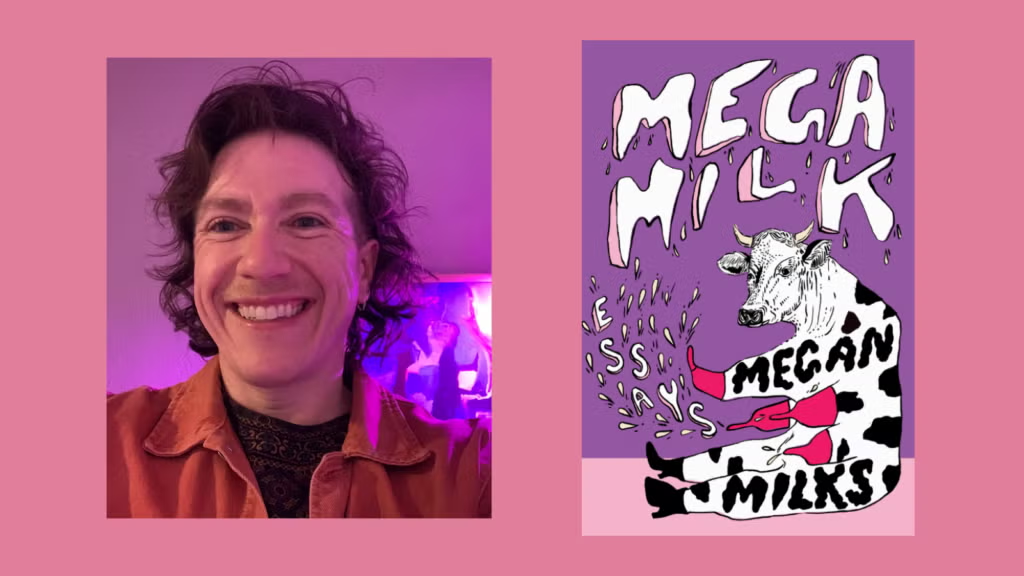
Megan Milks, the author of the recent essay collection Mega Milk, didn’t grow up on a dairy farm, but they do have a last name that sounds as if they did. “[Milks] has always been my last name, and so I have always had a close and at times uncomfortable relationship with the substance and its associations,” they write in the first essay “No More Cows.” This essay serves as an introductory one, connecting questions of changing their name, first and last, with the impetus for the resulting collection.
“No More Cows” also sets the collection’s scope and rhythms: researched facts—in this essay, about nuclear families and milk consumption—layered with personal anecdotes. Milks writes about how their mom would fill their house with cow-related paraphernalia and about their relationship with their family, calling themself “the agent of queer disruption sullying my family’s wholesome vibes.” In addition to being the outsider of their family, Milks positions themself as an outsider to the dairy industry, which allows them to move through this subject with lightness and grace, curiosity and surprise, so that the resulting collection expands like frozen nitrogen when it hits the air, but with much more delight.
Milks finds several ways to gain experience: they visit an animal sanctuary in the Hudson Valley and attend the North American Manure Expo. They buy bull semen from Cattle Visions, settling on a sire named King George, and have it shipped to their apartment in Brooklyn. “Milking the Bull” starts with the semen’s arrival and a conversation with their then-partner B about what to do with it. “You should take more risk,” B says when Milks suggests eating it for breakfast mixed with milk. Together they plan a sex scene involving a third partner and the (nonviable) semen, but as time passes, they break up and the semen sits in Milks’s freezer.
For “Milking the Bull” to arrive at a satisfying end, the semen must come out of the freezer. In the meantime, Milks writes about Lonesome George the turtle who was the last of its kind. They write about definitions of “to milk,” how personal essays require milking the self, how “milking the bull” is slang for masturbation, and that Lonesome George was masturbated without luck. They write about the lives of sires like King George and how their hooves never touch pasture. And then, in an attempt to “absorb [King George’s] life,” Milks inseminates themself with the semen. What results is a fictional meditation from the perspectives of the two Georges within Milks: the bull and the turtle. By going through with the scene on their own, Milks becomes less lonesome. They cross borders and practice a kind of radical interspecies empathy. As a piece of writing, “Milking the Bull” does what all the long essays in this collection do so well, a magic trick of pulling together various and seemingly unconnected lines of thought to illuminate something new about ourselves and our condition, which in this case is about what we can and cannot share with animals. Milks pushes the capaciousness of the essay like they push the intersections between their life and the writing.
The large and multifaceted vision at play in Mega Milk highlights how much meaning and understanding is lost when anything is confined to a narrow perspective. In “MAGA Milk,” Milks starts by examining their estrangement from their brother: “Maybe he’s MAGA and the predictable kind of Fox News zealot. Maybe he jokes that LA’s ’71 genders’ are at fault for the wildfires razing the region.” In addition to political “dis-ease,” they share a few experiences that have perhaps enhanced the siblings’ distance. They leave this question open.
From here, Milks investigates the whiteness of milk, both its literal color and how lactose persistence (“the ability to break down lactose in the body into adulthood”) is mostly a trait of white people. Despite this physical barrier in a large percentage of the population, milk is served as the only beverage in free school lunches and touted on TV as “do[ing] a body good” (even more recently with Aubrey Plaza’s commercials). They write about wet nurses, who could afford them and then the transition to feeding babies cow milk and how much of that milk was contaminated. Then again, near the end, they return to their previous question of estrangement. White supremacist ideology is also lurking behind the rift between Milks and their brother. “Right-wing cultural and religious authorities” believe “trans people curdle the milk,” bring a level of contamination to this nation. They end on an experience in a small town and the gut-dropping fear of being followed.
To be trans and nonbinary in 2026 is to be constantly assailed with the violence of narrow ideologies. And considering these conditions, Milks in Mega Milk is exceedingly generous. Not only do they genuinely engage with the prismatic sides of their topics, making sure to represent various points of view, but they also have given the dairy industry a badly needed “queer disruption,” a critical and rigorous shake up and perspective that is often lacking. Small farms like my family’s are always closing, a “squeeze” as Milks puts it, another kind of narrowing. Milks writes, “Noob that I am, I grieve the death of smaller dairies […] But then I think about the role of the farm—and livestock—in the invention and acquisition of private property in the US.” I, unlike Milks, do believe family farms are worth maintaining, if you’re lucky enough to have the land and the energy, not least to keep food production away from greedy corporations, but also because I am biased and entrenched in this way of life. There’s plenty in agriculture that we can do without, but there’s also plenty that we cannot or do not want to forgo (cheese, yogurt, and ice cream are my favorite dairies). Solutions are not obvious. Yet I do think Milks offers a way forward that this industry (and so many others!) would do well to imitate, to keep openness, generosity and critical inquiry at the ready.
Amber Ruth Paulen is a writer, an educator and a copyeditor who lives on her family’s dairy farm in rural Michigan. After years of living in and traveling through other continents and states, she is learning how to nurture a plot of soil to grow flowers and food. Paulen graduated with an MFA in fiction from Columbia University in NYC and is writing a multi-generational novel about the struggles to keep one family farm running and the costs of inheritance. Paulen’s writing has been published around the internet and in print and was nominated for a Pushcart Prize. I teach writing and copyedit for the UN.
Megan Milks (they/them) is the author of Margaret and the Mystery of the Missing Body, Slug and Other Stories, and Mega Milk: Essays, all published by Feminist Press. Their personal history of early online music fandom, Tori Amos Bootleg Webring, was published as part of Instar Books’ Remember the Internet series. They are also the co-editor, with Marisa Crawford, of We Are the Baby-Sitters Club: Essays and Artwork from Grown-Up Readers. They have written book reviews for 4Columns, The New York Times, and Bookforum, among other publications.