
When the rain arrives, it does so the way a forgotten feeling returns; it was quiet at first, barely audible. The light dims a few degrees, the air thickens, and then the first drop hits the windowpane with the soft authority of something older than language. In Portland, the season doesn’t truly shift until this moment. Calendars are one thing; rain is another. Rain carries its own kind of certainty, a punctuality that doesn’t require our permission. I’ve always thought there was something slightly vintage about the first rain of the year, as if it had traveled a long way to reach us and picked up a faint sepia tint along the journey. The city seems to remember itself under that patina. Cedar darkens, moss brightens, and sidewalks release an earthly scent that feels borrowed from decades before I was born. When the rain arrives, I feel as though the present loosens, letting the past seep in through whatever cracks it finds.
Rain, for me, is an archivist with its own opinions. It summons what it chooses, not necessarily what I expect. A single gust of wet air can unzip a decade. A certain slant of light on the water pooling at the curb can return me to a childhood kitchen, my boots dripping onto linoleum, my mom laughing at the mess. These memories come back whole, almost overconfident, as if rain has kept them carefully sealed and simply waited for the right moment to deliver them. Yet not all memories are so well preserved. Some dissolve even as they surface. Rain retrieves those too, though it seems less certain about where they belong. They feel like fragments of rams or stories someone once told me, but not quite mine. I’ve come to accept that memory, especially in this landscape, operates on a weather system of its own.
Here in the Pacific Northwest, rain is less an event than a language. It is our seasonal metronome. But the rhythm is changing. Storms arrive out of sequence. Rains pause when they should persist, or fall in sudden torrential sheets that feel unfamiliar, almost embarrassed to be here. When the weather misremembers itself, I wonder what that means for us—those of us who anchor our sense of self to the patterns we were raised to trust. If rain is a keeper of memory, then a changing climate is a kind of amnesia. Maybe that’s why I listen so closely now when the rain begins. I’m trying to hear what it still remembers. If rain is the archivist, then fog is the unreliable narrator—the one who tells the story slant, who leaves out names, who gestures vaguely at the truth but never quite confirms it. River fog especially. The kind that rises off the Willamette in early morning and slips between the bridges like something living, something undecided.
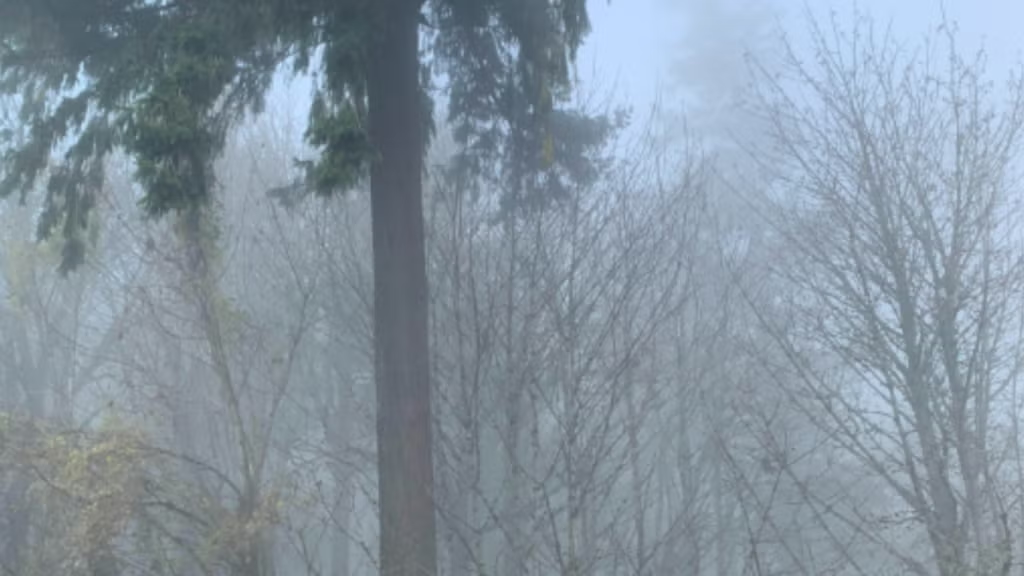
There is a particular hour—just before the city wakes—when the river fog is thick enough to suggest that the world has misplaced its edges. Buildings soften, water blends into the sky, and shapes move without announcing themselves. You could walk along the east bank path during that hour and almost believe you are crossing into a memory you haven’t yet had. Fog doesn’t obscure the world so much as it rearranges it, placing things where they don’t quite belong. I’ve always been drawn to that kind of distortion, maybe because my own recollections often come to me in the same softened outlines. There are memories I trust, anchored firmly by detail—rain-soaked sidewalks, the sound of a turning key, the blue enamel pot my grandmother used for everything. But there are others that drift in like fog. Moments I feel certain happened, but only in the way I’m certain a dream belonged to me when I first woke. A gesture someone made, but I can no longer place the room. A conversation that feels true, but the voice shifts each time I try to replay it.
The mind tries to make sense of the blurred edges. It assigns meaning where none may exist, or misremembers meaning where it once mattered deeply. In fog, the familiar becomes unfamiliar; in memory, the once clear becomes suspect. Both demand a kind of humility. Both remind me that certainty is a luxury, and perhaps an illusion. Sometimes I think the river knows this better than we do. Fog forms when the warmer surface water meets cooler air—an argument between temperatures, a brief negotiation in which neither side fully wins. Memory forms in similar tension: between what happened and what we can bear to recall, between what we felt and what we’ve convinced ourselves we felt. Fog and memory both occupy the in-between space, that liminal threshold where truth becomes porous. On mornings when the river is hidden under that shifting gray veil, I feel a strange comfort. The world is allowed to be ambiguous. The story does not need to be linear. And perhaps the past is not fixed but capable of rearranging itself into something gentler, or more honest, or simply more survivable.
Snow in Portland is less a season than a rumor. It arrives rarely, and when it does, it behaves like someone unsure of their welcome—hesitating at the edge of the neighborhood, stepping lightly, ready to vanish if stared at too directly. I grew up thinking of snow as something other places received. Places with steady winters, predictable frost, the kind of cold that enters a landscape and claims it. Here, snow feels more like a visitor who appears once every few years to remind the city of a version of itself it barely remembers. Because of its rarity, the first snowfall never feels entirely real. It carries a charged uncertainty, like an old photograph developing in slow motion. I remember one such morning—the city still asleep, the streetlamps casting soft halos through a faint, drifting white. The flakes fell in cautious, intermittent intervals, as though testing the air. I watched from my window and felt the same sense I get with certain memories: a mixture of recognition and disbelief, the feeling that something ghostlike is brushing past the edges of the present.
Snow alters the world differently than rain or fog. Where rain excavates the past and fog unsettles it, snow covers everything at once—without judgment, without preference. It blankets rooftops, mailboxes, sidewalks, cars. Even sounds are muted, wrapped in a fragile hush that seems designed to protect whatever we’re not yet ready to face. The city becomes quieter, and in that quiet, the past feels both closer and more distant, as though someone has turned down the volume on my life just enough for me to hear whatever memory has been waiting underneath. But snow in Portland melts as quickly as it arrives. By midday, the white veil turns to slush, sidewalks reveal their familiar cracks, and the brief spell breaks. Its departure mirrors the way certain memories vanish the moment we reach for them. A faint impression remains—a sense of cold on the skin, a brightness on the ground that might have been there or might have been imagined. The details become questionable. Did the snow fall as heavily as I remember? Was the world really that quiet, that bright? Or has my mind added softness, smoothed the edges, filled in what time has since eroded?
Because it visits so rarely, the first snow holds a place in my memory disproportionate to its duration. It becomes symbolic by scarcity alone. A metaphor with its own intentions. A reminder that sometimes the things that touch our lives only briefly leave the most persistent echoes. Perhaps it’s the same with certain people, certain decisions, certain seasons that never quite settled but nevertheless reshaped the internal landscape. Snow, here, does not stay long enough to become a fact. It lingers just long enough to become a story.
When I think about memory, I rarely consider it as something individual. It feels more like a shared reservoir we dip into, shaped as much by place as by personal history. In the Pacific Northwest, weather is part of that inheritance. Rain, fog, the occasional snow—they form a kind of collective memory that stretches across generations, across cultural lines, across the invisible boundaries of neighborhoods and rivers. There are stories here that are retold so often they begin to sound like myth: the winter storms that brought down entire stretches of old-growth trees; the river floods that lifted houses off their foundations; the years when the rain seemed endless, unbroken for weeks, as if the sky had forgotten any other verb. Even people who weren’t alive during those events tend to recall them. They’re passed down the way families pass down heirlooms—carefully, reverently, with a hint of exaggeration that feels less like distortion and more like devotion.
And then there are the new memories we have been forced to form. The wildfire smoke that blanketed the city in a sepia haze, tinting the sun a bruised orange. The heat dome that pushed temperatures far beyond what our collective imagination believed possible here. The rains that arrive out of rhythm, or not at all. These experiences gather quickly, becoming shared reference points, shifting our regional sense of self. We recognize each other now not just by our rain jackets but by the stories we tell about the weather that betrayed us. Weather shapes our identities more subtly than we admit. It informs our emotional vocabulary, sets the pace of our days, influences how we walk, how we wait, how we hope. When the patterns we grew up with begin to change, something in us changes too. We feel a quiet disorientation, as if the narrator of our childhood has begun rewriting the plot in real time. What does it mean to grow up in a place defined by rain only to live in a version of that place where rain starts forgetting its own lines?
I sometimes think our memories—individual and collective—are braided together with the memory of the land itself. What the rivers recall, what the trees hold, what the air repeats each year. And when the environment shifts, the braid loosens. The stories slip. The rhythm falters. We are asked, suddenly, to imagine new ways of remembering ourselves. This, too, is part of the weather’s echo: not just what it recalls, but what it erases. Not just what we inherit, but what we lose.
Felix Lilly is a writer based in the Pacific Northwest. His work explores memory, place, and the quiet intersections between landscape and inner life. He has been published in several small literary magazines across the United States, and is particularly drawn to themes of weather, grief, and the ways environments shape personal and collective identity.