

Published in Issue 65.1: Winter 2026
You can purchase our Winter issue here.
Fear it, Ophelia. Fear it, my dear sister,
And keep you in the rear of your affection,
Out of the shot and danger of desire.
— Hamlet, 1.3.36-38
You should have known when she rolled up her sleeve to reveal a tattoo of Saint Francis that she would be a martyr.
*
In Catholic school, you learned there are three types of martyrs: red, green, and white.
The white martyr is someone who consecrated their life to God without having to endure bloodshed. It is most often attributed to those who devoted themselves to virginity.
*
White is the color of your mother’s kitchen cabinets and pulled daisy petals and frosting imperfectly smoothed over homemade birthday cakes.
*
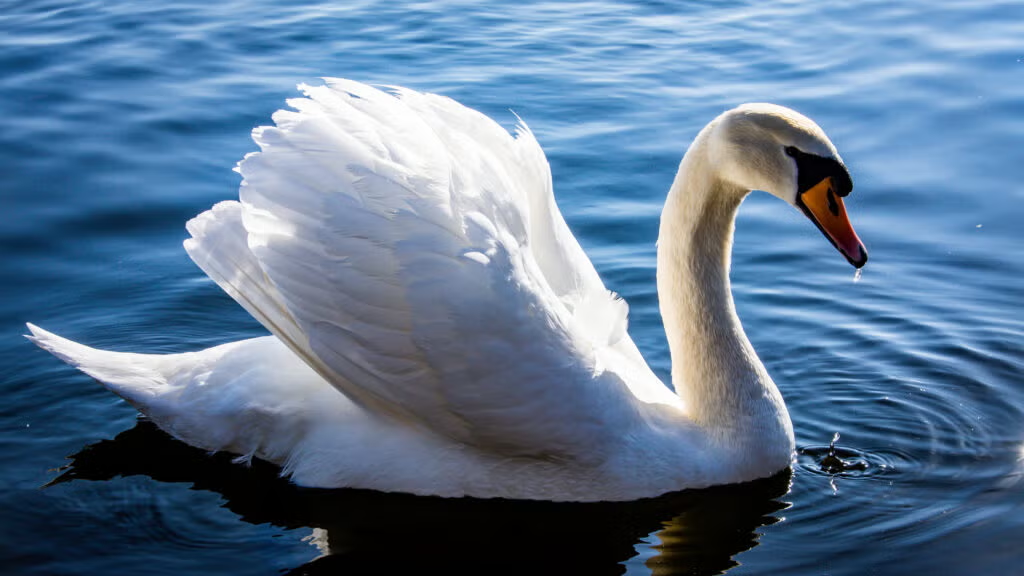
She thought herself a swan. When she first told you this, you mused how fitting it was that she had been a swimmer in high school. You had not witnessed it, but you liked to imagine her body gliding, her arms cutting through the water like a wing.
*
There is a swan constellation, Cygnus. You didn’t learn until after she broke up with you that it’s also known as the Northern Cross.
When the swan stretches its wings, it becomes something else.
*
Her mother gave her a purity ring with fear it inscribed on the inner rim. It wasn’t intended as a threat, just a joke shared between them. Still, you both lived for the fear of each other’s touch. To be vulnerable is to anticipate a wound.
*
In the bible, God forbade the Israelites to eat swan because it was impure.
*
When she was younger, she wished her mother had named her Ophelia. You always wondered if she had started swimming to rewrite the ending of Hamlet. But now you wonder if there was something inside herself she was looking to drown.
*
She told you the purity ring broke inside her high school swimming pool. You envisioned sinking light ricocheting off the halved pieces of silver as they fell to the floor.
*
St. Philomena was the daughter of a king who had converted to Christianity. At thirteen, she pledged her virginity to Christ. When an emperor fell madly in love with her beauty, she rejected him. She had no interest in breaking her vow. So, the emperor tortured her. First, he scourged her and ripped the skin covering her ribs. Then he shot her with arrows, piercing her flesh and blemishing her body with holes. After that, he drowned her. The angels undid all her wounds, every time.
Finally, the emperor decapitated her–the one thing that couldn’t be undone.
*
You never learned to swim. You never needed to—you’ve always belonged to the ground.
She promised to teach you. She wanted to give you oceans, to swim to the center of the earth and hold you inside it.
You never learned to swim.
*
The morning after you first had sex, she told you she was lucky. She was happy it was you that “deflowered” her. She fixed you an egg in a basket. The egg was oversalted, but you only said that she wasn’t as lucky as you.
*
White is the color of the spoiled milk that made you vomit and the maggots you found in a coffee mug you left sitting on your desk for months and the Easter lilies your mother took home from church and threw out the next day because she remembered they could kill the dog.
*
When she broke up with you, she forgave you for the first time you had sex, and you said thank you. But you didn’t understand why you needed forgiveness and she got thanks. You remembered that night. You remembered her on top of you. Her asking you. And yes.
But she told you that you had done the one thing that couldn’t be undone.
*
In your undergrad, you drank a bottle of $5 wine and passed out on the floor of your friend’s house. When you woke up, you were being held tightly by a boy you didn’t like very much but felt sorry for because you knew he was in love with you. This left a ghost in you. All you know is that you woke up being held, arms wrapped too tightly around your ribs. You don’t know what happened before—if he touched you, what he touched. When he woke up, he didn’t look at you. But he looked guilty. You remember feeling uneasy in your body as you walked to his car and up the stairs to your dorm room. When you showered, you inspected your body for marks–some sort of clue–only to find nothing. Maybe you should have felt relieved, but it only added to the uncertainty. Your body had become an incomplete archive that couldn’t give you an answer.
*
After the breakup, you were sick. You racked your memory of the night you first had sex, searching for a wrong, but only found images of her hand on your thigh, an echo of her giggle, the impression left on your waist from the arm she tucked around you as she fell asleep. You remember a warmth in your stomach, not a flutter or twinge, but a firmness like an animal curled and resting on your belly. It was a feeling you were certain was love.
*
In school, you were taught that Ophelia drowned herself because she was driven mad by her love for Hamlet. But she told you it wasn’t that at all. She was pregnant, she said. She didn’t fear it enough.
*
For a long time after, the thought of sex made you nauseous. When you fucked yourself, you sobbed. Always, your thoughts came back to her. Her hands strumming your upper thigh, her mouth teasing on your lower abdomen. But she told you these things that you had remembered as love, she now categorized as transgression. And what did it mean that these were the memories that returned to you when your fingers were lost under the same floral sheets she had touched you on? How could that make you anything other than sick?
For a while, you believed you would never have sex again—you shouldn’t. You feared it.
*
You started seeing a therapist after the breakup. You told him you were a monster, no different from the boy in your undergrad. If she said I did these things, then I must have done them. Your therapist told you that this wasn’t true. Think about it like this, he said. If you had done those things, it would be so out of character for you, so strange. It would be as if you’d seen a lion in Stillwater. You would remember, you would know.
He was right. You hadn’t seen a lion that night. Only a swan.
*
In 2012, a swan was blamed for a man’s drowning at a park in Illinois. The swan knocked the man from his kayak and attacked him until he drowned. His family said he likely died because he didn’t want to harm the swan.
You think he must have loved the swan.
*
You asked your therapist why she would say those things to you, why forgive you for something you never did. Sometimes forgiveness is just a way for someone to avoid accepting responsibility. Just because she forgave you, it doesn’t mean you needed to be.
You can speculate, but you’ll never really know why she pushed you underwater. You think that she saw you as a manifestation of sin, that it might have been easier to drown you than to see you. Or perhaps, to be seen by you. She was ashamed, you think, that she didn’t fear it enough.
*
A year later, you find yourself in a lake. You still can’t swim, but you don’t fear drowning. There is only you and your friends and the red dirt you push your toes into. One of your friends rubs this dirt into her chest and pronounces it has healing qualities. You smear the red muck all over your body. When you go farther out, your friends hold onto your arms. They know you can’t swim. When you float on your back, their fingertips graze the back of your ribs.
You don’t sink.
On Writing the Piece:
I started writing this piece because I had an ex-girlfriend who called herself a swan. For years, I just kept putting little facts about swans in my pocket and started seeing connections between water, religion, and swans. I also like the idea of complicating this beautiful, feminine, fairytale creature into something capable of harm as a means of showing that abusers aren’t always the people you expect. And of course then Hamlet found its way in there, as Hamlet always does.
SOPHIE EZZELL is a queer Urban Appalachian writer who holds an MFA from Oklahoma State University and is pursuing a phd in Creative Writing at the University of Mississippi. Her nonfiction has appeared in The Sun, River Teeth, Black Warrior Review, The Pinch, New Orleans Review, and others.