
“Can I?” Ansar asked in Arabic.
“You can,” our youngest aunt told her.
Ansar crawled on all fours with her back extended like the hump of the camel she chose. The three steps pushed her past her sister and within my arm’s reach. I contemplated what animals I haven’t yet chosen. Maybe two elephant stomps? Or will three frog leaps carry me to victory?
Angry shouts erupted over the announcer’s elongated “goaaaal” from my uncle’s room above us.
We ran, transforming back to our human selves to investigate. The room had been silent during the soccer match, and our whispering had gotten us kicked out before halftime.
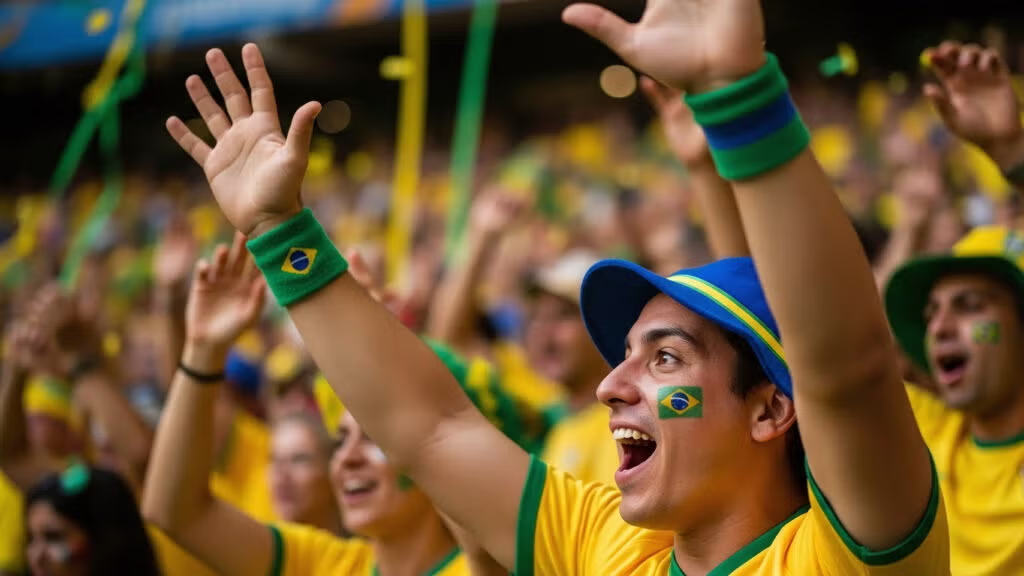
“If Brazil doesn’t score, they’re out,” my uncle said to his eldest sister, two brothers, and three brother in laws crouched around the TV.
The yellow and green jersey my aunt’s husband wore had a tear under the armpit and didn’t have a name or number on the back like the jerseys of the fans on TV. He squeezed his son’s shoulders as Ala stood under him looking from the screen to his face. Ala didn’t come out to play with us because he played soccer and the grownups treated him like he was a lot older than seven.
A few months prior, his four-year-old brother wrestled me and my brother to the ground when he first met us. I had said I preferred Real Madrid over Barcelona and the child that barely made it to my hip had me on the floor begging for mercy as he shouted that Messi was the greatest ever. My brother, who was also four, immediately pledged his allegiance to Barcelona, not knowing or caring who to support, but I had laughed and taunted the little one for the rest of my visit.
Brazil lost that night, ending the defending champions chance at another World Cup win. The final match split the household into two, some rooting for France because of the Algerian Muslim star playing, and some rooting for Italy to spite France for defeating Brazil.
Four years later, we once again filled my grandparent’s home to watch the finals, but this time we were downstairs in my eldest uncle’s room. Khalo Mohammad’s room became the hangout spot that summer. Because of Khalo’s year-long absence, it was empty. But he was finally back home now.
I watched as the camera zoomed in on Nelson Mandela seated in the stadium, and listened to the Arab announcer praise the leader. I was too young to understand who he was and why the adults in the room echoed the praise, but a decade later I would pose next to his statue in downtown Ramallah for the camera with a smile on my face.
That day, it felt like the stadium extended from the screen to the room when Spain’s Andres Iniesta scored the winning goal. Had we been playing our childhood game, we would’ve made such great lions with the roars that escaped us. We ran up two floors, chasing our uncles and aunts who let out zaghrootas in the middle of the night. My grandparents, who usually would shush us, didn’t stir. They were softer when their eldest son was around.
The home buzzed with excitement and celebration that summer night as it did in the winter, when Khalo was released from prison. He walked into his home and was met with his siblings and parents cheering, hugging and releasing zaghrootas late into the night. My dad, who struggled to take time off to visit Palestine with us, had flown in to surprise us and join in on welcoming him home. We had stayed up all night to catch up on lost time since no one was allowed to visit him while in captivity.
Spain’s win led us to extend our celebration under the night sky on the open rooftop, where we found two other neighbors out on their roofs with their TVs, hookah, and stools. My uncles yelled over in excitement. Khalo Mohammad wasn’t yelling like his younger brothers, but he clapped along with us and smiled. His hair was almost back to its usual length, and he looked less thin.
I don’t know how long we spent sitting on the roof. My brother, cousins and I were just happy we weren’t ordered to bed and had found some cards to play with as the adults talked and Khalo smoked. He didn’t use to smoke, and I hated the smell it left on him.
At 26, the smell of cigarettes or the image of red Marlboro packs still sours my mood. The very thing that’s meant to relieve others’ stress, induces my own as soon as it invades my nostrils. Not for health reasons, but because it reminds me of the defeated look I see in the faces of the men in my life, and it pains me. I grew up avoiding my dad when he went outside to take a few drags. I knew my three maternal uncles before they ever picked up a cigarette and with every visit, I saw them transition into men who no longer doused themselves in cologne to cover the smell once they got home.
I understand what a nicotine addiction is, but I also know that it’s more than an addiction for some people. For Khalo Mohammad, the cigarette snuffed out a certain future he had envisioned for himself. It stamped another routine into his life that was similar to that of his neighbors, friends, and younger brothers.
I remember teasing him as a child because he would spend so much time in front of the mirror applying different products into his thick wavy hair. He’d spray so much cologne over his ironed kamees, wear his flashiest watch and then wink at me, whispering that he’s meeting with a possible fiancée. There was a consensus back then, among my six cousins, my brother and I that Khalo Mohammad was the favorite of our uncles because of how playful he was with us, all the snacks he would buy us and the fun trips he’d take us on. Our newer and younger cousins only knew him as the serious and overworked uncle after the day he came home bald and in sweats.
Summer was always soccer season in Palestine. Or maybe it just happened to be so because every overseas visit we were able to make coincided with a World Cup year. After Spain’s win in 2010, we spent almost every minute outside on the hills, running across fields with or without a ball.
Ala would take us to an abandoned field hidden somewhere up a hill behind Ansar’s house. One time we found boar bones on the way, and were told to run if we heard any snorts. Wild boars are not native to the land, and have destroyed so much of my aunt’s crops and some of the fencing around her family’s farms. We poked their bones with a stick and our faces squished in disgust.
Ala would sometimes bring his neighbors to join us for soccer, partly because none of us were any good and partly because he wanted a few more boys. He took his practice seriously and would show us his newest moves and plays.
Before our visits, my mom always packed suitcases full of gifts to pass around, including athletic shoes for her nephews. Not the off brand Abibas that littered the “sport” stores in downtown Ramallah, no, she would pack some good quality shiny branded Nikes and Adidas from the United States that were packed in their boxes, even though it took up more space in the luggage. Those shoes were worn out after years of strictly only wearing them on soccer fields and putting them back in their collapsing boxes.
Eventually, the shoes were passed down to younger siblings and other cousins, like a treasured family heirloom.
Ala’s dad, the one with the tattered Brazil jersey, would teach at the boy’s school his sons attended, and would coach their soccer team after classes. He also ran a soccer league for the men in his town—mainly his brothers and cousins—and the two nearby villages to play on a weekly basis. I learned about the most talented players from him. Newer players like Kaká who I cheered for on the screen when he played for Real Madrid that year, but also the older legends Brazil is known for like Pelé and Ronaldo.
Translated to “ball of the foot” in Arabic, the sport showcased hope to so many children like Ala. They saw players rise to the global stage and make a name for themselves and their countries after playing in the poorest of conditions and most limited resources. The school Ala’s dad coached at was in the village, far from any major city and was not able to compete against other schools. Their matches were more like a scrimmage consisting of the same kids who practiced together. The goal was to improve in order to play elsewhere one day.
Sometime around 2014, we were told Ala and his dad were able to travel to France for a weeklong summer soccer camp and shortly after, Ala’s relative from his father’s side, signed on to play for a youth club team in Belgium. The photos and “mabrook” texts flooded the Whatsapp family chat, and we hopped on Skype calls to hear more from my aunt. This was the first time Ala left the West Bank and the first time he boarded a plane. The possibilities seemed endless. Especially since that spring, the Palestine national football team won their first title at the 2014 AFC Challenge Cup, and qualified to play in the 2015 Asian Cup. The hope for the sport to open more opportunities and for it to take Ala, and the Palestinian people, somewhere better than where they were in the moment was high.
I don’t remember much from the 2014 World Cup that also took place that summer, aside from the fact that it had been four years since I was last in Palestine, and that we were watching it in our quiet living room in Michigan, away from our cousins and uncles. Just a few months prior, we watched the Super Bowl and talked about what teams we were rooting for at school. There were flyers circulating at the mosques and restaurants of watch parties to gather the youth. But in the summer, we were at home paying for a service to stream the matches in the early mornings and middle of the day while friends and neighbors were out camping or at the pools.
A massive event was happening that touched every corner of the earth except the state, and probably country, we lived in. Like our use of Fahrenheit while my cousins used Celsius and our use of yards while the sports announcers counted meters during the matches, I felt like we lived in another world, cut off from everyone else. I think we tuned in to Al-Jazeera instead of the final match that year though, because just a few days before the final, Zionists invaded Gaza and massacred thousands in another round of aggression that lasted more than a month.
The feeling of living in a bubble untouched by what the rest of the world was paying attention to, only intensified as the years went on.
The yearning to be with family and walk streets and neighborhoods decorated with an array of colorful flags of countries was so strong that in 2018, I flew to Palestine with my younger brother. At that point it had been eight years since I last stepped foot into my grandparent’s house, and so we had to learn the names of Khalo Mohammad’s wife, their three kids, as well as all the other new cousins who popped up since. Ansar was teaching English at the elementary school and was married with a child, while Ala was studying sports management at Birzeit University.
Our great grandmother passed away in Jordan days after we landed and so our grandmother left to mourn her mother with her siblings across the border, leaving us with our uncles and aunts. I had missed the mornings where I’d wake up to gold bangles clinking as Sito spread the dough for a fresh batch of bread with sprinkles of olive oil and zaatar, and the soft boil of milk with sugar on the stove behind her. Instead, I would wake up to our blaring alarms, half an hour before Fajr prayer to begin our fast during that last week of Ramadan. My uncle’s wife would come down with her infant on her hip to invite us up to their apartment, that was not built last I was there, for suhoor together. Khalo Mohammad was quiet as he ate, only looking up to tell us to eat more and not to be shy. He would then quickly head out to work one of his many jobs, pausing to kiss his youngest daughter who refused to go back to sleep, and to lightly hug my brother and I on his way out.
I invited our cousins to watch the World Cup matches that had just started after the Eid celebrations, and had tried to track down my two single uncles. But the same people who had never missed a league or match where their favorite players were playing, were too busy working or studying to watch the tournament that used to take up all of their time. The matches were streamed in the middle of the day since we weren’t too far from Russia, where it was hosted, and so my brother and I spent that summer watching the matches with a different combination of younger cousins running around the living room. My youngest aunt popped in for a match or two, and sometimes I’d skip a match to venture out to Birzeit with her to sit in on her economics classes and visit her sisters in the city after.
That trip wasn’t at all how I hoped it would be.
Driving anywhere outside of the village took longer than it used to because of a new settlement that was constructed just a few hills over during my time away. The settlement was heavily walled, with new cemented roads and armed soldiers constantly surveilling, and sometimes stopping, the cars driving by. This was why my three uncles would leave after dawn to make it to work in the city. To Ramallah, it would take anywhere from half an hour to two hours depending on the soldiers and if they decided to have a checkpoint for the day; and to Nablus, one of my uncles would spend at least three to four hours in the car, sometimes sleeping the night there and heading back the day after. When they were home, we’d mainly see them at the dinner table or deep asleep in their beds.
As an adult, I held onto the childhood memories of running around the village and of the nights we’d spend playing pretend or soccer with my cousins. The same debates of whether Barcelona’s Messi or Madrid’s Ronaldo was the better player were still ongoing among the younger children. I’d smile as the Ronaldo fans would share a debunked rumor that Ronaldo donated to money to Gaza to strengthen their argument, while reporting how Messi had visited the Wailing Wall in Jerusalem and met with Israeli leaders—this one was true—and that was enough to tarnish his reputation among some of the children.
Ala was still studying and practicing soccer at this point in time, but he shifted his focus from a career as an athlete to instead possibly managing a team or working with one. Some semesters, he spent sitting at home because of closures due to a martyred classmate or two which delayed his education.
The childhood experiences surrounding soccer felt far and like a distant memory. Something about the sport still felt innate to me, even after seeing how it didn’t hold the same weight to those I loved anymore. Recognition at the global stage was what soccer achieved for Palestinians along with a hope for a better future. Players like Mesut Ozil, Karim Benzema, and so many more would be celebrated over the years for their posts standing in solidarity with Palestine every time another round of Israeli aggression took place. Soccer fans around the world would don Palestinian flags in the stands at matches that had no Palestinian players or representation to show their love. In Morocco, fans came up with a song dedicated to Palestine that would be specifically sung during their soccer matches. But in the end, the sport was a form of entertainment, and the reality was there were more important matters for even diehard fans like my uncles to attend to.
Back in Michigan, I tried to convince my younger brothers to join soccer during their time in middle and high school by reminding them of our summers back home, playing in the fields. I told them that they may have a better chance to play professionally than our cousins did in Palestine, but they chose American football.
I held a disdain for the sport, but I watched and cheered for my brothers from the bleachers. I hated the distance it created between my parents and my brothers, and between us and our relatives overseas. My parents tried to come to a few games, and it took them a while to understand that their eldest son’s biggest accomplishment on the team was a sack and that it was unlikely he would score a touchdown in his defensive position.
This past June, our family chats and my social media feeds were flooded with excitement over the Palestine national team’s chance at qualifying for their first ever World Cup. After mourning the magnitude of loss and destruction in Gaza for two years at the hands of Zionists and their state, the soccer team was a breath of relief and hope for some kind of victory. The momentary joy was extinguished once Oman scored a second goal, breaking the tie and disqualifying Palestine from their chance to play at the global stage.
I watched from my couch in California and sunk to the floor and again felt the flicker of hope soccer usually gave me fade away. The loss was still celebrated like a win, and the players were celebrated like champions. It wasn’t an easy feat to play and train while their family members were lost under the rubble, and former teammates were killed by Israel’s assaults. The national team had long been training and competing in other countries, far from their own, due to the obstacles put in place by the Israeli occupation across their homeland.
Through Instagram, I watched children and adults in Gaza crowd around a working TV surrounded by the sound of drones and ambulances, to cheer on the players. The possibilities of elevating their struggles to the global stage where the world would be forced to witness and maybe act. Just a few years ago, Palestinian flags filled Qatar’s stadiums during the 2022 World Cup, and even made it to the main field in the final matches thanks to Morocco’s players who displayed the flag in an act of support during their victories. Palestine was so deeply intertwined with soccer even when there were no Palestinian players. The chance to see the flag on the jerseys of the players this time felt so close. But after the loss, it was again only a dream to imagine a Palestinian team succeed to make it that far.
In September, I filled out applications to enter a chance to win 2026 World Cup tickets. I live just over an hour away from the San Francisco stadium that’s slated to host a few matches, and have been planning to budget in some money to attend at least one match. I know the exact Palestinian jersey I would wear and would pack a large Palestine flag to raise in the stands.
As I waited for FIFA to notify me of my ticket status, my mom flew in to visit with a suitcase full of gifts from her summer visit to Palestine. Among the handmade embroidered shoulder scarf and the ceramic “Jerusalem” magnets, she handed me a beige gym outfit that she bought from her sister. The leggings weren’t the best quality, and the matching short sleeve zip up top sat right above my hip. Gym clothes weren’t a typical gift from my mom, but her sister was receiving large clothing shipments to sell to the girls in the village and around town.
At 27, Ala was in China pursuing his master’s in sports management. He found some friends to play soccer with outside of school hours, and he had the idea to send the latest trendy gym outfits to help his parents with expenses. The school and hospital where they worked were unable to pay them regularly and had cut some of their paychecks due to checkpoint closures and further issues caused by living under occupation.
Ala had been unable to secure any job opportunities after he graduated from Birzeit. His younger brother, the one who wrestled me to the ground as kids, dropped out of high school years ago and has been working various construction jobs to help support his family while Ala contributes from overseas. Whether he decides to return home depends on an income, and whether he is able to still pursue his dream to play or work in soccer is yet to be determined. But with the way things have been heading, he has been focusing on what’s within reach.
In October, I got the notification from the FIFA website that I did not secure any tickets. That same week, FIFA’s president stated they could not “solve political issues” and refused to suspend the Israeli team from participating in the upcoming tournament for their ongoing assault on Gaza. FIFA had suspended the Russian team in 2022 for their crimes against Ukraine and had extended that suspension for the 2026 World Cup as well.
A week after the announcement, Norway won against the Israeli team, defeating their chances of qualifying and donated the proceeds of the match to Gaza relief. That same week, a ceasefire was finally announced in Gaza and nearly 2,000 Palestinians were released from Israeli captivity. I watched as men who looked like my uncles were embraced in the streets by their families, and I once again felt hope for a better future.
But then the attacks and massacres against Palestinians only continued, as they usually do. More intense and less hope.
I entered another draw for tickets and was still unable to secure any, but this time I wasn’t upset. It didn’t matter if I was in the stands anymore. It’ll be just like the World Cup of 2014. In America, again. Far from home, again. And most likely, overshadowed by concern for the safety of family, again.
Malak Silmi is a Palestinian-American writer and MFA creative writing student at UC Davis. She is a 2025 alum of the Tin House Summer Workshop. Silmi worked as a journalist covering local government and elections with bylines in Outlier Media, Al-Jazeera English, In These Times, San Antonio Express-News, and more.