

Published in Issue 65.2: Spring 2026
You can purchase our Spring issue here.
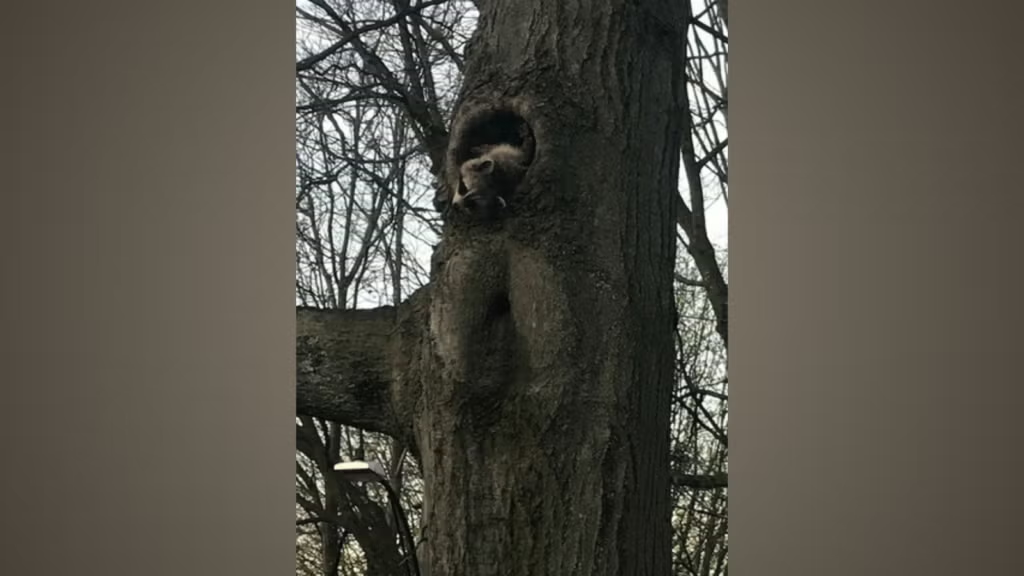
One morning in April, a face appeared in the oak tree. Previously home to squirrels that helixed around its trunk, the tree was not remarkable in any way. It was tall. It shouldered snow on its branches and discarded acorns onto our roof. Now we stood at the front window, squinting at a pair of eyes in its hollow. As a first-year physician, my new degree was fastened like a leech to my last name; I had to make decisions based on very limited data. Maybe it was because I had never seen one so high off the ground, or because the hollow seemed too small. The shadowed eyes of an animal caught my glance and slid back into the darkness. Then there was just the hole, black and finite. “That’s not a raccoon,” I said.
***
One week after Danny—who was definitively a raccoon—moved into the tree in front of our home, I started working nights. This meant that he and I effectively had the same schedule: we spent our days sleeping and our evenings trying to stay alive. I felt solidarity each night at 6:30 p.m. when it grew dark and Danny and I stirred from our beds, and I felt a small amount of betrayal when I returned home at 8:30 a.m. to find him already asleep in his hollow. Lack of sleep will make you jealous of a raccoon. It will make you hate patients in pain, whose nurses wake you from a nap at 4 a.m. to ask for more oxycodone. And it will make you hate yourself for hating these things.
As a psychiatry intern, I was required to spend half of the year covering various medicine units—in this case, an infectious disease inpatient floor at Yale New Haven Hospital. I worked fourteen-hour shifts, during which time I admitted new patients and took care of the twenty or so patients already on the unit. I was supervised by an upper-level resident who watched over both me and another intern, who also cared for another set of twenty patients. An attending physician, who supervised the upper-level resident, was at home sleeping and rarely awakened.
“What is it like to work fourteen hours a night for seven nights in a row?” I wish someone had asked me. Most of the twenty-four hours of the day I spent counting forward in fear to 6:30 p.m. or in hope to 8:30 a.m. Every hour of the day was measured against these two benchmarks, between which any number of horrible things could happen to my patients. Mostly the feeling I carried through those fourteen hours was one of dread. Having been a woman in the world for some amount of time, I understood that bad things happened under cover of darkness. Though it was never pitch black in the hospital, and the sharp fluorescence of the hallway lights startled me when I exited the dim call room, the feeling of being alone in the dark, of being vulnerable, tailed me.
***
Almost every morning Danny stuck his head out of the hollow upon hearing the sound of my car pull into the driveway. The triangles of his ears twitched as I walked up the sidewalk into the house. When I climbed the stairs, took off my shoes, and dropped my bag on the floor, he was watching me upside down, his head lolling out of the hollow. He spent most days like this, alternately napping (mouth open and closed) and awakening to keep a close eye on whatever dogs or humans walked below. He was undeniably cute, with a jaunty swath of a black mask and a small, pert nose. I took many photos of him in various positions of head flopping; I sent them to my mother and posted them on Instagram. “Meet Danny,” I wrote, “my new bff.” He never left the hollow during the day, and after several weeks I had seen so much of Danny’s head that his body—whatever it looked like—became irrelevant.
This was, after all, what I wanted. At night, I asked patients with newly diagnosed HIV about fevers and nausea. I pressed my stethoscope against their backs and peeked between their toes. I did these things to provide the best care for my patients, but I had little interest in their bodies per se. While the medicine residents reviewed rashes and chest x-rays, I read patients’ chaplain and social work notes. I longed to tap patients’ foreheads and whisper: What’s going on in there? I wanted the body to be extraneous.
Perhaps more accurately: I wanted my body to be irrelevant. While no resident was particularly delighted to be working nights, everyone around me seemed to be enduring the long shifts and flipped schedule with a good dose of dark humor and an unabated appetite for 2 a.m. cafeteria sushi. Meanwhile, my Crohn’s disease—normally well managed with medication—flared up on night shifts, giving me perpetual nausea, dizziness, and diarrhea. “Only fourteen more shifts to reach my goal weight,” I told my fiancé, who looked appropriately appalled. I drank smoothies, which I found more palatable than chewing food. I took Zofran. I memorized the codes for the staff bathrooms on every floor.
***
On my days off, I lay on the couch, napping between episodes of The Sopranos. My primary thought while awake was: “I am not at the hospital.” Working nights had winnowed my world smaller and smaller. While a male urban raccoon typically moves within a mere .03 to .3 square mile radius to feed, mate, and sleep, a female psychiatry resident need only travel two miles in circumference to reach the team room, the call room, the patient’s room, and her own bed. As a nocturnist, these four places acquire the utmost importance.
1. The team room is the initial and penultimate destination of a shift, where I receive a summary of patients from the day team and hand back signout in the morning. It is inevitably windowless, its computer bay littered with plastic cups and graham cracker wrappers (remnants of the so-called Surgery Sandwich, a double stack of layered graham crackers and Jif peanut butter). On nights when the work slows, I grab gloves and shock the sticky desks and keyboards with bleach.
2. The call room consists of a cot, a desk, a computer, and a side table. I retreat here when I am hopeful I may get an hour to nap, or at least a moment to lie in bed in the dark. The room is too stuffy, too cold, or sometimes—somehow—both. Housekeeping ostensibly changes the bed sheets every day, but the next night I find my pillow pushed in the same position against the wall, the sheets rolled tight as a noose.
3. The patient’s room is the only locale that changes wildly from night to night. Sometimes it is packed with a family eating McDonald’s and requesting an update. Sometimes deflated balloons frame an old man dying alone. Sometimes the room is empty. The patient has eloped! the nurse calls me, panicking. What a good idea, I think, before calling security.
4. My bed is the promised land. After I get home, I take off my scrubs in the kitchen and make a smoothie. I sit by the front window and watch Danny while I drink breakfast. At 9 a.m. he is still awake and eyes me upside down with intense curiosity. I imagine setting up a pulley system from the window to the hollow to send across food—perhaps a Surgery Sandwich. My fiancé strictly discourages this plan, or any effort on my part to acquire rope. Danny and I stare at each other as the rest of the world wakes up. In the bedroom I find my fiancé sprawled across the bed, his face pushed into the pool of a pillow. In those moments he is all body, both wholly present and somewhere else completely. This is the most pleasurable part of working nights: watching the man I love sleep. I gently rearrange an arm or a leg before lying down next to him. I place a black mask over my eyes.
***
A nocturnal animal is a creature that God has chosen to live in darkness. Existing at night is one of the most basic forms of crypsis, or tricks that animals use to avoid detection by predators. Under cover of darkness, it can be easier to avoid being eaten, but it can also be easier to eat, with fewer predators competing for the same prey. I print the Wikipedia article on nocturnality one evening in the call room and underline the phrase temporal division of the ecological niche.
A nocturnist is a doctor who has been chosen to work at night. While bats echolocate and cats have evolved retinas composed heavily of rods—a cell type that allows better visualization in the dark—I longed for wider pupils so I could stare without squinting at the computer screen as I scrolled through never-ending notes of a patient transferring from the ICU. With cupped ears, I could confidently nap and still awaken to the sound of the pager, rather than sleeping in fitful bursts interrupted by nightmares of men breaking into my call room. And if my heart were larger, I could summon more empathy for the woman shouting at me for another Xanax at 2 a.m.
I had a lot of experience being a patient, during which time I would characterize myself as prey and the physicians as frequently predatory—taking my blood, telling me what I could eat and even—during an x-ray—when I could breathe. But I did not feel much higher up the food chain as a first-year physician. I was alone in the dark with nurses hunting me down to examine a patient’s swollen legs or change a miswritten order. I hid behind the knowledge of older residents when a patient began to have trouble breathing. And I was criticized on morning rounds about decisions made overnight. Why had I not run HLA B*5701, a test I had never heard of, or thought to perform Myerson’s sign on a patient with Parkinson’s disease? The attendings clucked their tongues as I sweated through my white coat. I had not evolved to be a doctor at night—or, I began to worry, at any time of day.
***
I saw Danny’s body for the first time at around 10 p.m. on my night off. I was reading by the living room window and heard soft scrabbling noises outside. By the light of the street lamp, I watched Danny’s head whip back and forth, up and down the street. When all was clear for several minutes, he pulled his upper body out of the hollow, grabbed onto a large branch just to the left of the hole, and dragged himself onto the ledge. It was a slow process and not at all graceful. I had imagined that his body would be proportionate to his head, an idea that his actual body seemed to hold in contempt. His belly and rear end were enormous, threatening to teeter off the branch.
He stood very still for many minutes, surveying the street, before wrapping his legs around the tree trunk and slowly shimmying down with his head facing up. With each shift of his legs, pieces of bark cracked and fell to the ground. When he was about a foot from the grass, he slowly completed a 180-degree turn, spinning so his head was now facing down. Then he hit the ground and ran off.
***
My initial superstition that bad things happen more frequently to patients at night became more and more fixed. On my third night at work, I walked out of the team room to speak to a nurse. As I passed a patient’s room, I heard a horrible gurgling sound from the hallway. An old man was struggling to breathe, his nurse suctioning thick clots of yellow mucus from his throat. I pulled the signout sheet from my scrub pocket. The patient was an eighty-three-year-old man with advanced dementia who had come into the hospital with aspiration pneumonia. DNR/DNI was highlighted in bold letters next to his name. This meant that whisking him away to the ICU for intubation, our last intervention when someone was struggling to breathe, was off the table.
We’ve been trying to tell the doctors about this all afternoon, the nurse said sharply as I walked in the room. I had not received any information from the day team that this particular patient wasn’t doing well. I stayed in his room for a long time as we tried several non-invasive measures to ease his breathing. A few hours later, he looked bad and sounded even worse. I called my resident to assess him. Pulling off our gloves and gown outside the room, we both sighed. Calling a wife to tell her that her husband is dying is bad at any hour of the day but is definitively worse at 2 a.m. “I would come in now,” I told her. “I wouldn’t wait.” Two hours later, with his wife and daughter at his bedside, he died.
I went to sleep and woke up again. I examined the wet stub of a patient’s below-the-knee amputation, threaded a nasogastric tube into an elderly woman’s stomach, and called a stroke code on a gentleman whose speech became suddenly garbled. Loss began to feel inevitable. I became increasingly worried that I would come home one morning to find Danny gone. My breath caught in my throat when I spotted a small pile of fur on the side of the road. I turned around and craned my neck, pushing my nose against the car window to see if I could—and I was sure I would be able to—recognize his face.
***
I asked my fiancé to check out books on raccoons from the Yale library. In the late afternoons before work, I read about the debate over raccoons’ intelligence, which apparently reached a fever pitch between 1905 and 1915. Though there has been limited interest in assessing their intellect more recently, several years ago a lab ran the “Aesop’s Fable Test” on a series of raccoons. In the original test, as in the parable, thirsty crows are presented with a too-deep pitcher of water and a pile of stones that they must drop into the pitcher to raise the water level. The test was adapted for the raccoons: a cylindrical container attached to a platform held a single buoyant marshmallow, too low to grab. Two of the eight raccoons successfully repeated the crows’ behavior of dropping stones in the pitcher to retrieve the treat. A third raccoon climbed onto the cylinder and rocked it back and forth until the whole apparatus toppled over. “That,” said study leader Lauren Stanton, “was something we hadn’t predicted.”
So much of a mammal’s intelligence comes down to its hands, and raccoons do wonders with theirs, tipping trash cans and tunneling furiously into attics. Their name in almost every language makes reference to their paws or their behavior of “washing” food in water before they eat. In Norwegian, vaskebjørn means “wash-bear,” and the raccoon’s name in Venezuelan Spanish translates to “fox, wash thy hand.” In classical Spanish, mapache derives from an Aztec word meaning “the one who takes everything in his hands.” While scientists previously hypothesized that raccoons’ washing behavior was born out of a desire for cleanliness or an insufficient amount of saliva, they now believe that raccoons moisten their paws when feeding to increase an object’s tactility. They wet and caress clams, frog carcasses, and stones to better “see” them before deciding whether to eat. I imagine Danny’s paw like the hamsa that a pregnant patient hung outside her hospital room, a protective amulet.
What I did with my hands was also my identity. I continuously palmed a pager, awaiting the sharp-pitched signal that I was needed. In the dark of my pocket, I ran my fingers along its plastic edges, willing it not to ring. The interns rotated so frequently that to the nurses and patients I was just another resident taking too long to put in an order. I was the doctor who carried twenty patients rather than caring for them.
***
Despite raccoons’ dexterity and tenacity, they are portrayed as ne’er-do-wells and tricksters. In the mid- to late nineteenth century, their shortened name was used to describe blackface minstrels—they, too, wore a mask—and the slang term became a racial slur for any person of African descent. Even in modern cartoons, “trash pandas” are often portrayed as thieves, pseudo-intellectuals, and con artists. They are crafty, not smart. They are pests, not resilient.
But Danny was curious. He paid spontaneous attention, tracking my movements in the living room as I rotated between the couch and the armchair late afternoons before work. He watched with interest as a parade of people walked down the street and squirrels ran the branches of a nearby tree.
Meanwhile, at night, I read closely through patients’ medication lists and strained to hear the double thump of their heartbeats. I was constantly worried I would inadvertently harm someone—or, somehow, myself. I paid close attention out of fear, not curiosity. Danny seemed to model a different sort of awareness entirely. “That raccoon is amazing,” I told my fiancé. “You need to get a dog,” he said.
***
Just as my body settled into the rhythm of working nights and the responsibility of caring for a hallway of patients began to feel more bearable, my schedule flipped. I walked into the blinding light of morning after my last night shift and celebrated with breakfast at the local diner—pancakes with a swirl of crispy cinnamon sugar and topped with a zigzag of cream cheese icing. Then I went to sleep for the very last time during the day.
I woke up the next morning to a world entirely too bright and too loud. Switching from nights to days induces a kind of jet lag. I was nauseous, disoriented, and wanted to sleep and eat at all the wrong times. I was back working on the infectious disease floor, but now the unit was bustling with nurses giving report, janitors turning over beds, and small pods of doctors and medical students inching down the hall on morning rounds. Instead of giving the overnight admission presentations in the morning, now I was receiving them. I jotted down snippets on the back of my signout sheet—
43 m
HIV noncompliant h/o Kaposi, htn, hld
CD4 23 & viral load 86,000
Azithro?
Words I did not know several weeks prior I now used easily. I wrote out to-do lists for all the new admissions and patients already on the floor. Every morning the list appeared briefly insurmountable, with notes to write for every patient, labs to follow up on, consults to call, nursing homes to update, family meetings and case conferences and grand rounds to attend. Somehow, everything got crossed off.
***
One evening during my first week back on day shift, I heard our neighbor talking on the porch with my fiancé about a raccoon. I ran down the stairs. “Are you talking about Danny?” I asked. “Excuse me?” she said, laughing. I explained that the raccoon had been living in our tree for over a month and that I had seen him come out of his hollow a few times in the evening. “I think I saw baby raccoons in there,” she said. “Danny is Danielle!” I was incredulous. I had been watching Danny for weeks and had never considered that he was a pregnant she. Though I had assigned the raccoon a gender without any evidence, I felt in many ways that I knew him. “I don’t understand why you’re so upset about this,” my fiancé said as we got into bed. I didn’t have an answer.
In retrospect, the details tetris together perfectly: the raccoon’s giant belly, her hyper-attention to her surroundings, even her choice to move inexplicably into a very tall tree in the middle of spring. But I had written a story and I became possessive of it. This was a way to survive. Later, in a borrowed library book, I read the following:
The culmination of mating season varies through April and May. The mother gives birth to 4–6, usually in the hollow of a tree.
***
There are losses that we imagine will be difficult (a breakup, a first patient death) and others (an empty tree hollow) that we do not. One weekend in the middle of the night my fiancé climbed into bed after studying for a graduate school exam. “Hey!” he nudged me awake. “I just watched Danny move her babies out of the tree. Should I have woken you up?”
“Maybe,” I said. “Is she gone?”
“I think so.”
“Oh,” I said, sleep rushing back over me.
When I woke, this conversation registered as a dream until I passed by the front window and saw the empty tree hollow. I checked my email and found a series of messages my fiancé sent between 1 and 2 a.m. in which he narrated Danny moving her pups to a new den:
I heard scratching noises so I looked out the window and saw Danny climbing down the tree with a little baby raccoon in her mouth, the way that cats carry their babies! So cute.
And soon after:
OMG so much drama—Danny just carried another little baby out!
The emails were filled with enthusiasm and exclamation marks—a distinct contrast to his many weeks of exasperation. “I was trying to understand why you loved her so much,” he said later. “I was paying attention so I could tell you all about it.” In total he watched Danny carry four pups down the tree and run with them across the street and into the darkness. In between the retrievals he heard the pups crying out sharply for their mother. “Where did she go?” I asked him. “How long was she gone between each baby pickup?” I pictured an aerial map of our neighborhood and tried to guess how far she could have traveled in a handful of minutes.
***
Despite knowing the facts—raccoon mothers move their pups from the initial den after a week to avoid predators and prevent the increasingly mobile pups from falling out of a tree—and living with an eyewitness of Danny’s departure, I still believed she might return. The next few days I looked out the living room window compulsively, waiting for her to reappear. When walking to the gym or the local bodega, I noted open crawl spaces and areas of thick underbrush that might be ideal for a raccoon den. After returning home from dinner, I checked the half-collapsed shed behind our house with a flashlight.
During one of my last days on the infectious disease floor, an ophthalmology resident berated me over the phone, an agitated and delirious elderly man with pneumonia swung at a nurse, and I had to tell a woman younger than me that her husband of four years had been unfaithful and given her HIV. I returned home and stood in front of the hollow. I cried, accepting its emptiness.
***
Several months before my intern year began, my fiancé and I began watching The Sopranos. In the pilot episode, Tony Soprano is referred to a psychiatrist for depression; he immediately begins by pushing boundaries (“What part of the boot you from, hon? . . . my mother would have loved it if you and I got together”) while regaling Dr. Melfi with the story of his first panic attack. But the star of the episode is a family of newborn ducks Tony joyously discovers in his backyard. He builds a ramp so the mother and her babies can waddle easily into his swimming pool, and he wades into the water in his bathrobe to toss them chunks of Italian bread. He shouts at his children to come outside and watch the baby ducks as they attempt to fly, skimming just above the pool line.
On his son’s birthday, with a stogie in one hand and a can of lighter fluid in the other, Tony looks up to see the baby ducks and their mother lifting off easily from the pool. They fly over his home’s chimney and into the afternoon sky. “At first it felt like ginger ale in my skull,” Tony says, describing a panic attack coming on. He hyperventilates and passes out, the lighter fluid igniting a flash of fire as he drops the can onto the barbecue grate. “But do you feel depressed?” Dr. Melfi asks, trying to get to the point as the session reaches an end. “Since the ducks left,” Tony says. “I guess.”
Much has been made of the ducks—what they do or don’t symbolize, how and why a tough mob boss becomes so attached to them. Dr. Melfi interprets the ducks leaving as representing Tony’s fear of losing his family; we are left to wonder if this family refers to his wife and children or the capital F mafia Family—or perhaps both. Whatever the significance, the ducks’ presence in Tony’s life catalyzes his initiation into therapy, which becomes a narrative frame for the rest of the series.
In the pilot episode of my intern year, my attachment to Danny’s presence in the tree represented something else—a model, maybe, for surviving loneliness. Working nights pared me down; I became scrappy and selfish. I thought about myself constantly and all the things I needed that I didn’t have: sleep, dinner, a single quiet moment devoid of responsibility. I felt, for a brief period, more understood by a raccoon than by any human I loved.
Many months after Danny departed, as we reached the last season of The Sopranos, I hypothesized to my fiancé that the ducks would make a final appearance. Perhaps another generation of birds would nest on the edge of Tony’s pool, or he would choke up seeing a wavy “V” of ducks flying slowly over his home. I was hungry for circularity. But my desire for a nostalgic, tidy conclusion was not fulfilled. The story ends, as perhaps it should, in darkness.
***
Luckily, life is sometimes more cinematic than the movies. Several months after Danny’s disappearance, my friends and family continued to give me raccoon paraphernalia: books, socks, and a small yellow bowl with a blue-eyed, black-masked face painted on the bottom. Just as my fiancé diligently recorded Danny’s movements the night she carried her babies to a new den, people were paying close attention to my obsession—which was, of course, a sign of love.
I was done working on inpatient medicine and was now carrying and caring for half a dozen patients on an adolescent psychiatry unit. The days were long, and the patients were very ill; many of them had experienced unspeakable traumas and were now in the foster care system, buffeted between strangers’ homes. After cutting her arm with a razor blade, one young woman was stuck in the hospital for an additional week because her foster mom would not allow her to return home. I sat with her as she cried to her biological mother on the phone and, afterwards, we read aloud a young adult novel from the unit library.
That night, as my fiancé and I were falling asleep, he heard rattling sounds in our backyard and nudged my arm. The window behind our bed looked out onto a concrete lot where we parked our cars, beyond which sat a weed-strangled lawn and collapsed shed. I pulled the blinds open. Climbing on top of our trash can and pulling scraps of food through a hole in the lid were four small raccoons. I pushed my nose against the window, a soft sound of joy fogging the glass.