
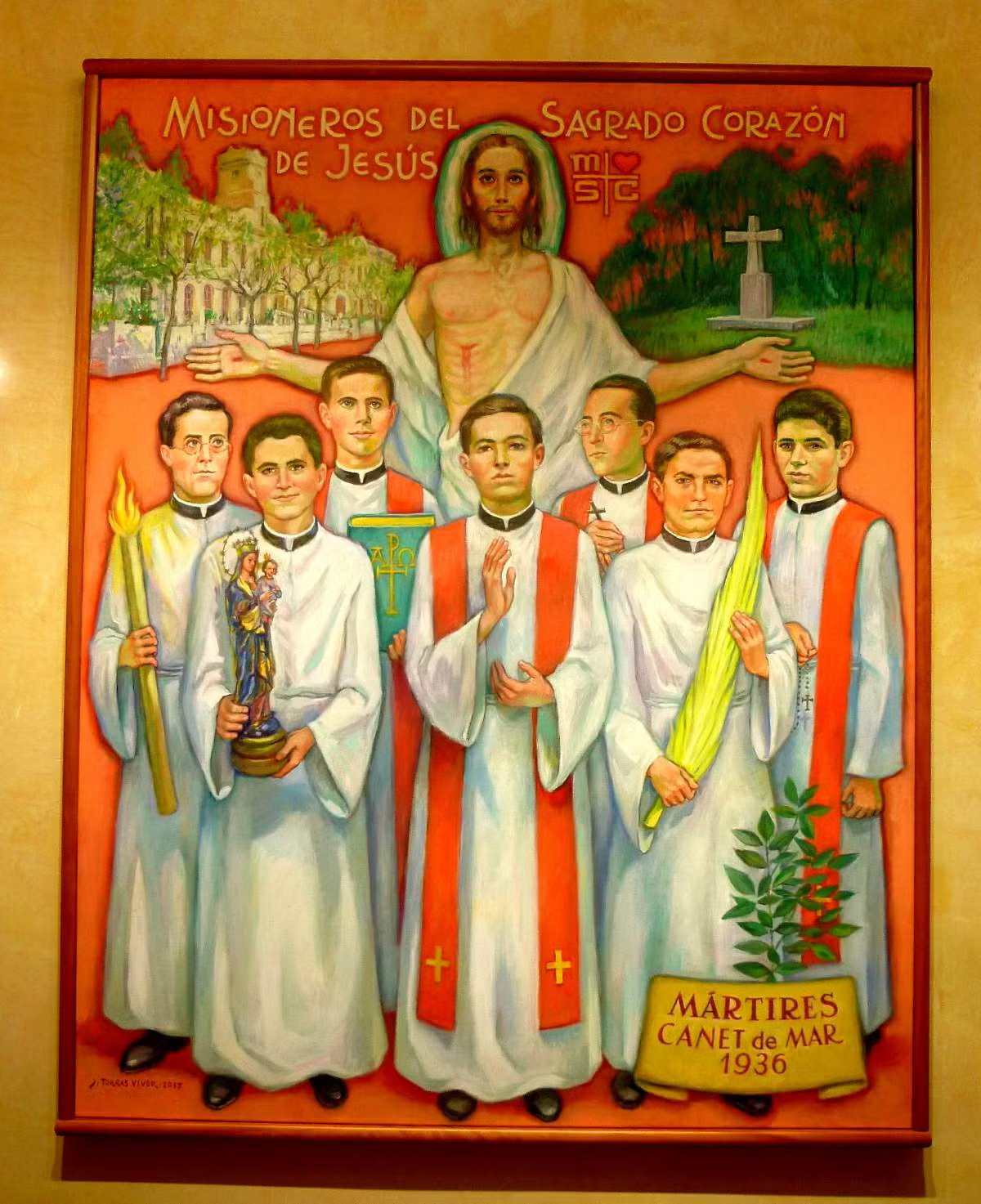
In our 68/1 issue, we feature two essays on transatlantic Catholic political movements.
ANTONIO CAZORLA-SÁNCHEZ and SOPHIA RODRÍGUEZ-LÓPEZ One Cross, Two Continents: How Women’s Catholic Resistance in Mexico Inspired Their Spanish Counterparts (1926–1936)
PIOTRE H. KOSICKI and SYLWIA KUZMA-MARKOWSKA Brokering Right-to-Life: Poland and the Transnational Entanglements of Catholic Pro-Life Activism, from Santiago to Washington to Gdańsk, 1970s–1990s
The articles draw links between Mexico and Spain, between Chile, Poland, and the United States. The movements our four authors describe would seem to fit neatly on the right side of the ideological spectrum. They are variously counterrevolutionary, pro-fascist, anti-abortion, and anti-communist. On closer inspection, however, one sees patterns that are harder to characterize. The movements are transnational in reach, yet avowedly nationalist in orientation. They are often populist, yet they appeal to hierarchy and the institutional power of the church. Like movements on the Left, they are critical of liberalism. They are inclusive of women and rely on them as organizers, leaders, and shock troops, yet one could hardly call them “feminist.” They advocate freedom of conscience and thought, but not for everyone and not as “enlightenment” ideas. Finally, they evolve alongside the church and in relation to state actors and policies, but they retain a “para” and sometimes “contra” relationship to both church and state.
Not enough research has been done on movements like these. Our authors explain why that might be. We asked them if they were surprised by the overlaps in their arguments. Their answers produced another fascinating set of alignments. At stake, across all these movements, is the status of liberalism in modern polities. The activists in question favor church over secular state, nation over globalism, and unifying authority over pluralist democracy. Among the many variants of anti-liberalism now emerging across the world, this is a distinct variant.
What political alliances are conservative Catholic social movements likely to produce? Who benefits from the forms of identity and inclusion these movements make possible?
For ideas and answers, read on.
Sofía Rodríguez-López and Antonio Cazorla-Sánchez
Reading our colleagues’ article on abortion and transnational Catholic networks, the first thing that came to our mind was that it describes the same issue that we highlighted for the 1920s and 1930s regarding laicization and civil conflict in both Mexico and Spain: namely, that significant sectors of the Catholic world coordinated their efforts to fight against what they considered to be hostile governments and social forces. But there is a deeper discourse underneath all this that strikes us: how did some Catholics understand the meaning of freedom in the modern world? This meaning is fundamentally different from the liberal and humanistic ones prevailing in civic discourses since the French Revolution. It is also, despite international collaboration among Catholics, a deeply nationalistic and even xenophobic discourse.
The 19th century Church did not welcome the arrival of liberalism or nationalism. It had serious problems with the first, but eventually it managed to co-opt and to interiorize the second. It can be argued that it was not until the Second Vatican Council (1962-65) that the official Church, represented by the Holy See, embraced democracy and the defense of human rights. This aggiornamento, however, was not uniformly welcomed. Important sectors of Catholicism in fact resented it and, to an extent, it was rejected under the papacies of both John Paul II (1978-2005) and Benedict XVI (2005-13), which promoted Catholic organizations, such as Opus Dei or the Legionaries of Christ, with clear anti-modernist and anti-humanist programs. According to the pre-Vatican Council doctrine of the Church, freedom was interpreted not as the guarantee of individual rights but as the freedom of the Church and its moral superiority as a “perfect society” over any civil society. This concept made democracy, at best, irrelevant and, at worst, an enemy to the Church’s interests. What mattered to the Church was its rights, which were often perceived by its critics as mere privileges. This position allowed the Church to coexist with right-wing authoritarian regimes, which defended the Church’s social preeminence, but excluded the supposedly totalitarian ones, especially Communist, that threatened its freedom and status. Historical examples of the former are plentiful, from Franco’s Spain to Pinochet’s Chile.
The issue of nationalism ended up being less controversial for traditional Catholicism. The main problem of the Church with nationalism was not its presumptive threat to the universality of the Christian message, but that it was expressed in terms of popular sovereignty; that is, as a will above the authority of the Church. The solution to this risk was to nationalize Catholicism, either, as it did originally, by making it an ally to traditional antidemocratic social elites (the Spanish monarchy being a clear case of this) or, later, by mobilizing the conservative, already patriotic middle classes through Catholic parties and organizations such as Catholic Action. For this transition, there was a powerful, symbolic interclass mechanism for nationalizing the Catholic masses: the preexisting Marian cults. Madonnas such as the Virgen de Guadalupe in Mexico, Virgen del Pilar in Spain, and Our Lady of Czestochowa in Poland (and Lourdes in France or Fátima in Portugal)—constructed as defenders of both the national identity and the rights of the Church against external and internal enemies—provided an exclusive/inclusive identity that expressed a simultaneous faith in God and the Nation. It is not by chance that their images “led” the political movements that opposed the enemies of the Church and its rights, from the Cristeros in Mexico to the Francoist rebels in Spain and the anti-Communist forces in Poland (as well as anti-Republican forces in France and Portugal).

Of all these cases, patriotic Catholicism identified with democracy only in Poland. While this association was very real and sincere in many social sectors, for others it was basically circumstantial. This allowed for the identification of “freedom fighters” in Poland with antidemocratic regimes, including the very surprising affirmation by some Polish Catholics that Pinochet’s regime “respected life,” a clear admission that the only life that needed to be respected was that of the fetus, not, as common human rights doctrine defends, that of the people. The Pinochet regime’s nearly 4,000 dead and missing did not register in this moral and political vision of freedom.
The same interpretation happened during the Cristero War, when Catholic rebels, in the name of the Christian credo, murdered or maimed representatives of the godless Mexican Republic. An even worse result took place in Spain after July 1936, when the civil war began. There, the Church’s alliance with the nascent Francoist regime included, on one hand, proclaiming its victimization at the hands of the Republicans (which was true, as close to 7,000 clerics were murdered by the pro-government forces), and on the other, a complete disregard for the ongoing atrocities of Franco’s supporters against the Republicans (the rebels killed some 100,000 people during the war). Once the war was over, the Church and its close ally, the Francoist regime, continuously remembered and honored their own victims (close to 50,000 people) while either ignoring or insulting the memory of victims on the other side (in total, once postwar executions and deaths are included, some 150,000 people). The Catholic world, with minor exceptions, fully endorsed the Spanish Church’s portrayal of reality and its one-sided vision of victimhood, both during and after the war. Catholics from Ireland to Quebec and Poland supported Franco and disregarded inconvenient information about his crimes. International official Catholicism did not start turning against the dictator until the papacy of Paul VI (1965-78), a stern, albeit subtle critic of Franco’s regime.
In sum, we believe that both papers reflect the problems that significant sectors of Catholicism have had, and still have, with principles of majority rule and the non-negotiable nature of human rights as defined by the 1948 United Nations declaration. Both papers also show that deeply entrenched, nationalistic Catholicism is no enemy of ultra-conservative international cooperation when confronting the perceived evils of the modern world.
Piotr H. Kosicki and Sylwia Kuźma-Markowska
The global marketplace of ideas is rife with liberal discontent. University of Notre Dame political theorist Patrick Deneen—once lauded by former US President Barack Obama for offering “cogent insights into the loss of meaning and community that many in the West feel”—has become the prophet of a “post-liberal” political order. In the United States, the second Trump administration has put an aggressively nationalist face on this order, blending populist appeals to the global Rust Belt with the brazen empowerment of a small clique of the world’s wealthiest oligarchs. The world’s heretofore most ardent exporter of liberal internationalism is now accelerating a global reversal whose vanguard hotspots have included Brazil, Hungary, the Philippines, and Russia.
The great journalist-turned-historian of Central and Eastern Europe’s liberal transformation, Timothy Garton Ash, recently posted to his Substack an essay he originally wrote in 2021, now deemed “more relevant—and urgent—than ever.” Garton Ash ponders, “What if it’s too late? What if the influence of liberalism is inexorably declining along with the relative power of the west? What if anti-liberal Deneen is right to gloat over ‘a 500-year-old philosophical experiment that has run its course’? Speaking only for myself, I hope I will then go down with the good ship Liberty.”
The liberal passion and the despair at a post-liberal future that I share with Garton Ash have in the past year left me on many days questioning the meaning of my own vocation as a scholar of history. Today, however, is not one of those days. As I finish my readthrough of the thought-provoking article by Antonio Cazorla-Sánchez and Sofía Rodríguez-López, I find that the editors of CSSH have done their readers an extraordinary service by placing this article alongside the one Sylwia Kuźma-Markowska and I have co-authored about Poland, Chile, and the United States. Spoiler alert for our readers: we’ve been here before! Deeply principled thinkers and activists have long justified political violence on religious grounds. And yet religion has time and again proven more resilient, and far more pluralistic, than the political Far Right operating under its banners.
Both articles tempt readers to immerse themselves in the cultural, political, and intellectual imaginaries of Roman Catholicism. Our protagonists are Poles, active from the 1970s and ‘80s through the present day, who admired Augusto Pinochet’s 1973 Chilean coup and drew active support from US-based members of the Reaganite “pro-life” coalition of the 1980s. These are Catholic activists for whom “right-to-life” entails openness to political violence under certain conditions. In point of fact, a whole contingent of Polish Catholic intellectuals and social activists for decades have expressed varying degrees of admiration for Pinochet—and for the Iberian exemplar on whom Pinochet drew, destroyer of the Second Spanish Republic, Nazi- and Fascist-supported victor in the Spanish Civil War, Francisco Franco.=
Superb, cutting-edge work by historians of transatlantic Ibero-American flows (Kevin Antonio Aguilar at UC Irvine, Kirsten Weld at Harvard) has shown just how influential the Spanish Civil War became during World War II and the Cold War in shaping a militant, offensive, racist Hispanidad that updated the nineteenth-century Ibero-American cultural pedigree for a new era—and ultimately became the foundation for much of what we consider the twenty-first-century global Far Right. In an influential essay for Dissent, Weld contends that Franco’s legacy for Latin America included “ideas that proved to have real staying power: that literally any kind of political regime was preferable to ‘communism’ or anything that might lubricate the slippery slope toward it; that the war against ‘communism’ was a spiritual, civilizational war to the death; and that anything perceived as an attack on the institutional pillars of church, military, and nobility merited extermination.”
Cazorla-Sánchez and Rodríguez-López turn the clock back further to the American origins of the Spanish Civil War. In their view, Mexico’s liberal Constitution of 1917 provided cover for a campaign of ecclesiastical disenfranchisement that, read as militant secularism, triggered a mass violent conservative uprising known as the Cristiada, or Cristero War. I, for one, am convinced by their case that a wide range of Spanish rightists readying themselves to massacre Republicans in the late 1930s consciously assimilated lessons from Mexico a decade earlier.
And yet, this type of reasoning has its limits. Legendary anthropologist Clifford Geertz cautioned against infinitely regressive arguments (“turtles all the way down”). After all, weren’t Mexican liberals aware of Otto von Bismarck’s Kulturkampf in Prussia of the 1870s? Or the papacy’s six-decade-long standoff with the unified Kingdom of Italy? Cazorla-Sánchez and Rodríguez-López themselves note the role of the Third French Republic in inspiring the secularist strategies of the Second Spanish Republic—and, though they don’t explicitly mention Action Française, the legendary French monarchist movement clearly inspired the Spanish magazine Acción Española, which excoriated critics of Nazi Germany for having failed to level similar criticism against a liberal Mexican government that punished Cristero rebels.
The easy answer to this criticism is one of multiple causality. We can always excavate deeper, and broadening the lens transnationally or globally opens ever wider horizons of possibility that reveal transmission belts (some acknowledged, some unacknowledged) far and near.
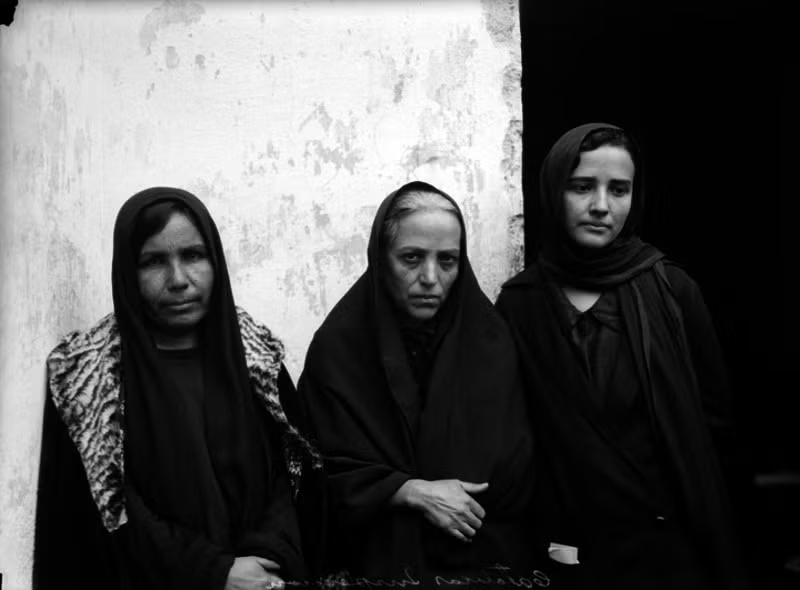
But the more impactful heuristic innovation that the present CSSH issue showcases by bringing our two articles together is to recenter gender as a category for making sense of anti-liberal causes. The role of Catholic women’s movements—including weapons-bearing clandestine guerrilla fighters—charted by Cazorla-Sánchez and Rodríguez-López for the Cristiada and the Spanish Civil War alike decenters the self-important, masculinizing origin story of mainstream fascism. As our own article shows by highlighting Ewa Kowalewska’s central role in embedding a right-to-life discourse in the Polish publishing world of the 1990s, women could shape, and have shaped, both as individuals and as movements, the Right in its various theaters of twentieth- and now twenty-first-century social and political action.

One of the long-standing taboos of the historiography of Roman Catholicism is that to disclose the role of women in promoting the interests of the Vatican, or of conservative nationalism, or of the militant Far Right, is somehow to taint, if not doom, the progressive political goals of feminism writ large. But this disregards the conscious agency and the deeply held convictions of historical actors. Cazorla-Sánchez and Rodríguez-López’s female protagonists were not “useful idiots,” but instead activist pioneers. In post-communist Poland, Catholic discourses of “right-to-life” have relied on gendered agency, too: the masculine has been hegemonic since the 1970s (true to the Franco and Pinochet exemplars), yet the forcible exclusion of women can make or break a conservative project. The clearest example is the Women’s Strike of 2020-21, which saw over 100,000 women protesting in the streets after Poland’s Constitutional Tribunal foreclosed their biopolitical agency with a near-total ban on abortion.

It may yet prove to be the case that Deneen’s “post-liberal” future—aligned with the MAGA Catholicism that has made common cause with Christian populism across Eastern Europe, prominently inclusive of Poland—will help shape the next generation’s worth of twenty-first-century political and social activism. But as Cazorla-Sánchez and Rodríguez-López show for the 1920s and ‘30s, and as Kuźma-Markowsk and I show for the 1970s through ‘90s, these were not static realities, but actively contested ebbs and flows, locally rooted but transnationally negotiated.
Excavating and exploring gendered agency in the history of the Far Right’s rise, locally as well as transnationally, must be an essential part of the historian’s project of saving liberalism from its own blind spots—and (to adapt Garton Ash somewhat) of building “a better liberalism.”

Antonio Cazorla-Sánchez is Professor of History, Trent University. He is the author of dozens of articles and books, including Los pueblos de Franco: mito e historia de la colonización agraria en España, 1939–1975; Franco: The Biography of the Myth; and Fear and Progress: Ordinary Lives in Franco’s Spain (1936–1975). He teaches on political violence and memory, fascism, genocides, and the Spanish Civil War. He is a frequent contributor to numerous international newspapers and TV series on these subjects. He is the recipient of Trent University Distinguished Researcher Award, Fellow of the Royal Society of Canada, and Commander of the Order of Isabel la Católica of Spain. He is a co-founder and a co-director of the Virtual Museum of the Spanish Civil War.

Sofía Rodríguez-López is assistant professor of Contemporary History at the Complutense University of Madrid. She was awarded the Blas Infante Research Prize for her Ph.D. dissertation Mujeres en Guerra [Women at War] (2003). In 2021 she was recognized by the Society for the History of Children and Youth for her research. She has published six monographs as well as fifty articles and book chapters on the Falange Women’s Section, fifth columnists, civil war, political repression, and daily life in the rural world during the Franco dictatorship. She is currently a member of the research team “Gender and Francoist nation. Transnational and intersectional perspectives” (University of Valencia, PID2022-141082NB-C22).


Piotr H. Kosicki is Associate Professor of History at the University of Maryland. He is the author of Catholics on the Barricades: Poland, France, and “Revolution,” 1891–1956 (Yale University Press, 2018) and the editor/co-editor of eight volumes on topics ranging from political Catholicism to historical memory of mass violence. His peer-reviewed articles have appeared in Contemporary European History, the Journal of the History of Ideas, Modern Intellectual History, and Slavic Review. He is a frequent contributor to journals of public opinion, including The Atlantic, Commonweal, Foreign Affairs, and The Nation. He is presently at work on a book entitled A New Kind of Progressive: How Poles, Venezuelans, and Germans Reimagined Latin America.

Sylwia Kuźma-Markowska is a historian and Associate Professor at the American Studies Center, University of Warsaw. She specializes in twentieth century social and cultural history of Poland and the United States. Her areas of research include transnational history, women’s and gender history, and the history of social movements. She is the author of two books, and her peer-reviewed articles have appeared in the Historical Journal, Medical History, Gender and History, Technology and Culture, and the History of the Family. Currently, she is pursuing research on the transnational history of the Polish anti-abortion movement (1970s–1990s) and is leading a group project on pro-life activism in Poland, Ireland, and Spain.
