The U(M) Center for Inquiry Based Learning and AMiIBL present: A Virtual Summer Workshop Series
For Michigan College Math Instructors…and Beyond!
May 29: Voices of Inclusion: Supporting Students’ Sense of Belonging through Asset-Based Frameworks
June 16: Why Should That Convince Me?
July 8: Let’s Do Math Differently: Weaving Research into Your Courses
July 22: Building Community in the Classroom on the First Day and Beyond
Voices of Inclusion: Supporting Students’ Sense of Belonging through Asset-Based Frameworks
Facilitators: Ileana Vasu & Candice Reneé Price (Smith College)
May 29, 12:30 – 2:30 pm ET
This workshop is capped at 25 participants. If you register and then can no longer attend, please let us know!
How can we create mathematics classrooms where every student feels seen, valued, and capable of success? As mathematics teachers, we have a unique opportunity to foster a strong sense of belonging in our students—an essential ingredient for their persistence and achievement. In this interactive session, we will dive into two transformative, equity-centered frameworks: Culturally Relevant and Responsive Practices (CRP) (Gloria Ladson-Billings & Geneva Gay) and Yosso’s Community Cultural Wealth (CCW) model. These approaches move us beyond deficit views of student ability and preparation, encouraging us to recognize and build on the rich strengths, experiences, and cultural knowledge our students bring. Together, we will reflect on our own teaching practices, exchange ideas, and brainstorm concrete ways to create more inclusive and affirming environments in mathematics. Bring your experiences, your questions, and your hopes—we’ll leave with strategies and renewed inspiration for supporting every student’s success.

Ileana Vasu was born in Bucharest, Romania, and came to the United States as a political refugee and immigrant. She has undergraduate degrees from Stanford University, and graduate degrees from Yale University and University of Massachusetts, Amherst. Always excelling in mathematics and STEM, as a young immigrant, she spent some of her initial years feeling isolated and yearning to be accepted. These experiences impacted deeply her identity and shaped her stance and commitment for equity and inclusion.
Ileana’s research interests and expertise include STEM higher education, and implications for student inclusion, culturally responsive teaching and mentoring, and teaching with inquiry. Within mathematics, she enjoys discrete mathematics and combinatorics, topology, and the history and philosophy of mathematics. She led several NSF initiatives notable for their support of students traditionally underrepresented in STEM and currently serves as an advisory board member for the S-STEM Research and Evaluation Center at the American Association for the Advancement of Science. Regionally, Dr. Vasu is one of the founders of the New England Community for Mathematics Inquiry in Teaching, NE-COMMIT, a community of college and K-12 mathematics educators from New England advocating for active and inquiry oriented teaching.

Candice Reneé Price, an esteemed African American mathematician, was born and raised in California. She has distinguished herself through contributions to mathematics through education and service. Growing up passionate about mathematics, Price earned her undergraduate degree (2003) in mathematics from California State University, Chico, and a master’s degree (2007) in mathematics from San Francisco State University. She went on to complete her doctoral studies (2012) in mathematics at the University of Iowa, where her research focused on DNA Topology under the advisement of Dr. Isabel Darcy. Her published work now spans diverse areas of research including applied mathematics, mathematics of social justice, and discrete mathematics.
Beyond her research, Candice Price is known for her advocacy for diversity in STEM fields and her mentorship of aspiring mathematicians, particularly from underrepresented backgrounds. She has received numerous awards and honors for her contributions, including the 2022 Mathematics Association of America Inclusivity Award.
She remains a role model and inspiration, both as a distinguished mathematics educator and for her commitment to promoting inclusivity and diversity in the mathematics community.
Why Should That Convince Me?
Facilitators: Brian Katz (CSU Long Beach) and Elizabeth Thoren (Pepperdine University)
June 16, 12:30-2:30 pm ET
While the current mathematics educational system only gives some students access to positive experiences with proof, learning how to justify ideas is vital in all of our courses. In this session, we will share a framework for understanding the structure of arguments, called Toulmin analysis, that we have used across our courses, from Math for Liberal Arts to advanced proof-based courses to high school mathematics. Toulmin analysis helps us unearth our disciplinary practices with the goal of empowering students to evaluate mathematical justifications for themselves. In this session, we will share ideas about Toulmin analysis and how we teach students to use it, and we will model and reflect on the kinds of student-centered pedagogies we use when doing this work. The session will use examples from both formal proof and less formal mathematical reasoning contexts, so it is appropriate for teachers across many course contexts.

Brian P Katz (BK) is faculty in Mathematics Education and coordinator of the single subject mathematics credential at CSULB. BK is passionate about interactions between inquiry, epistemology, identity, authority, and justice as both a scholar and teacher, especially in the context of preparing teachers to lead student-centered and rehumanizing classrooms of their own. BK is Associate and Communications Editor with PRIMUS, a former Chair of IBL SIGMAA and the SoCal-NV MAA Section, a current member of the executive board of SIGMAA RUME, an MAA textbook author, an Editor of the inclusion/exclusion blog, and an Associate Director of Project NExT. BK supports two of the best cats in the world and loves to sing.

Elizabeth Thoren is faculty at Pepperdine University where she supports math majors and non-majors as they engage in authentic mathematics through inquiry, especially during critical transitions in their mathematical journeys. Elizabeth has also served as a workshop designer and facilitator for MAA OPEN Math and the AIBL summer workshops and a Guest Editor for the PRIMUS special issue on Teaching Inquiry. In addition to teaching math, Elizabeth loves cooking, early morning HIIT workouts, and playing board games with her family.
Let’s Do Math Differently: Weaving Research into Your Courses
Facilitator: Mercedes Franco (Queensborough Community College CUNY)
July 8, 1:00-3:00 pm ET
This workshop is capped at 20 participants. If you register and then can no longer attend, please let us know!
This hands-on workshop is designed for mathematics faculty interested in integrating undergraduate research—recognized as a high-impact practice— into their curriculum. Through practical tools and examples, the session will guide faculty in designing meaningful research experiences that enhance engagement and critical thinking in math courses.
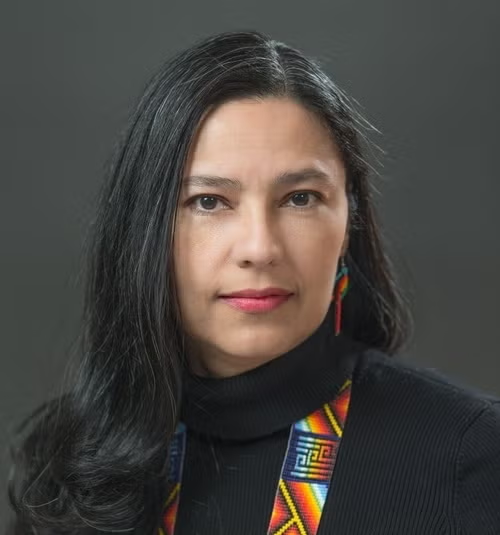
Maria Mercedes Franco holds a Ph.D. in Applied Mathematics (with a minor in Computer Science) from Cornell University and is currently a professor in the Department of Mathematics & Computer Science at Queensborough Community College of the City University of New York. She played an instrumental role in the institutionalization of Undergraduate Research (UR) as a high-impact practice and the launching of the research-in-the-classroom modality at her college. Additionally, she spearheaded the UR program within her department. Mercedes has mentored students from both 2- and 4-year colleges/universities in summer and academic year research through the apprenticeship and research-in-the -classroom models. She is co-director and co-PI of the NSF-funded programs MSRI-UP REU and the Center for Undergraduate Research in Mathematics (CURM).
Building Community in the Classroom on the First Day and Beyond
Facilitator: Katie Waddle (University of Michigan)
July 22, 1:00 – 3:00 pm ET
Creating an equitable, supportive, and joyful classroom community requires thoughtful work on the part of the instructor. In this session we will discuss some key actions to take in the first days of the semester and as the semester progresses. Participants will leave with activities they can implement to get to know their students as human beings, concrete methods for norm setting around students’ behavior in groups, and ways to deepen connection over time.

Katie Waddle is an experienced math educator who cares deeply about making the math community and math education more equitable, supportive, and welcoming. She completed the Stanford Teacher Education Program and taught for 7 years at San Francisco International High School, which serves newly arrived immigrant students learning English. Seeking a balance between teaching and doing math, she completed a Master’s in Math at San Francisco State University, and is now working on a PhD in math at the University of Michigan, where she has taught both Calculus 1 and Calculus 2. She is trained in the implementation of Complex Instruction, a teaching orientation and set of techniques that aim to implement groupwork that supports the learning of all students.
Her website: https://sites.google.com/view/katie-waddle/home
Formative Peer Observation: A Means to Build Community, Foster Reflection, and Support Pedagogical Change
Facilitators: Stephanie Salomone & Valerie Peterson (University of Portland)
August 1, 1:00 – 3:00 pm ET
As teachers, we know that learning something new requires practice, reflection, and feedback. Classroom observation can be a powerful source of such feedback for college faculty seeking to evolve and grow in their teaching. This workshop offers a framing of peer observation as a formative process—distinct from summative and/or evaluative models—for building relationships and supporting change. We will discuss what individual faculty, departments, and institutions can hope to gain from encouraging a culture of ongoing, reciprocal peer observation. For teachers implementing new practices, getting feedback from a peer can be both a powerful lever for reflection and a source of expert support for refining and sustaining new pedagogical skills. Because change is hard, even for those committed to making it, we will also invite conversation about the various barriers to peer observation and consider ways to mitigate these barriers.

Stephanie Salomone, Ph.D., is a Professor of Mathematics at the University of Portland and Associate Director of MAA Project NExT. She is a math superstar who has changed the lives of countless STEM students and faculty, has helped to define and enact major programs and initiatives that improve STEM teaching at all levels, and if this were an in-person meeting, she would bring baked goods.

Valerie Peterson, Ph.D., is a Professor of Mathematics at the University of Portland. A loud proponent and humble practitioner of inquiry-oriented and inquiry-based methods, she has led a variety of PD for STEM faculty, including within the MAA and IBL communities. Together with Dr. Salomone and the REFLECT team, she helped formulate a model for supporting pedagogical change with formative peer observation. She would be delighted to come visit your class and welcomes you in hers.

