
The U(M) Center for Inquiry Based Learning and AMiIBL present: A Virtual Summer Workshop Series
For Michigan College Math Instructors…and Beyond!
May 27: Incorporating Values-Centered Definition Activities into Instruction
May 29: Math Autobiographies: A Tool for Student Insight and Classroom Connection
June 15: A Reflection Exercise Supporting Communication, Collaboration, and Self-Evaluation
August 3: Building Community in the Classroom on the First Day and Beyond
August 12: Shifting From Demonstration to Discovery: AI as Teaching Tool for Inquiry
Incorporating Values-Centered Definition Activities into Instruction
Facilitators: Rachel Rupnow (Northern Illinois University) & Kristen Vroom (Michigan State University)
May 27, 1:00 pm EST
While the mathematical community is guided by many shared values and norms of practice, these values and norms are not always made clear to students. In this session, we will discuss some of these norms and values related to definitions, showcase some activities other mathematics instructors have made, and guide participants in creating an activity they could use in their instruction.
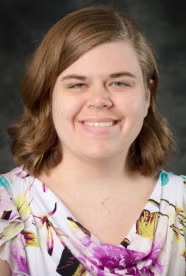
Rachel Rupnow is an Associate Professor of Mathematical Sciences at Northern Illinois University, whose research especially focuses on learning from and collaborating with instructors. She has examined student and instructor beliefs and conceptual understanding in proof-based courses and how the norms and values of the mathematical community are understood by mathematicians and communicated to students. She teaches a range of courses, including Discrete Mathematics, Linear Algebra, Abstract Algebra, and graduate courses in mathematics education. In her spare time, she enjoys watching sports (especially football and basketball) and playing piano.
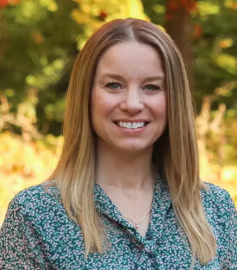
Kristen Vroom is an Assistant Professor at Michigan State University whose work centers on supporting instructors in ways that build on their individual strengths, contexts, and goals. She collaborates with a wide range of mathematics instructors to co-design and refine instructional practices, from developing and scaling inquiry-oriented materials to enhancing lecture-based teaching through thoughtfully integrated activities. Rather than taking a one-size-fits-all, top-down approach, her work is grounded in partnership, where instructors, instructional designs, and her own teaching practices evolve together through the collaborative process. Outside of her professional work, Kristen enjoys spending time outdoors with her family, playing and swimming with her two children, and especially looks forward to Michigan summers.
Math Autobiographies: A Tool for Student Insight and Classroom Connection
Facilitators: Robin Wilson (Loyola Marymount University) & Anne Cawley (Cal Poly Pomona)
May 29, 1:00 pm EST
Every student has a math story. Through intentional classroom activities that allow students to reflect on and share their own stories, we can learn who our students are and can utilize their stories to humanize their mathematics experiences in our classrooms. We argue that implementation of mathematics autobiographies provide two major course benefits: 1) it can assist instructors in getting to know their students better both as individuals and as a group of learners and 2) it can help students build connection with one another as mathematics learners in the classroom while developing a mathematics community. As instructors, when we know our students well, we can choose instructional strategies that will support their strengths and build on their weaknesses, and we can respond more appropriately to their successes and failures in our classrooms. In this workshop, we will offer suggestions on how to use the Mathematics Autobiography assignment as a way to build community in the classroom early in the term, and build connections among students that will last beyond the first weeks.
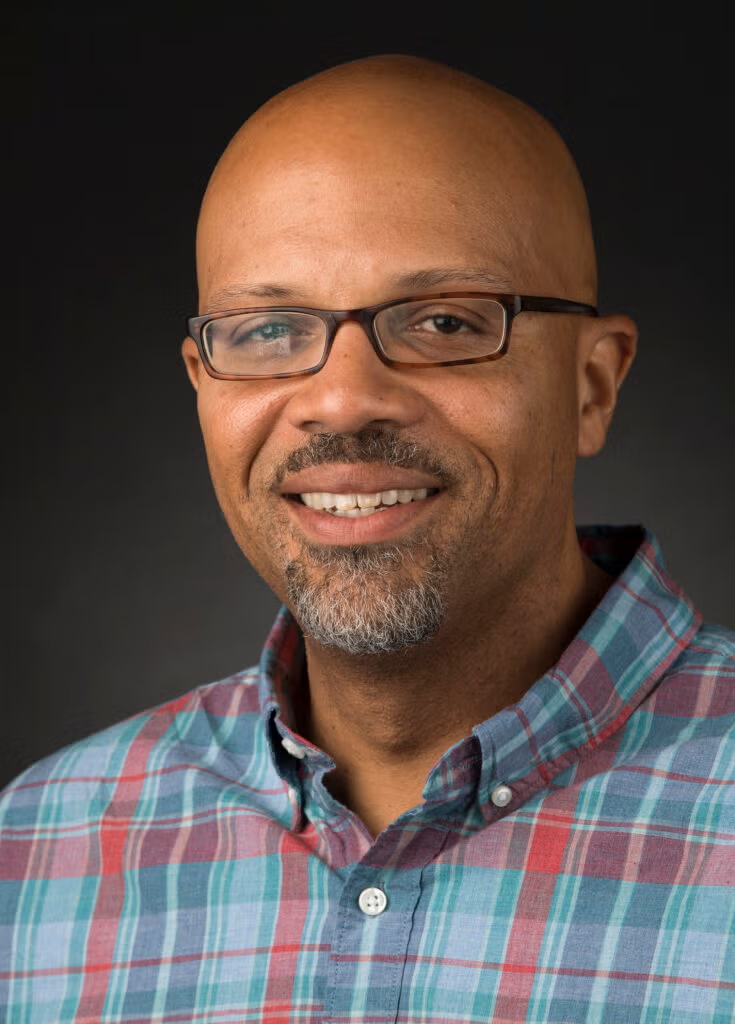
Dr. Robin Wilson earned his PhD at the University of California, Davis. He is currently a Professor in the Department of Mathematics at Loyola Marymount University. Prior to joining the faculty at LMU Dr. Wilson served as Professor in the Department of Mathematics and Statistics at California State Polytechnic University, Pomona. Dr. Wilson has also been a Visiting Professor at Georgetown University and Pomona College. His scholarship includes both mathematics and the scholarship of teaching and learning. Dr. Wilson’s work in mathematics education focuses on issues of equity and access for students of color in the K-12 and undergraduate mathematics classroom. He has worked as a facilitator with the Academy of Inquiry Based Learning and has been using IBL in his classroom for several years. In addition to his scholarship, Dr. Wilson is also active in the local community where he is a part of the Algebra Project network and works to support programs that promote math literacy in the Los Angeles Area.
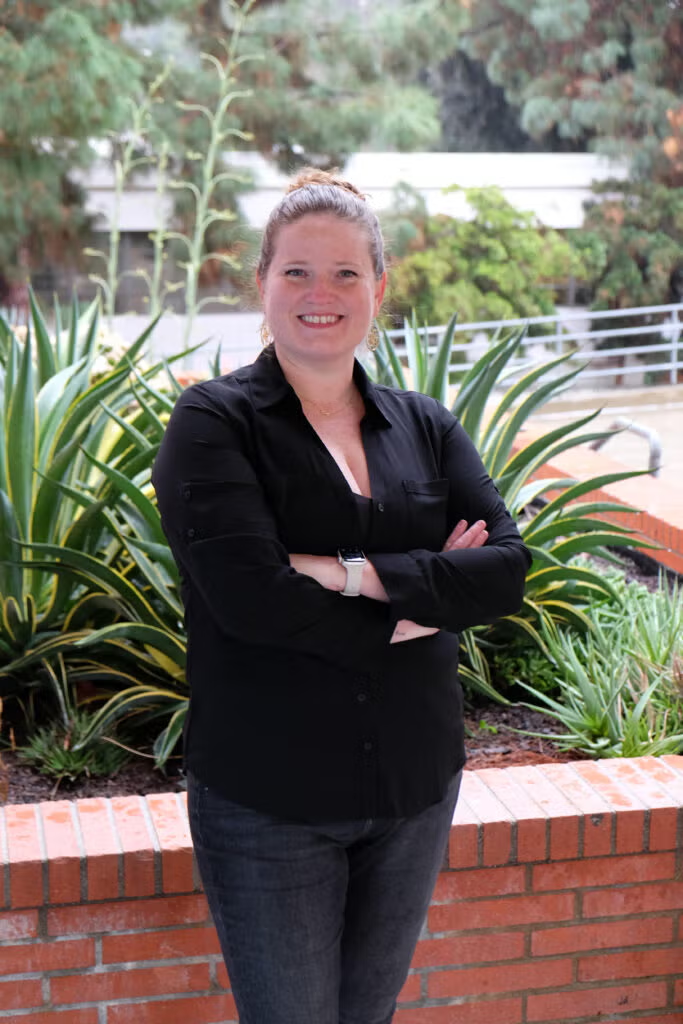
Dr. Anne Cawley is an Associate Professor of Mathematics and Statistics at Cal Poly Pomona (CPP). Her research in Mathematics Education relates to DEI, classroom experiences of historically underrepresented and minoritized students, math instruction in the first two years of college, and professional development for mathematics faculty towards equity-minded teaching practices. Current projects include 1) providing professional development for instructional supports and inclusive teaching practices college math instructors, 2) implementing professional development for community college faculty teaching mathematics courses for future elementary teachers, and 3) developing student sense of belonging in the college classroom. Anne was the course coordinator for co-requisite mathematics courses and the Early Start Math program at CPP.
A Reflection Exercise Supporting Communication, Collaboration, and Self-Evaluation
Facilitator: Alice Mark (Vanderbilt University)
June 15, 1:00 PM EST
When crafting learning goals for a newly-to-be-coordinated Multivariable Calculus course, the instructional team felt strongly that students should grow in their ability to collaborate, communicate mathematics, and self-evaluate their own mathematical understanding. This of course raised the question of what outcomes could be measured relative to these goals. A reflection exercise was written both to prompt students to understand the meaning of these goals and how they might achieve them, and to give instructors insight into students’ progress. In this session, we will consider a sampling of student responses from the last 4 semesters and consider how the introduction of worksheet-based active classtime may have impacted student thinking about collaboration. There will also be time to brainstorm reflection prompts for goals you may have for students that you don’t have other ways of measuring.
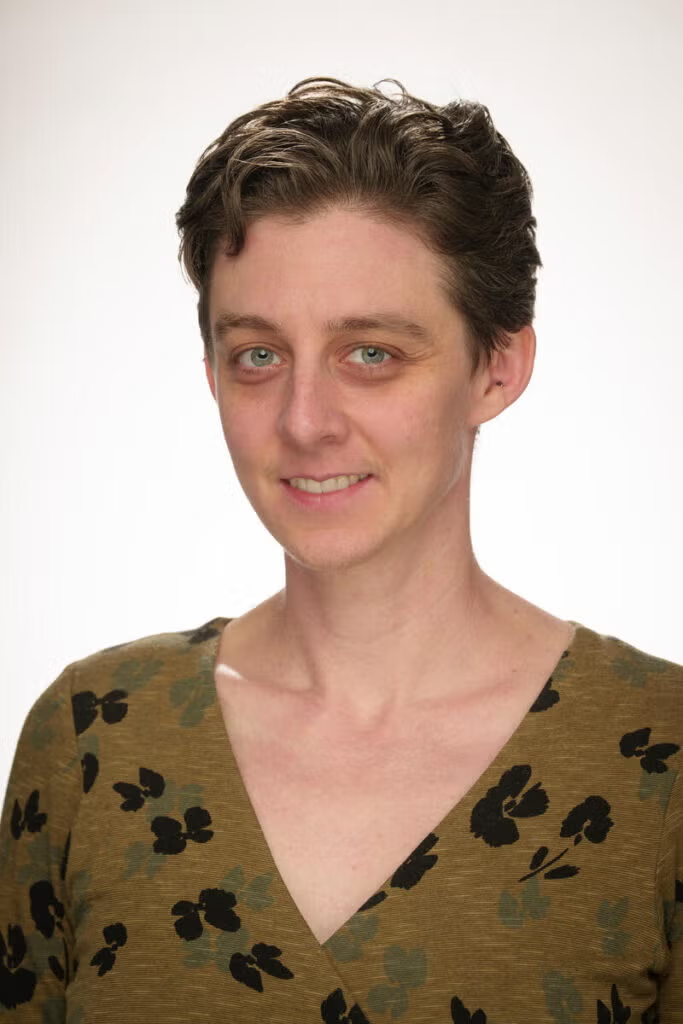
Alice Mark is an Assistant Professor of the Practice and the Barbara Burnett Director of Undergraduate Math Education at Vanderbilt University. Her work there involves training and supporting instructors, especially newer instructors teaching in lower-level courses. Most of her IBL teaching and teacher training experience has happened at MathILy-Er, where she has been an instructor since 2015 and was director 2019-23.
What is TBIL?
Facilitators: Francesca Gandini (St. Olaf College) & Drew Lewis (Center for Grading Reform)
June 23, 11:00 am – 12:00 pm & 2:00 pm – 3:00 pm EST
Team-Based Inquiry Learning (TBIL) is a structured form of active learning that incorporates the pillars of Inquiry-Based Learning into the structure of Team-Based Learning. This pedagogy was developed primarily to facilitate inquiry in lower division service courses such as Precalculus, Calculus, and Linear Algebra. This workshop will introduce participants to the basics of TBIL, with a specific focus on how the structure of TBIL activities can be used to highlight student thinking.
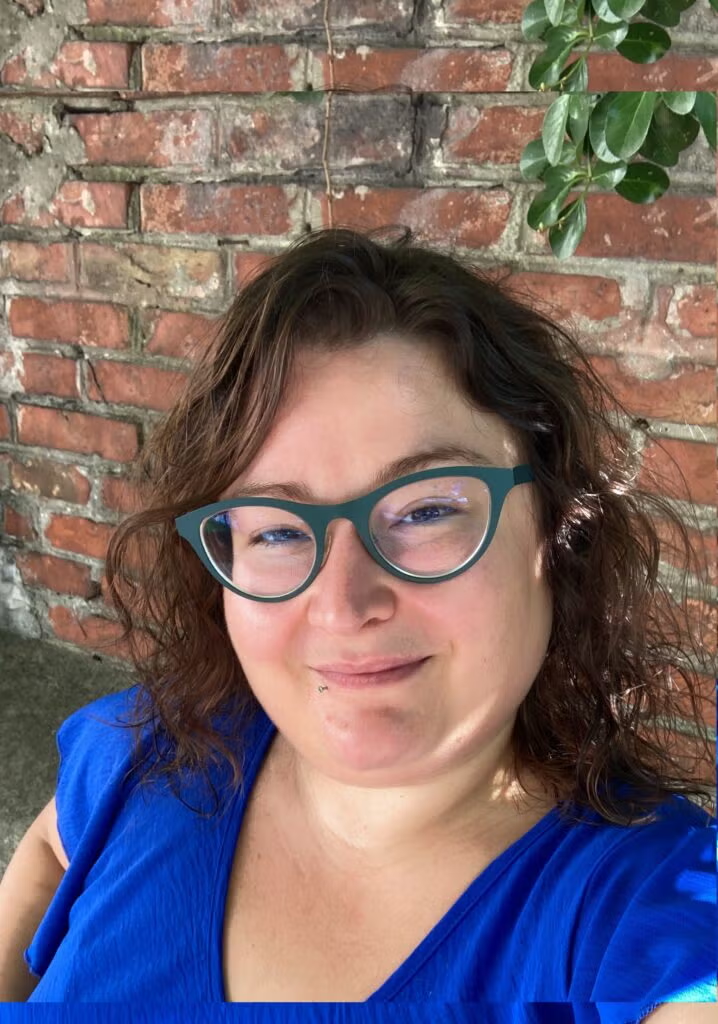
Francesca Gandini is an Assistant Professor at St. Olaf College and earned her Math PhD and Master in Post-Secondary Science Education from the University of Michigan. She was a participant in the first TBIL Institute in 2021, and has been mixing IBL and TBIL in her classes since. She is passionate about teaching with inquiry, grading for growth, and Open Educational Resources — she is one of the co-authors of “Calculus for Team-Based Inquiry Learning”. She was previously on the leadership team of the Alliance for Michigan IBL and has facilitated online TBIL and IBL workshops since 2019.

Drew Lewis is a higher education consultant who also serves as the Director of Research for the Center for Grading Reform. He received his Ph.D. in mathematics from Washington University in St. Louis, and has served on the faculty at the University of Alabama and the University of South Alabama. Dr. Lewis regularly works with faculty across the country in areas such as inclusive teaching, improving grading practices, and inquiry-based educational strategies. His research interests include the impacts of grading on students’ mindsets, math education, and quantitative justice.
Building Community in the Classroom on the First Day and Beyond
Facilitator: Katie Waddle (University of Michigan)
August 3, 1:00 pm EST
Creating an equitable, supportive, and joyful classroom community requires thoughtful work on the part of the instructor. In this session we will discuss some key actions to take in the first days of the semester and as the semester progresses. Participants will leave with activities they can implement to get to know their students as human beings, concrete methods for norm setting around students’ behavior in groups, and ways to deepen connection over time.

Katie Waddle is an experienced math educator who cares deeply about making the math community and math education more equitable, supportive, and welcoming. She completed the Stanford Teacher Education Program and taught for 7 years at San Francisco International High School, which serves newly arrived immigrant students learning English. Seeking a balance between teaching and doing math, she completed a Master’s in Math at San Francisco State University, and is now working on a PhD in math at the University of Michigan, where she has taught both Calculus 1 and Calculus 2. She is trained in the implementation of Complex Instruction, a teaching orientation and set of techniques that aim to implement groupwork that supports the learning of all students.
Her website: https://sites.google.com/view/katie-waddle/home
Shifting From Demonstration to Discovery: AI as Teaching Tool for Inquiry
Facilitator: Steve Tuckey & Alana Tuckey (Jackson College)
August 12, 1:00 pm EST
Modern AI tools can quickly generate examples, datasets, graphs, and alternative approaches to problem solving; so how can we make the most of them to support healthy, discovery-oriented teaching rather than passive consumption or the disruptive short-circuiting of the learning process? In this workshop, participants will collaboratively explore ways to use AI tools as catalysts for creative assessment and mathematical investigation in lower-undergraduate algebra, calculus, statistics, and quantitative reasoning courses. We’ll engage in live inquiry tasks, compare AI-generated representations, and work together to design activities that encourage conjecture, experimentation, discovery, and discussion. The workshop emphasizes adaptable strategies appropriate for a wide array of course formats and institutional contexts. Participants will leave with classroom-ready ideas for integrating AI into meaningful ways.

Alana & Steve Tuckey are professors at Jackson College, a small two-year college in Jackson, Michigan.
Alana (she/her) teaches calculus and statistics, has served as the President of the Jackson College Faculty Association since 2011, is the Chair of the Mathematics Department, and has written three Excel manuals to accompany statistics texts.
Steve (he/him) is the Raven Endowed Chair for Mathematics & Engineering, and he teaches calculus, differential equations, statistics, physics, and astronomy. In addition, Steve has also served as Chair of the Faculty Professional Development Committee and sits on the AI Taskforce at Jackson College.
Married in 1998, the couple first met while studying at Michigan State University, where they first discovered their life-long love of teaching mathematics together. They live with two adorable canine friends, an unmanageable amount of Lego sets, dice, jigsaw puzzles, knitting and crocheting projects, and an ever-expanding library of math & physics toys.

