


Christiane Gruber
Synopsis:
The Aga Khan Museum in Toronto preserves a magnificent leaf, possibly from a carob tree. It was dipped in gold and inscribed with a verse from the Qur’an (17:80) that calls upon God to grant believers an honorable entrance and exit. Most likely made in Ottoman lands during the 19th century, these types of inscribed tree leaves are relatively rare and quite fragile. The Aga Khan Museum’s leaf includes cursive calligraphy that takes the shape of a boat, suggesting a voyage, while its underlying “skeletal” structure suggests waves at sea. This talk explores this type of textualized plant matter, exploring its efficacy in evoking the brittleness of life and the passage of time.
Worksheet:
A worksheet for this video is available here.
Also visit the Khamseen Worksheets page here.
Selected References:
Blair, Sheila. Islamic Calligraphy. Edinburgh: Edinburgh University Press, 2018. 
Neumeier, Emily and İrvin Cemil Schick. “Hat San’atında Sefîne İstifleri ve Nuh’un Gemisi.” In Nuh Kitabı, edited by Emine Gürsoy Naskali, 221–232. Istanbul: Kitabevi Yayınları, 2013.
Özsayiner, Z. Cihan. “Yaprak Üzerinde Yazılan Hatlar.” Antik & Dekor 13 (1991): 36–41.
Safwat, Nabil. “The Golden Leaf.” In The Art of the Pen: Calligraphy of the 14th to 20th Centuries, The Nasser D. Khalili Collection of Islamic Art, vol. V, 204–211. London and New York: Nour Foundation in association with Azimuth Editions and Oxford University Press, 1996.
Citation:
Christiane Gruber, “A Gilt and Inscribed Leaf in the Aga Khan Museum,” Khamseen: Islamic Art History Online, published 17 September 2026.
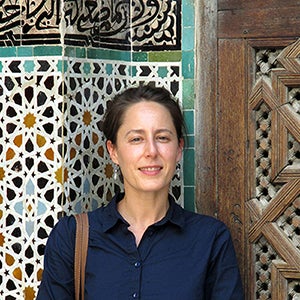
Christiane Gruber is Mehmet Ağa-Oğlu Collegiate Professor of Islamic Art History and Former Chair in the History of Art Department at the University of Michigan as well as Founding Director of Khamseen: Islamic Art History Online. Her scholarly work (available here) explores medieval to contemporary Islamic art, including figural representation, depictions of the Prophet Muhammad, manuscripts and book arts, architecture, and modern visual and material cultures. Her two most recent publications include The Praiseworthy One: The Prophet Muhammad in Islamic Texts and Images and The Image Debate: Figural Representation in Islam and Across the World, and her public-facing essays have appeared in Newsweek, The Conversation, New Lines, Jadaliyya, and Prospect Magazine, among others. Her current research projects include eco-Islamic art and architecture as well as the visual culture of the Nation of Islam.
