

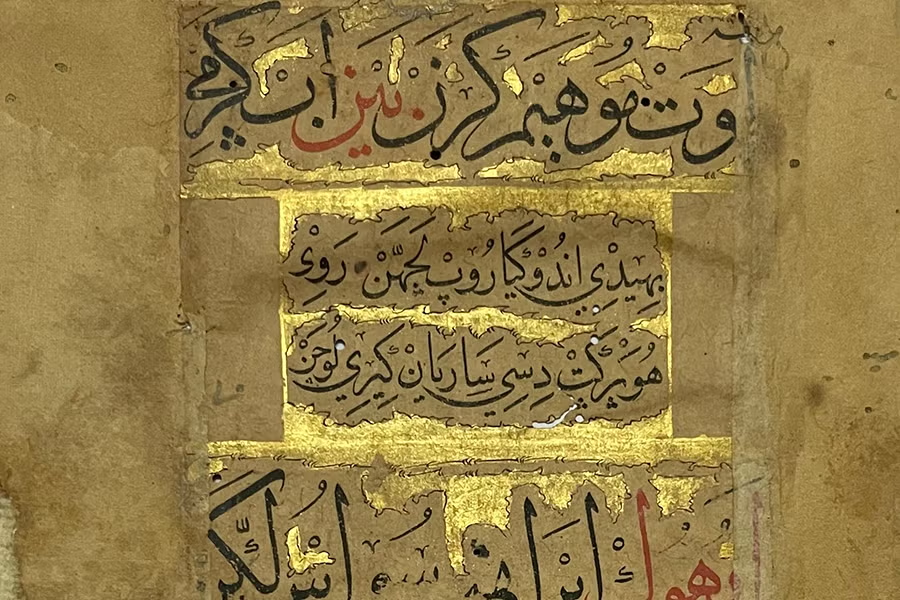
Zoë Woodbury High
Khamseen Graduate Student Presentation Award 2025 Recipient
Synopsis:
This talk examines the Kitab-i Nauras, a Dakani song collection composed around 1600 CE and attributed to Ibrahim ‘Adil Shah II of Bijapur, as a multisensory work that drew together Indic and Persianate literary and musical traditions. By addressing manuscripts of the text written in nasta‘liq, naskh, and other vocalized Persianate scripts, I explore how scribes emphasized the songs’ sonic and emotional dimensions through raga headings, vocalization, script choices, and illumination that linked the work to both musical performance and sacred book culture. Ultimately, I suggest that the visual, textual, and musical features of the manuscripts worked together to produce rasa (aesthetic emotion) for readers and listeners across linguistic and religious boundaries in early modern South Asia.
Selected References:
Ahmad, Nazir. Qand-i Mukarrar-i Parsi. Translated by Seyed Hasan Abbas. Tehran: Intisharat-i Duktur Mahmud Afshar, 2011. 
Eaton, Richard Maxwell. The Sufis of Bijapur, 1300-1700: The Social Roles of Sufis in Medieval India. Princeton: Princeton University Press, 1978.
Fischel, Roy. Local States in an Imperial World: Identity, Society and Politics in the Early Modern Deccan. Cambridge: Cambridge University Press, 2019.
Ghelichkhani, Hamidreza, Kimia Maleki, and Jake Benson. “Khalilullah ‘Padishah of the Pen’: Royal Scribe and Ambassador of Shah ‘Abbas and Ibrahim ‘Adil Shah II.” In Iran and the Deccan: Persianate Art, Culture, and Talent in Circulation, 1400-1700, edited by Keelan Overton, 367–400. Bloomington: Indiana University Press, 2020.
Ibrahim ‘Adil Shah II. Kitab-i-Nauras. Edited and translated by Nazir Ahmad. New Delhi: Bharatiya Kala Kendra, 1956.
Overton, Keelan, Kristine Rose-Beers, and Bruce Wannell. “Indo-Persian Histories from the Object Out: The St Andrews Qur’an Manuscript between Timurid, Safavid, Mughal, and Deccani Worlds.” In Iran and the Deccan: Persianate Art, Culture, and Talent in Circulation, 1400-1700, edited by Keelan Overton, 257–336. Bloomington: Indiana University Press, 2020.
Overton, Keelan. “Book Culture, Royal Libraries, and Persianate Painting in Bijapur, circa 1580-1630.” Muqarnas 33 (2016): 91–154.
Citation:
Zoë Woodbury High, “Inscribing Emotion in a Musical Manuscript: The Book of Nine Tastes (Kitab-i nauras),” Khamseen: Islamic Art History Online, published 1 October 2026.
Zoë Woodbury High received her PhD from the University of Chicago in August 2025 and is currently a postdoctoral fellow at the University of Osaka, funded by the Japan Society for the Promotion of Science. She is a cultural historian of early modern South Asia and the Indian Ocean World, with a focus on the multilingual literatures, music, and arts of South India’s Deccan courts. Her dissertation, titled “Renewing the Nine Rasas: Translating Taste in the Early Modern Deccan Sultanates,” examined the poetics, manuscript tradition, and reception of the seventeenth-century vernacular song collection Kitāb-i Nauras (Book of Nine Tastes) by Ibrahim Adil Shah II. Her broader interests include connections between aesthetics and consumption culture; Islam, music, and the arts; and religious interactions in early modern South Asia.