
When the siege on Gaza tightened, kitchens became one of the first frontlines. Not because families stopped cooking, but because the act of cooking itself turned into an act of resistance: a quiet insistence on survival, humanity and a culture refusing to be erased. Under bombardment, displacement and hunger, food was no longer just food. It became memory, identity and endurance simmering in dented pots over makeshift fires.
After two years and 56 days of war and 18 years of an indefinite blockade which was imposed by Israel in 2007, Palestinians in Gaza find themselves facing one of the worst famines in modern history. According to a press release published by the World Health Organisation in August 2025, over 1.7 million Palestinians in Gaza live in a state of famine. 640,000 face what is classified as a Catastrophic level of famine or IPC 5. Over 1.1 million Gazans live in Emergency levels or IPC 4.
Despite the current ceasefire that came into effect in early October 2025, a significant amount of food aid is still not reaching people in Gaza, due to delays imposed on aid trucks at the borders, a result of ongoing disagreements between Israel and Hamas. Currently, only 70-90 food aid trucks enter Gaza per day, far below the 600 food aid trucks that was agreed on. Palestinian officials told news outlet Al Jazeera in November that only a quarter of food aid trucks are being allowed in. The issue of food shortage has been compounded by militia groups that loot food aid trucks and resell food aid on the black market for unaffordable prices.
Because of this, 80% of Gazan families continue to live off just one meal a day. With the continued shortage of fuel, limited electricity and an agricultural system that has been decimated by over two years of air strikes, Palestinians in the territory find themselves having to cook using methods their grandparents and great-grandparents used, building brick ovens from the rubble. With a remarkable ability for resourcefulness, they are turning the most basic ingredients into facsimiles of traditional Palestinian dishes.
Reinventing Recipes When Ingredients Vanish
Flour was the first staple food to disappear. Over time that was followed by rice, oil, spices and lentils, staples in every Palestinian kitchen. As shelves emptied mothers began rewriting their recipes. Palestinian mothers are known for being treasure troves of recipes passed down to them by their mothers, grandmothers and the women before them. Each Palestinian mother will have her own slight twist on the way she makes traditional dishes. However, the war forced them to put a cruel twist on their recipes.
33-year-old Noor Abu Nadda and her three children now live in the rubble of a bombed home in Khan Younis. During the war, like hundreds of thousands of Gazans they were displaced from the north to the south of Gaza. She says she could not get hold of flour for months. With bread being synonymous with life in Gaza — before the war, bread was served alongside every meal of the day — and the threat of famine looming over their heads, Abu Nadda found herself using whatever food was at her disposal to create a replacement. It is a technique she still uses as access to food aid is still limited.
“We started grinding rice in the coffee grinder and mixing it with crushed biscuits,” she recalls. “We called it ‘emergency dough.’ The kids hate it, but it fills their stomachs and makes them feel like I’m trying.”
In the northern neighbourhood of Sheikh Radwan in Gaza City, 49-year-old grandmother Shereen Daghmash uses corn sold as animal feed to make a flatbread resembling cornbread. “It tastes bitter,” she laughs, “But my grandchildren dip it in olive oil and say, ‘Mama made mana’eesh.’”
Creativity Born from Scarcity
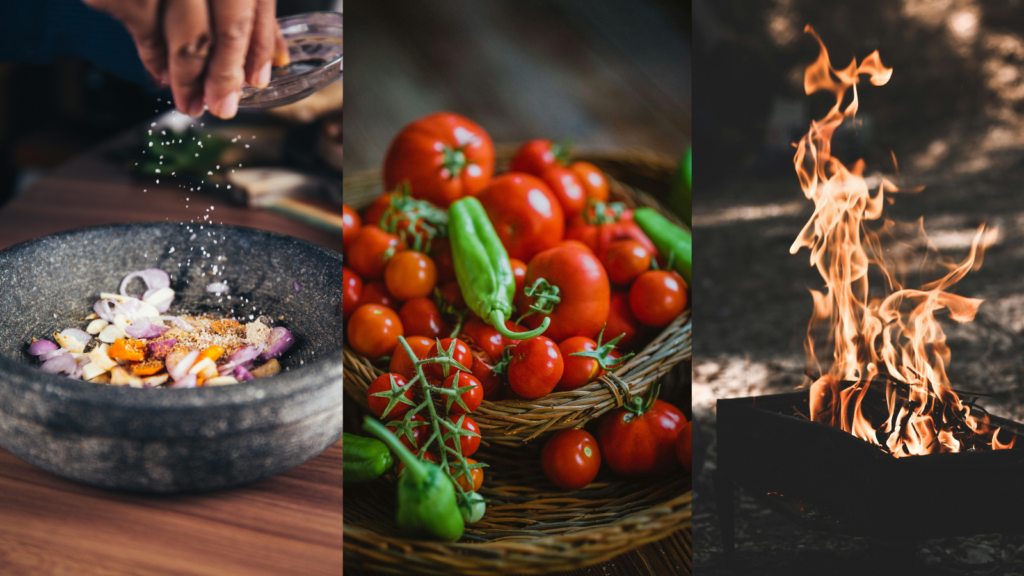
With fuel gone, families turned to burning broken furniture and branches for cooking. The streets filled with the smell of smoke — not the aroma of grilling or bread, but the scent of survival. Yet creativity flourished. Eggplants were roasted over rubble to make smoky mutabbal, a popular dip which before the war would have been made from eggplant, tahini, garlic, lemon juice and salt. Tomato paste was made by sun-drying tomatoes on metal scraps and coffee was reinvented by roasting barley and date pits before grinding them and filtering hot water through the grounds. Mothers mixed crushed biscuits with water and a pinch of sugar to create a dessert they jokingly called “war tiramisu.”
With za’atar and spices disappearing, families revived an old Gazan staple, dakka. The well-known Gazan salad is made from crushed green chilli peppers, tomatoes, cucumbers, onions, lemon juice, olive oil and dill seeds and is made in a clay pot. But with fruits and vegetables becoming a luxury, dakka too was reborn as a wartime version, made by roasting lentils or chickpeas over firewood, then grinding them with a bit of salt and pepper.
Alaa Al-Turk from North Gaza found himself using this crude cooking technique to feed his children. “I roast the lentils over firewood and then grind them. My children dip it in the tiny amount of oil we have and say, ‘This is our new dakka.’”
Food as Memory in a Time of Loss
In Gaza, food is more than ingredients; it is history, ritual and inheritance. Lentil soup is a grandmother’s voice. A pot of maqluba is the scent of Friday. A warm loaf of bread is a fragment of childhood. When these foods disappear, the memories tied to them are threatened too.
20-year-old Rana Al Shaer from the neighbourhood of Zeitoun in Gaza City recalls making maqluba with just potatoes and onions. The original recipe for the famous Palestinian dish calls for rice, red meat or chicken and a variety of vegetables like eggplant, cauliflower, potatoes, carrots and onions. “I cried while cooking it. Not because of the taste, but because for a moment it felt like our old life was just out of reach,” she says.
Even the simplest dish, made from whatever is available, becomes a ritual of holding on to what remains.
The Fragility of the Ordinary
In shelters, cooking became a means through which Palestinians forged and maintained friendships and long-lasting bonds with each other. Women share ingredients the same way they share stories. One brings a fistful of rice, another a pinch of salt, a third a piece of pumpkin and suddenly, a communal dish appears, embracing everyone around it. Children gather around the fire, watching the pot as if it were a TV screen. And the simple question, “What will we eat today?” becomes a fleeting moment of reclaimed childhood.
Soup Kitchens: A Collective Spirit Defying Hunger
As the war intensified, community-run soup kitchens emerged, where people tried to confront hunger together. Displaced families began their mornings in long, crowded lines, standing for hours under the sun or rain, hoping for a single meal to keep them going for another day. These kitchens were not just distribution points, but spaces of collective creativity.
Simple recipes were prepared from whatever was available and familiar dishes were reinvented from the bare minimum. Among the faces that stood out was Gazan chef and food blogger Hamada Shaqqoura, known for crafting child-friendly meals from the simplest ingredients and distributing them for free to displaced families, making everything from cheeseburgers and fries to churros. Often cooking large batches of food single-handedly and relying on community support and donations through social media, he has turned the mammoth challenge of cooking and supporting communities in wartime conditions into a message of hope at a time when hope was hard to find.
Resilience in Every Bite
Cooking under siege is not romantically heroic. It is exhausting, painful and often humiliating. Yet within it lies an unbreakable truth: every meal cooked today in Gaza is an act of resistance against hunger, erasure and despair. Women, with hands cracked from the cold and smoke, continue preparing whatever they can, not because the food is delicious, but because feeding the family, even with very little, is a declaration that life is still worth fighting for.
Amid scarcity, they invent recipes. Amid fear, they create warmth. And under siege, they safeguard their culture. In every improvised dish, from emergency dough to lentil dakka and war tiramisu, the cultural identity of Gaza is kept alive.