
For almost twenty years, in every American high school where I’ve taught, Night, Elie Wiesel’s memoir of surviving the Holocaust, has been required reading. Tenth grade, usually. Increasingly, my tenth graders arrive having read many books about the Holocaust: The Devil’s Arithmetic, The Book Thief, The Diary of Anne Frank, Number the Stars, Maus, and Prisoner B-3087, to name a few. Such reading is essential to help them grapple with the enormity of our history. Rarely, though, do I encounter students who have read Palestinian authors, or teachers—including, until recently, myself—who teach Palestinian authors. Given the genocide in Gaza, however, it feels increasingly fraught to teach Night and the Holocaust without any mention of modern-day Israel, as if the events of World War II have no bearing on the events of today. The dearth of Palestinian voices in the American curriculum, and in the narratives through which we learn about genocide, is a silence we must counter.
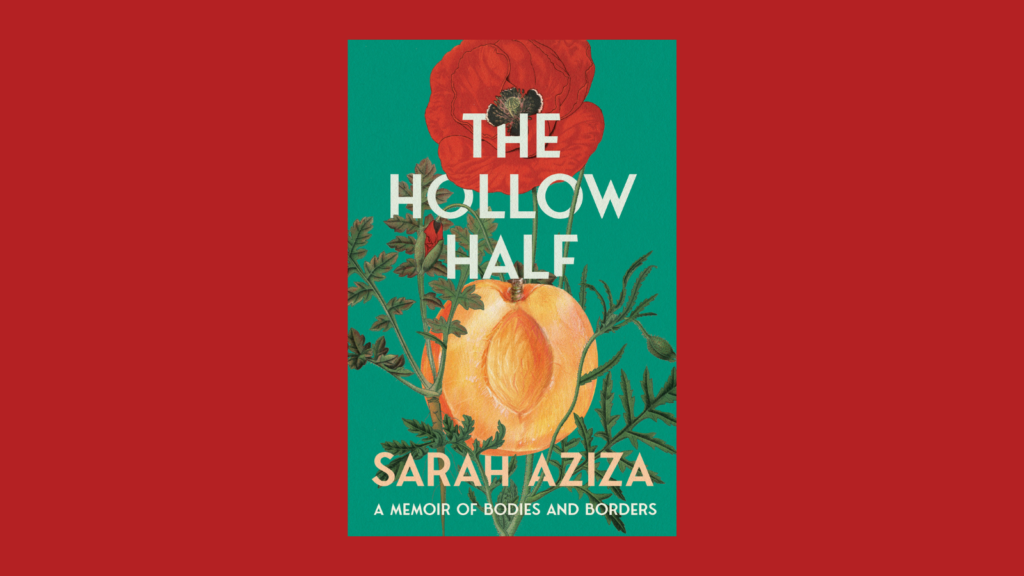
One such voice is that of Sarah Aziza, author of The Hollow Half: A Memoir of Bodies and Borders (Catapult 2025). The daughter of a Gazan father and a white American mother, Aziza tells the story of growing up partially in Illinois with Fox-News-watching, Christian grandparents nearby, and partially in Jeddah, Saudi Arabia, living with her Muslim grandmother, Sittoo, a Palestinian refugee. Before she was born, Aziza writes, her parents “imagined their future child as a private melting pot…half-and-half” (81). But the blending is not so seamless. From her maternal extended family, Aziza understands that “always, America [is] invoked alongside demands for ambiguous gratitude,” which bewilders her, since during the years she lived with her extended family in Jeddah, she “rarely felt deprived of more than Cap’n Crunch” (99).
Still, the story of her family’s exile from Palestine is a tale of undeniable loss. By weaving her own stories with those of her father and his mother, Aziza reveals the generational trauma inflicted on the Palestinian people, and its reverberations across time and distance. She also traces larger stories: Israel’s systemic denial of Palestine and its people, the United States’s unwavering support for Israel, and the effects of the past century on the Palestinian diaspora, particularly its writers.
Aziza doesn’t just write into silence, she also writes of silences, both historical and personal. As much as it is a tale of her Palestinian heritage, this memoir is the story of her struggles with anorexia. Anorexia is not just a silencing of hunger, but a silent way for people to make invisible pain visible on their bodies. The links between her family’s suffering and her eating disorder are hinted at but never fully drawn; instead, they appear like dotted lines on a map, like those of our rarely-agreed-upon borders.
The “borders” in this book’s subtitle are both literal and figurative. Identity is to the body what country is to the land: an abstraction, a myth, an idea—but one so powerful it shapes the experience of its concrete counterpart. Just as identity dictates what happens to a body, the ideas of what a country is or does dictate what happens on the land, not to mention what happens to the bodies that live on that land. Some of the borders Aziza explores appear on maps, like the border crossing between Jordan and Israel where, once her name arouses suspicion, she is told, “You are not going to Israel today” (253). Others are the constructed boundaries that determine what we allow ourselves to believe about who we are, or who we can be.
The “bodies” in the book’s subtitle include hers, certainly, but also the body of her grandmother, who spent her final decades constrained by undiagnosed pain, which forced her to crawl “onto the lawn to tend her mint bush” (142). And the body of her father, who arrives as a college student in the Midwest after a childhood as a refugee in Saudi Arabia. And the bodies of her Palestinian kin still in Gaza and Jeddah, and those of her fellow patients at the in-patient treatment facility. Aziza is interested in bodies as sites of pain and sources of knowledge, alluding to the parallel between bodies and land in lines such as this one: “I feel it in the soil of me…. The haunting in our happiness” (339).
A poet, translator, and journalist, Aziza brings all the skills of these professions to bear on this book, whether through lyrical descriptions, forays into the etymology of Arabic words, or footnotes that document the history of Israel and Palestine. Add in the transcripts of voicemails from her father, the mental status examination from her own medical records, and the lines from Palestinian writers like Emile Habibi and Ghassan Kanafani, and the book takes on the feel of a collage. Through each of these lenses, however, she investigates shame, duty, memory, and resistance. Ultimately this book is a story of survival: of herself as a survivor of anorexia and of her family—and Palestinians in general—as survivors of genocide.
Fittingly, the book begins, in a section titled Overture, with her grandmother, Sittoo, and with food. To start the day, Sittoo fed her “hunked cheese with jam or cucumber” and pita “charring over heat” (5). Food is nurturing, food is love. Later in the book, Aziza describes Sittoo urging more helpings on her father: “She wanted to fill him with her love until it could be read on his surfaces. I saw that flesh could be evidence of what we are given, what we take. That was before I learned bodies could tell the wrong stories too” (126). The book also begins with a sense of displacement: Aziza’s iPhone asks her repeatedly, “Is this you?” and “Who is this?”, as it tracks the pictures that document her drastic weight loss. Even her phone seems to recognize she is a stranger to herself.
The next section of the book, titled Silence, plants Aziza in a moment of crisis, in 2019, when her weight has dropped to 82 pounds (she is 5’10”). She spends several months at the in-patient treatment program in a New York City hospital. There she describes her body as “a constellation of pains with silences lodged between” (10). Newly wed, she has a diligent husband who visits every night; she yearns to go back to the apartment they share. After she leaves the hospital, though, much of her healing still lies ahead of her.
Aziza is particularly adept at tracking dehumanization. Her shrewd observations and matter-of-fact, sometimes deadpan delivery capture the flat sterility of the hospital: “In group sessions, we named our neuroses or had them pointed out. Therapists in pilling sweaters made lists on a whiteboard that never fully erased” (39). She marks how “the nurse kept the door cracked while I peed….our bodies, graphable amalgams of pulse and pounds” (24). On her last day, “the staff exchanged their warnings for distant smiles, lukewarm congratulations” (51). Later, at a for-profit recovery center where she must report each day until the COVID pandemic makes travel too risky, she wryly observes the negotiations between the center and her health insurance as “my CARE PLAN: increments of time and sickness for two companies to trade” (97).
This same level of observation Aziza brings to the lives of her father and grandmother, helping us understand what the policies of Israel, and of the world towards Israel, have meant for this specific family from Gaza. Sittoo “welcomed Ziyad [Aziza’s father] in a UN clinic, alone” in 1960 (180). Of her father, Aziza writes, “He would not have called his past unhappy—happiness was not the primary unit he used to measure the world…. He was seven when war displaced him to Jordan, then to Jeddah, where his family lived in Little Palestine, a large ghetto made of kin” (66). Aziza humanizes her father through details like the water bottle he fills with soil, soil that comes from the plot of land he bought in Gaza, on which he has never built.
The author’s empathy for her father and grandmother is generous, even as she explores the pressure she felt to be successful, to be American, to be happy. From a young age, she senses her life to be “a consoling corollary” to her grandmother’s suffering (5). Her father tells her, In this country, you can be anything (5). Sure enough, she fulfills one version of the American dream, attending an Ivy League university. At Penn, Aziza finds an activist community that offers her solidarity and a community where she can embrace her Palestinian roots, but she also finds bigots, corrosive men who “would ride their elite education into the halls of wealth and power” (321). Even then she struggled with her eating disorder. However, her father’s sense of her as strong and resilient is so deeply entrenched that in the hospital, he fails to recognize how sick she is. “But you’ll be fine, right?” he asks. She realizes “all he wanted was to see me thrive” (167).
Aziza doesn’t flinch, either, from describing the shame she once felt towards her hobbled grandmother, sitting on the kitchen floor and cooking over a propane stove, an object of curiosity, disgust, and ridicule for American guests to her Midwest home (See, honey, that’s what people look like in other countries, Jill, one particularly galling woman, says to her son, as they gawk at Sittoo (137)). Aziza reflects on the silences that patched over the ignorance and condescension of such visitors, what she calls “this first imprint of shame” (138). Would her shame over her grandmother, her suppression of the Arab parts of her identity, have lessened if her father had “explained the small humiliations he swallowed, the wrongness others saw in him” in the United States (138)? Maybe. But she concludes, “Doing this would have cost us both some innocence, hardening the edges of the gauzy dream” (138).
By 2020, home after treatment, Aziza sees through this “gauzy dream,” though she struggles to heal. Sittoo, now deceased, begins to visit her in dreams. As she remembers and reflects on Sittoo’s resilience, love, and nurturing, Aziza takes strength from her grandmother’s legacy. She doesn’t allow us, or herself, to see her grandmother as Jill saw her: a pathetic figure, a victim of suffering, a symbol of strangeness. No, Sittoo is a survivor. For her own survival, Aziza takes inspiration from the life of her beloved ancestor, who outlasted so many violent attempts to erase her or take her home or destroy her sense of self.
Though this theme—survival as a rejection of silence—remains clear after Aziza leaves the hospital, in the section titled Language, the chronology of the book swirls. We keep moving forward in time, through 2020 and 2021, as Aziza fights the urge to “restrict,” in the language of the hospital, and as she and her husband find their way in a new marriage full of hardship both within (her disease) and without (the pandemic). Interspersed with the events of this timeline are the stories of her college years at Penn, her grandmother’s exile, the years her family lived with Sittoo in Jeddah, the years Sittoo lived with them in Illinois, and the years in her twenties when Aziza began traveling or working in Jordan, Saudi Arabia, and Palestine.
Each segment tends to be brief, either a few pages or sometimes just one sentence adrift on the otherwise blank page. Because the pieces are so fragmentary and often leap both in time and geography, reading the second half of this book can be unmooring. Perhaps this aesthetic effect is intended in a book about porous boundaries and fractured identity, but it may work better as an author’s literary intention than a reader’s immersive experience. Even Aziza’s syntax bends toward fragments, in prose studded with lines like these: “Feel the swoon of heart swinging back to chest. Hitting it like water, a hot pink spreading beneath my ribs. One beat, two beats, to pretend that this can last” (130). Still, albeit in a cyclical, lyrical fashion, Aziza does fill in the pieces of her life and family’s story.
Two places where Aziza’s lyricism overrides her narrative are in her ruminations about her queerness, and in her description of her marriage to C., who gets only an initial to tether him to the book. She refers throughout the book to suppressed desire for another woman, alongside her sense that “some things simply couldn’t be” (313). Although I understand a memoirist’s protective impulse in writing about those closest to her, the scenes with C. seem equally hazy, full of portent, so much withheld that we are left wondering just what, precisely, we are meant to understand. Here she is on their relationship: “Our bond, the lean vessel we are riding from the past world to the next. Our two bodies, soft and precarious, a shared inheritance” (144). When she swerves into abstractions of feeling or theory, readers can lose the threads of her story.
The memoir’s final section feels the most diffuse and expansive, as Aziza switches from first person to the universal second and writes in sections just a paragraph or two long. The book’s arc also mirrors this expansion: as Aziza conjures her memories of Sittoo, her sense of her own story widens. She names her loss; she confronts her past shame; she claims her family. Sittoo is no mere symbol, but she does become synonymous with Gaza—battered, defiant, human—and Aziza seems to see Palestinian resistance as a model for her own healing: Gaza “daily births her refusal to succumb or disappear” (345). The same could be said of Sittoo, and Aziza herself. Resistance is the will to live.
The Hollow Half is an attempt to make sense out of senselessness, whether anorexia or genocide, and in this—even in its refusal of a tidy narrative—it succeeds. The writing becomes an ordering principle, a line of surveyor’s flags staked on the chaos and suffering of this world. For most of the book, Aziza’s deft touch illuminates exactly the stories too often silenced, especially in the United States and its public schools. Her book helped me confront my own ignorance about the history of Israel and Palestine, and it clarifies the link between the past one hundred years of violence and the photographs I see today: images of Gazans killed while approaching aid trucks or malnourished Gazan babies in hospitals with no formula. Aziza warns, “Gaza’s sky is our own. There is no innocence for we who dream ourselves separate from her fate” (346).
Long after I closed the book, two passages stayed with me. One was a description of the indignity Aziza’s uncles suffered in 1967, when two of Sittoo’s sons (“all men above fourteen”) were forced by Zionist soldiers to “an empty square near the sea” (195). Aziza’s father, only seven, snuck down and from a hiding place “watched guns point, ordering the men’s faces to the sand…. The soldiers were after not blood but gold that day. Each pocket was turned out, every wallet confiscated. The captives staggered away without their watches, bodies returned to them” (195). Shortly thereafter, Aziza’s father and Sittoo left Palestine for good.
This scene echoes one in Wiesel’s Night that I have taught over and over. It’s in chapter two, when the Jewish prisoners in cattle cars are stripped by German officers of their gold, silver, and watches. It’s hard not to wonder if the Zionist soldiers knew how much their actions mirrored those of Nazis just 25 years before. (Or whether they cared.) What happens when we only hear one side of a story—Jews as victims—and never another—Zionists as oppressors? To be sure, we must recognize that not all Jewish people are Zionists, just as not all Israelis support the actions of the Israeli government. But Aziza’s book is a welcome counterpoint to complicate the more simplified narratives that cast genocide as an historical tragedy, never a present-day tragedy.
The second passage that echoes in me also takes place near the sea. At the end of the book, Aziza recounts a return to Haifa. Written in second person and future tense, this section feels prophetic. On the last day of that trip, she writes, “You will take the train just to see the Palestinian boys jump off the ancient walls into the sea. You have treasured their memory since you first glimpsed them, many years ago. Standing next to your father, you saw him in each leap” (362). This is another act of generosity, as she invites us into her memories and her family’s story; it is also a call to action. She encourages us to see ourselves, our children, even our parents, in them, and to know, again, this warning: “Gaza’s sky is our own” (346). Aziza witnesses those boys jumping into the sea, their innocence irrevocable, their humanity our own. In doing so, she helps us see them, too.