
As a faculty member at East Tennessee State University, I have the fortune of working and teaching with painter and poet Valencia Robin, whose first book, Ridiculous Light, won Persea Books’ Lexi Rudniski’s First Book Prize and was a finalist for the Kate Tufts Discovery Award and named one of Library Journal’s best poetry books of 2019. Featured in On Being’s podcast Poetry Unbound, her debut collection sifts through memories of family, divorce, and Milwaukee to create a lyric portrait of a Black woman’s life in textured layers of grief, power, perseverance, and joy.
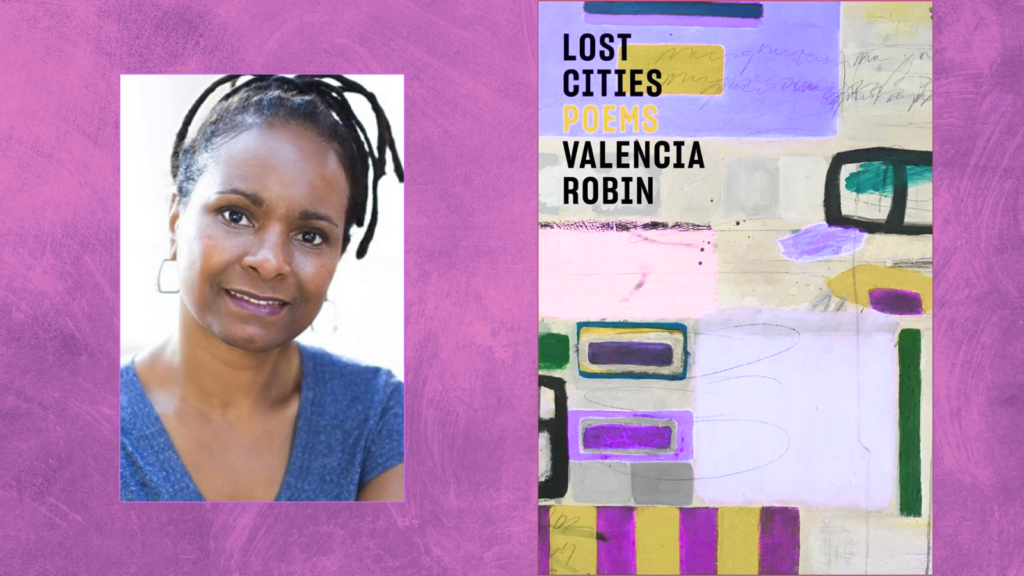
Robin’s second book, Lost Cities, also published by Persea Books, takes readers with the poet when she leaves Ann Arbor, where she earned an MFA in Art & Design from the University of Michigan to Charlottesville, Virginia, where she earned a second MFA in Creative Writing from the University of Virginia. Both cities represent the eponymous cities lost on this journey of self-discovery and reckoning with racial trauma to find guiding models in the arts, including Nina Simone, Eavan Boland, Stevie Wonder, and Nichelle Nichols, the actor who played Lieutenant Uhura on Star Trek.
Robin has also received a National Endowment of the Arts Fellowship and published poems in renowned journals and anthologies including The Best American Poetry, The New York Times, and The Virginia Quarterly Review, which awarded her the Emily Clark Balch Prize. To celebrate the release of Lost Cities, she gave a reading on our Johnson City, Tennessee campus, which we introduced with this conversation to contextualize her poetry and creative work for that audience.
Amy Wright: Your “Poem for the Guy Down the Street” in Lost Cities creates a wonderfully casual intimacy. How does poetry hold space for those kinds of relationships?
Valencia Robin: I think poetry is made for those kinds of relationships. I routinely file away the people, places and things that I notice in my everyday life. That guy was one of my neighbors; I’d pass him on the way to class when I was in graduate school at UVA. I didn’t know how or when, but I knew he’d end up in one of my poems, not just because he used to call me Darling, but because he was always working on his taxi, not in a garage but right on the street. Of course, the key to writing about something so ordinary—something that’s really just an anecdote—is finding the bigger story underneath it. I didn’t know when I started writing what that bigger story would be, but I knew that if I wanted to move my readers on an emotional level, I had to figure out what moved me about the man and what moved me was that as skilled and hardworking as he obviously was, he was still clearly struggling financially. Which is maddening to me and yet true for so many working people.
AW: The covers of Lost Cities and your first book, Ridiculous Light, both depict your paintings. Will you talk more about what painting allows you to express and transform?
VR: Painting is a kind of play for me. It’s a way to stop making sense, which is hard to do when I sit down to write a poem or to work with words in general. My painting reads as abstract and so, initially at least, I can delay the tendency to be logical, to figure out what I’m trying to say. Which I think benefits my poems as well as my painting because I’m constantly painting myself into a corner and having to find my way out.
The truth is, whether it’s a poem or a painting, I’m happiest when I’m making something. I don’t know if they still put toys in the bottom of the cereal box, but as a kid, I found the empty cereal box a lot more fun to play with than the toy. And that’s still true.
AW: In On Being’s Poetry Unbound podcast, Pádraig Ó Tuama gave a close reading of “The Coup,” from Ridiculous Light. He says the speaker in the poem appreciates the difficulty of both perspectives presented—of being a single mom as well as being the child of a single parent. Did writing that poem, and others in your first book, which is dedicated to your mom, help you see your relationship in a different light?
VR: Absolutely. Poems are magic like that. They can help you process relationships, experiences, memories. Writers probably don’t talk about that enough. And once you’ve finished a poem like that, there’s this incredible sense of satisfaction. It’s not as if you’ve fixed anything, but you’ve managed to give it some order.
Of course, by the time I’d written that poem about my relationship with my mother, I was already in a place where I could look at her as a person in the world and not just as my mother. I could look at her as a woman, as an African-American, as someone from the working-class and how each of those labels limited her opportunities. And yet she managed to send two kids to college. Which is to say, there were things that my mother and I didn’t agree on, but when I got to a certain age, I couldn’t help but be impressed.
AW: One of the cities referenced in Lost Cities is Charlottesville, Virginia. You write the city a letter following the August 2017 demonstrations that turned deadly when a white supremacist drove his vehicle into the crowd, killing Heather Heyer and wounding 35 other people. After that act of violence, you ask: “…is this where we live, Charlottesville? …city that gave me my first mountains…” Did poetry help you reckon with that tragedy and the history of racial violence it brought to the fore?
VR: It did. And yet, it took a long time to write that poem. I couldn’t find my way in until I came up with the first line: “I came here for poetry.” That line was important because I wasn’t from Charlottesville; I was studying poetry at the University of Virginia, a dream come true. In fact, before the Unite the Right Rally, you could say that I was in La-La land. I’d never been happier.
I wrote three different versions of that poem and dozens of drafts before I realized that what the poem was missing was my particular story. And it wasn’t until I arrived here at ETSU and Professor Michael Cody invited me to the Appalachian Studies Association Conference to do a reading with him and several others that I found that first line. The theme for the conference that year revolved around community and place, and something made me put the title of that poem on the application. Which meant that now I had to finish it. I read an earlier draft at the conference; it took a few more drafts before I found the right ending.
AW: That is a bold strategy. I’m glad it worked! Lost Cities opens with an Audre Lorde epigraph that reads:
the flights of this journey
mapless uncertain
and necessary as water
For me, it suggests the flights of joy and necessary water these poems draw from a deep well despite the many infiltrations that could pollute or dilute it, but what does it meant for you?
VR: That epigraph seemed tailor made for this book, which is very much about my journey to finding poetry. After graduate school, I had no idea where I was going to land. Part of the issue was that I’d fallen in love with teaching and yet most of my work experience was as an arts administrator. So, it captures the aspect of a journey that is mapless. And the journey felt necessary because, initially, I really didn’t want to leave Ann Arbor which felt very much like home. In fact, I applied to the University of Michigan’s MFA program with the hope of staying. But, in retrospect, leaving was just what I needed. I can’t imagine a better graduate experience than the one I had at UVA. And while I miss my friends, living in Virginia and now Tennessee has been quite the adventure, one that includes mountains.
AW: You are a Star Trek fan. Will you talk about the Lt. Uhura sequence and why she inspired a sequence of poems?
VR: I love space movies—or rather, I love utopic space movies, not scary ones. I started the Uhura series back in graduate school. I thought I would get five or six poems out of it, but I lost steam after the first one. Then, as I was putting this book together, I found that poem and thought it would be a good addition because Uhura and the rest of the Star Trek crew are on a journey like the speaker of my poems. For research, I watched all the old Star Trek movies, but it wasn’t until I discovered an interview with the actor who played Uhura, Nichelle Nichols, and heard what was happening behind the scenes, that I found my inspiration. For instance, Uhura was Martin Luther King, Jr.’s favorite TV character and in fact when Nichelle Nichols told him that she was going to quit the show and go back to Broadway, he convinced her to stay because he felt her role was such a positive one for Black people. Anyway, finding that interview meant that suddenly I had all the material I needed. In fact, the poems are actually in the voice of Uhura and Nichelle Nichols. I’m hoping to continue the series but, of course, saying that is probably the kiss of death.
AW: Maybe list that series before your next reading—setting deadlines for yourself seems to work.
With your poem “Woke,” you let readers into an experience so internal it almost can’t be expressed. It’s profoundly intimate when: “You’re simply walking from your office / to Monday morning staff meeting, // heading down a long corridor…a morning that couldn’t be less mystical, // when…—the universe blinks / and everything there is to know yawns into you // and you into it.”
VR: That poem really surprised me. I hadn’t written a poem in a long time, and something brought that memory to mind. It was the most bizarre five seconds of my life. I can still feel it, the sense that I was one with the universe, that for five seconds I knew everything there was to know. The question was, could I figure out a way to capture such a strange experience in a poem?
The funny backstory is that I belong to a writing group and when it was time to workshop that poem, I was on the edge of my seat waiting for someone to ask me about the experience. But nobody said a word. That is, they liked the poem and suggested a couple of tweaks, but that was it. Finally, I had to ask: has anything like that ever happened to you? And they all said: No, no but that it seemed totally believable.
In terms of turning such an intimate and frankly woo-woo moment into a poem, I’m pretty fearless when it comes to writing about my life. Not because I’m into self-display, but because speaking from the self’s specific viewpoint is the best way, I think, to connect to the reader. Which is what I love most as a reader myself; that I have a front row seat to someone else’s consciousness. The trick is to put the self in service to the poem and not to me or the experience.
AW: That is a very good trick—and great advice for other writers. Another poem I love from Lost Cities is “Ars Poetica.” It ends with the speaker waking up singing, “And I mean, really singing, catching myself all morning wondering what it means.” What is the relationship between music and poetry for you?
VR: Music was probably my first introduction to poetry, that is, besides the scriptures that I heard in church. My mother was a big reader, but nobody in our house read poetry. Like most kids, I couldn’t have survived without the radio and like most adults, I remember the stages of my life by the songs I listened to. And yet, I didn’t realize what an inspiration music was for me as a poet until I was putting together my first book.
“Ars Poetica,” was inspired by the Earth, Wind and Fire song “All About Love.” The song’s last line is: “And if there ain’t no beauty, you gotta make some beauty,” which totally loses its magic without the music, but what I realized while writing the poem was that that line had become a kind of mantra for me, a mandate. Thus the title, “Ars Poetica.”
AW: What a worthy goal! Thank you for sharing it and for talking with me.
Amy Wright is an Associate Professor of Creative Writing at East Tennessee State University. She earned her Ph.D. from the University of Denver and has authored three poetry books, six chapbooks, and co-edited the Virginia volume of The Southern Poetry Anthology (Texas Review Press, 2022). Her nonfiction debut, Paper Concert: A Conversation in the Round, (Sarabande Books, 2021) won a Nautilus Gold Award for Lyric Prose. She has twice been awarded a Peter Taylor Fellowship to the Kenyon Review Writers Workshop.