
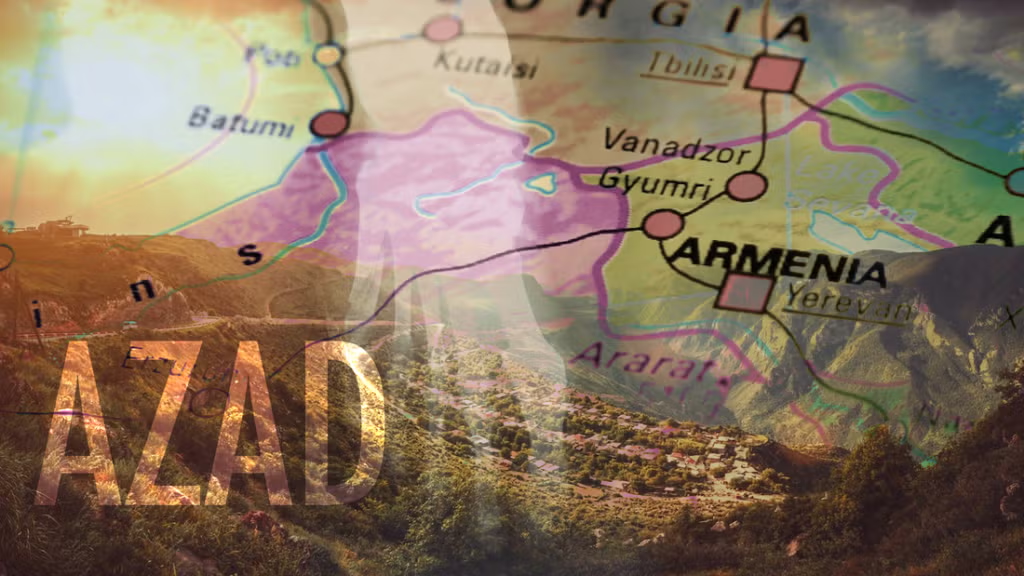
Azad Storytelling
The Keene Theater had been transformed—so much so, that it no longer felt like a university space, but something closer to home.
Instead of an Armenian rug-clad stage awaiting its performers, I saw my medzmama’s living room and imagined younger versions of my sister, my cousins, and myself sitting around her, watching intently as she peeled apples for us. Middle Eastern instrumentals floated throughout the theater via loudspeakers. A mother standing across from me asked her children, “Oor nisteenk?” “Where should we sit?” I rarely hear my mother tongue outside of family gatherings.
I first heard about the September 2024 Azad Storytelling performance through the Center for Armenian Studies (CAS) at the University of Michigan. I recently moved to Michigan for a new job and craved an opportunity to be in community with other Armenians. CAS staff members invited Sona Tatoyan, the main creative voice behind Azad Storytelling, to perform her full show with the puppets, which she hadn’t done for two and a half years since its debut in Los Angeles.
It wasn’t until the lights dimmed and oudist Harry Kezelian began to play his instrument that my attention returned to the stage. “Karagöz,” Tatoyan’s voice echoed off-stage. As if responding to a command, the lights behind the white puppet screen on the stage turned on, illuminating a lemon tree. Tatoyan continued, “An ancient, shamanistic shadow puppet theater. The puppeteer, the hand of the divine.”
Puppeteer Ayhan Hulagu framed the screen with his hands as Tatoyan continued speaking. A brightly colored puppet of a bird stood next to the lemon tree. “Karagöz: a form of pre-cinema that plays with shadow and light, originates in the lands we know today as Turkey, Armenia, Syria, Greece,” Tatoyan said. “An art form that was used to make social, political commentary— to speak the unspeakable, using bawdy, satirical humor…”
She spoke in slow, purposeful beats, allowing the audience to savor her words.
“I’d heard that my maternal great-great-grandfather Abkar was such a puppeteer.”
“A Magic Box in a War Zone”
“If you would have said to me six years ago, before I found these puppets, that I’m going to be working with puppets and they’re going to take over my life, I would’ve laughed and scoffed,” Tatoyan told me over Zoom after the performance. In a self-mocking tone, she continued, “I’m a serious artist. Like, what are you talking about? Puppets? Oh my god!”
During the Syrian Civil War in 2014, Tatoyan heard about her great-great-grandfather Abkar Knadjian’s 180 shadow puppets tucked away in the attic of her family home in Aleppo. Five years later, she made a perilous journey to rescue his puppets from the now abandoned house. When she finally laid eyes on his wooden trunk, she felt as if she discovered “a magic box in a war zone.” The hundred-year-old puppets, both stock characters in Karagöz tradition and Abkar’s original creations, were perfectly preserved.
Azad Storytelling is one of Tatoyan’s several ongoing projects through her organization, Hakawati, which means “storyteller” in Arabic. In the performance, she uses Abkar’s puppets to thread decades of history into a clear narrative that represents her growth as a storyteller. The puppets guide us through the Armenian Genocide, the Syrian Civil War, tales from 1001 Nights, and Tatoyan’s childhood to reveal her oft-repeated insight, that, “poison siphoned through story emerges as medicine.”
During the performance, Tatoyan shares that a week after she found Abkar’s puppets, she fell down the stairs in her Aleppo home and broke her foot. She immediately recalled a Western Armenian saying that her father often used: “May you break your foot, so you sit in your place.”
Forced to sit still, Tatoyan was able to reflect on the intergenerational trauma she carries and her feelings of isolation from growing up in the United States. “My whole life, I would spend my summers in Aleppo, and I would hear [my family’s] stories. I knew them to be true.” Back in the United States, she would eagerly flip through history textbooks to find no mention of the Armenian experience. For Tatoyan, Abkar’s puppets are healing—a counter to denialism.
Origins
Tatoyan was born in Baltimore, Maryland, to Armenian parents from Syria. She studied English and theater at Wake Forest University, where she was mentored by Dr. Maya Angelou. She later studied acting under William Esper at his studio in New York City.
In explaining the origins of her Hakawati organization, she said, “Every summer I would go back to Aleppo, and there I would always hear, ‘Abkar Dede [Grandfather] was a hakawati, a hakawati.’ I kept hearing this word…And then about eight years ago, I was on a silent meditation retreat in the woods of Finland with a Burmese monk.” She paused to laugh. “I love saying that sentence, ‘cause it’s like the beginning of a story!” During the retreat, she described that she had a “total download vision” of the Hakawati project.
The vision for Hakawati came to her in 2016, by the time most of her family fled from Aleppo as refugees to Yerevan, Armenia. “The stories I was hearing from remaining family members in Aleppo were quite different from the mainstream Western news media’s depiction,” she recalled. Reflecting on this observation, she asked herself, “What could I do to help create a space and a place to amplify the voices of those that were not necessarily being heard to tell their own story?”
A few years before this revelation, she met current Hakawati producer Raffi Niziblian in Yerevan. Tatoyan describes their connection as “a very natural, organic kind of development,” and she knew they would make great partners to grow the project.
Niziblian works to boost Hakawati’s reach in Armenia. In June 2024, he organized the 1001 Nights experience tailored for Armenian audiences in Yerevan. The event, which ran for about six hours, featured a storytelling performance by Tatoyan, meditation, music, and Armenian and Iranian cuisine. Tatoyan and Niziblian hope to host this event every summer. “Eventually, we want to capitalize on that and turn it into an experience that will be a more holistic one,” Niziblian explained. He hopes to engage Armenian audiences through workshops, trainings, and film screenings.
Like Tatoyan, storytelling is a central part of Nizblian’s life. “When I met Sona, I started thinking, why am I so inclined to storytelling? And just recently my dad passed away, and I was thinking about the whole journey of my dad and how he would tell us a story every night.” Niziblian carries on this tradition with his own children, inventing stories about horses with wings flying through thick clouds. “I, too, am telling stories non-stop.”
“The World is Just a Puppet Show”
Over a hundred years ago, Abkar and his puppets traveled around the Ottoman Empire. His puppets were handmade out of multicolored leather and cut into shapes like trees, people, and animals.
“He used story to distract from suffering…an enlightened alternative to savagery,” Tatoyan described during Azad Storytelling. Throughout its history, the Ottoman Empire systematically discriminated against Armenians and other non-Turkish ethnic minorities. Karagöz puppetry provided people like Abkar a safer vehicle for criticizing the empire.
Today, increased repression in Turkish society makes it difficult for artists to criticize Türkiye. Ayhan Hulagu, a Kurdish artist and the puppeteer for Azad Storytelling, originally studied the art form under the three remaining Karagöz masters in Türkiye. To safely practice the art form, he left for the United States under an EB-1(a) “Einstein” visa issued to individuals with extraordinary abilities in their field of work. In 2017, he founded the US Karagöz Theatre Company, which he describes as “a bridge between the West and the East.”
Tatoyan wholeheartedly believes in the healing power that these puppets possess. “One of our philosophies is creation as an antidote to destruction. And we’re in a world where people think that destruction is the antidote to destruction.” She let out a tense laugh. “If you can make [someone] laugh, [then] you find your common humanity.”
One of Hakwati’s first supporters—both personally and financially—was Osman Kavala, a Turkish philanthropist and human rights activist. Kavala organized several Armenian Genocide commemoration events in Istanbul despite Türkiye’s continued genocide denial. Tatoyan confessed that Kavala’s defiance to mainstream Turkish narratives “dismantled and reframed my connection and understanding of Turkey and Turkishness.”
Today, Kavala is facing his eighth year of life imprisonment after a Turkish court accused him of leading the 2013 Gezi Park protests. Unable to share his own story, Kavala is now an honorary board member of Hakawati, and he is an integral thread in AZAD (the rabbit and the wolf), a co-production with Golden Thread Productions. “A major part of that play is my story, my friendship with Osman,” Tatoyan says. “And again reframing the Armenian-Turkish relationship.” She says her friendship with Kavala counters “contentious, deeply seated hatred.”
She still writes to him in prison.
To be Human is to be a Hakawati
“Humankind has been telling stories since the cavemen on the walls,” Niziblian said. “It’s nothing new. It’s just reinventing itself. Human-to-human storytelling is sort of making a comeback, and I think that’s what we’re here to capitalize on and make sure that we’re putting that in the forefront.”
Tatoyan is also careful to clarify that storytelling itself is a tool. “It can destroy, and it can also heal.” She asks herself, “To what end is that storytelling being used?”
At the end of all her performances, Tatoyan includes a talk-back session. These discussions allow for the raw, human connection that she fosters with Hakawati. “People are so hungry to share,” she said. “There’s something about the work that sort of cracks people open. It’s not of a certain age group or an ethnicity. I’m really heartened by that.”
I saw audience members of various backgrounds sitting in the Keene Theater: South Asian, Palestinian, East Asian, Armenian, and more. Several people expressed how watching the performance reinvigorated their passion and commitment to the arts. One audience member shared how watching Tatoyan overcome trauma encouraged her to revisit the complex emotions she holds surrounding her father’s suicide. Another bonded with Tatoyan over their shared appreciation for South Asian culture. A Syrian Armenian American family in the audience shared their fond memories of life in Syria, including the sounds and smells of their neighborhoods.
“We live in a world where you see the Middle East, and usually the first thing in the global imagination is terrorism, war, subjugated women, violence, dark. Everything that rhymes with ‘not good.’” Tatoyan laughed. “If we can pivot and go, ‘look at what our region of the world has offered our global human family,’ it’s reframing all of this dark stuff and going, ‘we have so much to share in terms of the healing arts, the sounds of instruments, the stories we carry.’”
A key moment in Azad Storytelling is when Tatoyan launches into a tale from 1001 Nights about Scheherazade, the daughter of a vizier. One day, the sultan in Scheherazade’s kingdom discovered that his wife cheated on him. Blinded by anger, the sultan vowed to exact his revenge on women in the kingdom: every night, he would marry a virgin and behead her the next morning. Scheherazade, aware of the risk, agreed to marry the sultan. The night they married, Scheherazade began telling a captivating story to the sultan until the early morning. Wanting to hear more, the sultan agreed to keep her alive for the next evening. Scheherazade continued her story for 1,001 nights until the sultan’s anger subsided.
At the story’s conclusion, Tatoyan smiled widely. “A Middle Eastern woman saved the world. I bet you’ve never thought that before.”
In countering stereotypes about the Middle East, Hakawati also broadens our understanding of Middle Eastern identity. Tatoyan and Niziblian, like many Armenians—especially those in the diaspora—come from hybrid identities.
“I often sit with this question of, ‘What is Armenian-ness?’” Tatoyan began. “It’s different for many people. I grew up as a first-generation Armenian American. My Armenianness is connected to [the] summers I had in Aleppo. We had Turkish in the house with Western Armenian and Arabic, and the foods that came with that. When I think of my Armenian culture, it includes hummus and tabbouleh and falafel, whereas an Armenian in Isfahan is not going to have that experience. A third-generation Armenian from Boston who doesn’t speak the language is not going to have that experience. An Armenian from Artsakh is not.”
It sometimes seems that Armenian identities across the diaspora, whether Beirutsi, Hayastantsi, or Parskahye, are too disparate to ever find commonality. Yet, Azad Storytelling—with its tours across Armenian American communities in California, Michigan, and Massachusetts—provides all Armenians with a home where our broken pieces can fit together like we were never forced apart.
“We’ve talked a lot about this,” Niziblian added. “What is the region? We’re always hesitant to put a border around it because we realized how much impact Persian cultures had on Armenia, on the region, on the language, on spirituality with the Sufis. It’s just really multilayered and intertwined.”
The diversification of culture was crucial to the 1001 Nights experience in Yerevan. The music and food featured in the performance represent a wide range of histories: Armenian, Persian, Jewish, and Arab. Instrumental to the event’s success was Tatoyan’s partner, co-founder and producer for 1001 Nights, Isaac Saboohi, a Persian Jew who immigrated to the United States as a refugee when he was twelve. “[1001 Nights] is our joint vision around healing and our region of the world… a shared heritage vision,” Tatoyan said. “This is the closest he’s been able to go back to [Iran].”
Disrupting borders is a key philosophy for Hakawati outside of the 1001 Nights experience. “We need to be able to hear what’s different from the way we’re looking at things. We need to come together and create together.” For Tatoyan, the fact that she embodies a hybrid identity is what allows her to embrace a deep sense of empathy. “You don’t see things just from one narrow lens.”
“Listening to What’s Coming”
Tatoyan and Niziblian look forward to Hakawati’s continued expansion. “We have our plan. We have a vision,” Niziblian said. “What we have is a big appetite. What we need is a community that believes in what we’re doing and trusts us and supports us.”
In an effort to continue promoting cultural preservation, Tatoyan is planning an exhibition for Abkar’s puppets. “It’ll be an international exhibition that tours, and it’s about reframing the refugee experience. These puppets were refugees themselves,” Tatoyan shared. “I think we need to passport these guys!”
Niziblian is currently working on a documentary project for Hakawati, titled, Finding Hope, featuring Rwandan artist and refugee, Hope Azeda, and Bangalore artist, Nisha Abdulla. The documentary aims to demonstrate art as a tool for seeking justice and to empower viewers who are currently fighting against oppressive systems.
Last spring, Hakawati held its world premiere of AZAD (the rabbit and the wolf) in San Francisco, produced by Noubar and Anna Afeyan. The performance included Akbar’s 180 puppets as well as live oud performances by world renowned oudist, Ara Dinkjian.
“These puppets have given birth to two different performance pieces, a puppet exhibition. There’s just a lot,” Tatoyan said. The core of her creative philosophy, though, is listening. Whether discovering Abkar’s puppets or writing Azad Storytelling, nothing was a conscious decision. “Everything, for me, [is a] very organic kind of listening. Seeing one thing kind of leading to another is very important.”
Reflecting on his experience with Hakawati, Niziblian described undergoing a personal transformation. “I learned that I can use [storytelling] to make people feel better. In doing so, I’ve discovered that I’m feeling better.”
“It’s very humbling and it’s very moving to be doing this,” Tatoyan added. “My father always wanted me to be a doctor, and my mother always wanted me to marry an Armenian guy.” She paused to gather her words. “All my work is in celebration of my culture. So, you know what, Mom and Dad? I kind of did what you wanted, but in my own way.”
Aline Keledjian is a recent graduate of the George Washington University with a B.A. in International Affairs and History. She is passionate about dismantling mainstream understandings of Armenian and Middle Eastern identity via oral history and writing. Her work has previously been published in the Smithsonian’s Folklife Magazine and Azad Archives. Her poetry is forthcoming in the first issue of Palabra Magazine. Aline currently lives in East Lansing, Michigan on occupied Anishinaabeg land.