
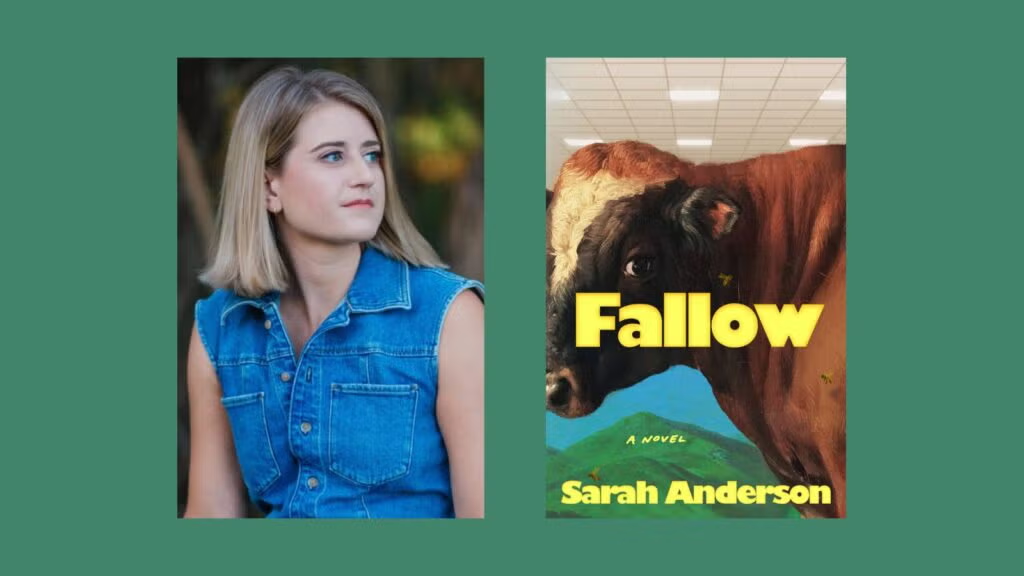
For writers who have yet to break through, success can feel impossibly distant. This is a profession steeped in rejection, and disappointment turns far too easily into cynicism. Spend enough time on X, Substack, or anywhere else struggling writers gather to vent, and the same idea takes hold: publishing is not a meritocracy but a private club. Its doors are open only to a privileged few, while the rest of us have no chance. But then a writer like Sarah Anderson comes along.
I first encountered Anderson’s work in Joyland. It was only her second published story, and it blew me away. A few months later, while she was still unrepresented, that story appeared in The Best American Short Stories. Soon after that, she signed with Bill Clegg, one of the premier literary agents working today. These are achievements that can feel impossible from the outside. But they make perfect sense when you read Sarah Anderson’s work. Fallow has a singular voice. It is both elevated and accessible and hilarious in a way few novels are. Its premise too is wonderful: A woman signs on to become a tech company’s in-house surrogate. Though it sounds dystopian it is shockingly true to our present moment.
I spoke with Anderson over Zoom about Fallow, her sudden arrival in the literary world, short fiction, and, naturally, reality television.
Michael Costaris: Fallow is what you might call a premise-based novel, built around this brilliant idea of a woman working as a surrogate for a tech company. I know this can be an impossible question to answer, but where did that idea come from?
Sarah Anderson: I’ve always been a premise-based writer. The idea comes first, and then I ask: What characters? How would I play this out on the page? The book started as a short story I wrote in my MFA. I was stepping back from full-time work for the first time and thinking a lot about what a good job meant, especially because so many of my friends were in careers they didn’t love. I’ve also always been fascinated by birth and motherhood. During the pandemic, I actually did the early part of doula training and that’s something I’ve always wanted to go back to. So those things came together to form the bones of the idea.
MC: When I first started reading, I definitely expected something more speculative. But the novel isn’t far removed from reality. Was that there from the beginning?
SA: No. I initially conceived of the short story—and the first draft—as much more speculative. That was maybe partly a plotting defense mechanism: I could tell myself, “This can be as ridiculous and weird as I want it to be.” But as I researched the book, I realized how much companies are already inserting themselves into parenting. Some companies will buy their employees The Snoo, this robot bassinet that requires a subscription. Or, pay for sleep training to improve productivity. Gradually, during revisions the book became much more grounded in realism.
MC: And one of the most surprising things reading this was that the program wasn’t presented as altogether terrible. I have two kids, so I’ve seen the toll childbirth can take, even if I can only understand it from the outside. But—and maybe I’m totally insane—it didn’t seem like an entirely unappealing career.
SA: The research process for this book only confirmed for me that pregnancy is such a highly variable experience. Some people have relatively smooth pregnancies, while others are sick every day or have major, sometimes traumatic complications. So this idea is really divisive, especially among women who have been pregnant before. But I can imagine it being a job I’d consider under the right circumstances—probably because that was one of my goals for the book, creating circumstances to make this a desirable position. It was always really important to me that Natalie chooses to take this job, and that it isn’t a dire, life-or-death, escape-from-extreme-poverty situation. She very much chooses this job because she thinks it’s a better option than the other options available to her. I didn’t want the premise to be didactic; I wanted the most complicated, nuanced version of it. That’s generally how I approach writing: start with a premise and ask, “what’s the messiest possible way this could play out?”
MC: The obvious, least messy structure might have been to follow all seven pregnancies in the contract and build out the world within that framework. Instead, you show us only two—the first and the last—and then make a major pivot that we can talk around to avoid spoilers. But I’m curious how you arrived at that structure?
SA: I think sometimes while writing, it can be tempting to settle on the first solution too quickly. I’m interested in asking what the strangest, most difficult, most unexpected way forward might be. I’m a big fan of writing out options, literally making a list of possibilities, especially the weirdest ones, and trying them out. But with Fallow, what’s funny is that when I looked back at the short story, almost the entire plot arc was already there.
MC: Another challenge must have been the birth scenes. Given the premise, they’re obviously necessary but we’ve seen childbirth depicted countless times in film and television, often through the same familiar tropes—
SA:—yeah, I think fiction, TV, and movies are getting better at portraying birth realistically, but there’s still a lot that falls back on heavy breathing, screaming, and then suddenly someone is holding a three-month-old baby playing a newborn.
MC: How do you write those scenes in a way that feels distinct, while also staying authentic to an experience that is so personal to those who’ve had it?
SA: Yeah. It would have been easier to have the contractions start and then go dark, cut away to the next scene. But I wanted those scenes to feel specific and lived-in. This was a book about motherhood and birth, so I needed to show the births. My sister was pregnant while I was working on the book, so I talked to her a lot and had her read the birth scenes. My professors in the MFA had children. They read it too. And honestly, Reddit was hugely helpful. People describe everything in incredible detail.
MC: One detail I can’t forget is Boingo the Clown, who the company hires to pester Natalie until she laughs, for whatever pseudo-scientific reason they think that matters. For anyone who hasn’t read the book yet, it should be said: this is one of the funniest novels of the year.
SA: Thank you.
MC: I was curious how humor fits into your style. I’ve talked to writers who approach it very differently: for some, the laugh is the most important thing. For others, they’re paring down jokes to keep a realistic spine. How important is the joke, or the laugh, to you?
SA: Pretty important. Humor has always been one of the great joys of writing for me. Julie Buntin once told me that you have to find a way in to every scene you write that keeps you interested—even when it’s a scene you have to write for plot reasons. Whatever your strength is, or whatever interests you, bring that into the scene. For me, that’s humor: making myself laugh, or finding a way to make something a little more absurd. So it’s always a priority, even if I’m not thinking about it consciously. And with serious subjects like bodily autonomy, birth, and motherhood, there’s so much value in finding the absurdity. Finding and revealing those moments is part of why I write.
MC: I wanted to ask about that. I just finished a draft of my novel and it’s premise-based, or high-concept, as well, which sort of mandates functional scenes. The necessary ones. Was that a challenge for you?
SA: That’s probably the hardest part of writing a novel for me. I love short stories, and in a short story you don’t have to worry so much about those functional parts. You can often just cut away. In a novel, though, sometimes you have to get somebody from A to B. A friend of mine captures the issue perfectly—he says, “I don’t want to have to write, ‘She walked into the kitchen for a glass of water.’”
MC: When it’s done poorly—like in one of those ’90s action movies where a cop suddenly gets a tender scene with his wife and you immediately know he’s going to die—it can derail the whole thing. What’s your approach to making those necessary scenes feel organic?
SA: A lot of that comes in revision for me. Adding that connective tissue was a big part of the editing process. I added about a hundred pages with my editor, Jenna Johnson, and some before that with my agent. And to do it effectively, I think you just have to find some way to make those scenes interesting to you. Obviously the goal is to make them interesting to the reader, but first, you have to be able to enjoy them as the writer. Whether that’s trying an interesting setting, or focusing on really good descriptions. I love animals, so I’m subconsciously always looking for a way to add an animal in. Or as an example from the book, part of the plot hinges on a relationship forming between two opposing characters. I’m really interested in annoyance as a concept. People you initially find irritating, but who, after enough time together, become yours a little bit. They become a friend. I grounded the scenes in that idea.
MC: Annoyance feels like a perfect way to describe one of the themes in Fallow. As a society—and especially through technology—we seem determined to eliminate inconvenience, friction, any kind of bother from our lives.
SA: Yeah. Of course there are conveniences that genuinely improve your life. But on a smaller scale, I’m fascinated by Wirecutter, which I certainly use. There’s almost a Wirecutter-ification of pregnancy and parenting now, where being a good parent can start to feel tied to having the best gear—the best baby sheets or whatever.
MC: There is so much of that. I spent a fortune on my kid’s first stroller because it felt wrong not to.
SA: And it can be so stressful. Like, why am I going on Wirecutter to pick out a spatula? I know my life is not going to be meaningfully different because I chose their pick for the best possible spatula. But that’s kind of how we think now. And that was a big thing for me with Natalie too: you think you want your life to be as easy and smooth as possible, but more and more it seems like that isn’t necessarily what makes us happiest.
MC: The consumption of media plays a big—and fun—role in the novel. I loved all the reality-TV references.
SA: I love reality TV, especially crazy-premise reality TV.
MC: Me too. But you don’t usually hear a lot of other writers talking about it. Were all the shows Natalie watches real? Because if they are, I’d love to watch them.
SA: There are some real shows in Fallow, like Love Island, but almost all of the other premises I made up. There’s one called DILF Dynasty, which doesn’t exist, but the copy editor highlighted it and said, “I can’t find this anywhere. Did you mean For the Love of DILFs?” and attached an IMDb link. And that is a real show hosted by Stormy Daniels.
MC: Oh my God.
SA: That was one of my favorite copy edits. The reality-TV stuff mostly made it in out of passion, but it stayed because it ended up working thematically in this weird way that I have trouble putting into words.
MC: Related to that, MFAs have this kind of entrenched reputation. You see the familiar criticism that something is “MFA writing,” usually referring to boring or unimaginative. But Fallow feels like a strong challenge to that stereotype. I’m curious, if you’re comfortable, sharing what your experience was like?
SA: I know that everybody has different experiences, but I can’t say enough good things about my MFA. It was honestly some of the best years of my life. A funded MFA is one of the only times you’re ever going to be consistently paid simply to write, and being surrounded by people who loved talking about fiction and also thought of writing as their top priority was unbelievably fun. I was never very good at writing while working full-time, and I discovered while writing Fallow that I’m a night writer. I wrote a lot of the book between 10:00 p.m. and 4:00 a.m., and the MFA schedule made that possible. That sense of community also informed the book, and the mentorship was invaluable. I was lucky to work with Julie Buntin, Kiley Reid, Peter Ho Davies, and Gabe Habash, who all gave me an enormous amount of time and support.
MC: I also wanted to talk about your second-ever published story getting into The Best American Short Stories. What was that experience like? I’m always curious if there is any warning or signs?
SA: That was probably one of the happiest moments. I had no idea it was coming. It completely came out of the blue. I’ve thought about it because I was obviously incredibly happy when I got my book deal too, but that was something I had been part of—we were talking to people, finishing the book, moving through the process. Best American was different. It just arrived. I never truly thought that would happen. I’d grown up reading those collections with my sister, so it was just an insane email to receive. Euphoric.
MC: Did those overlap?
SA: They were actually a few months apart. I found out about Best American in April, and then we sold Fallow in July.
MC: Pretty good stretch.
SA: Pretty crazy, yeah.
MC: And I have to ask about Bill Clegg. He’s one of those figures who, in the writing world, feels almost mythical—an award-winning writer who also happens to be one of the most sought-after agents in publishing. How did you end up signing with him?
SA: I got the Best American news just as I was getting ready to query, so the timing was really lucky. I’m sure being able to put that in the query helped. But before that, a few agents had reached out because of my story in Joyland. One was already very interested in the book and made an offer quickly, which fast-tracked the whole process.
I think the hardest part of querying is getting that first offer. Agents have so much volume that there isn’t always urgency until you tell them someone else has offered representation. That accelerated everything for me.
And honestly, I didn’t fully grasp how lucky I was to be talking to Bill because I knew so little about agents or querying. I didn’t realize how mythic he was until I started talking to other people.
MC: Is he as fascinating in person as he is to read about?
SA: Bill is incredible. All the hype is true. He’s incredibly kind and supportive, a genius, hilarious—everything. Working with him is the gift of a lifetime.
MC: Is he hands on with the novel?
SA: We edited the novel together for about two and a half months, and then one day he just said, “We’re ready.” I was shocked because I had expected to spend a couple more months editing. He said, “My senses say it’s time.” And I thought, well, you’re Bill Clegg, so I trust that. And it worked out.
Another thing that’s amazing about Bill is his love of short stories. There aren’t very many agents who genuinely love and focus on short fiction, largely because of how publishing works. Bill is the guy for that, and that was really important to me.
MC: Fallow began as a short story, and you’ve talked about how much that form still means to you. Is a collection next?
SA: That’s the hope. I’m working on stories now. Fallow came out of a short story, so maybe something will distract me into novel territory again, but for now I’m working on stories and really enjoying it.
Michael Costaris is a fiction editor at The Adroit Journal. His work has appeared or is forthcoming in The Kenyon Review, The Common, The Missouri Review, The Baffler, Pleiades, The Rumpus, X-Ray, The Florida Review and many more. He is currently at work on his debut novel.