
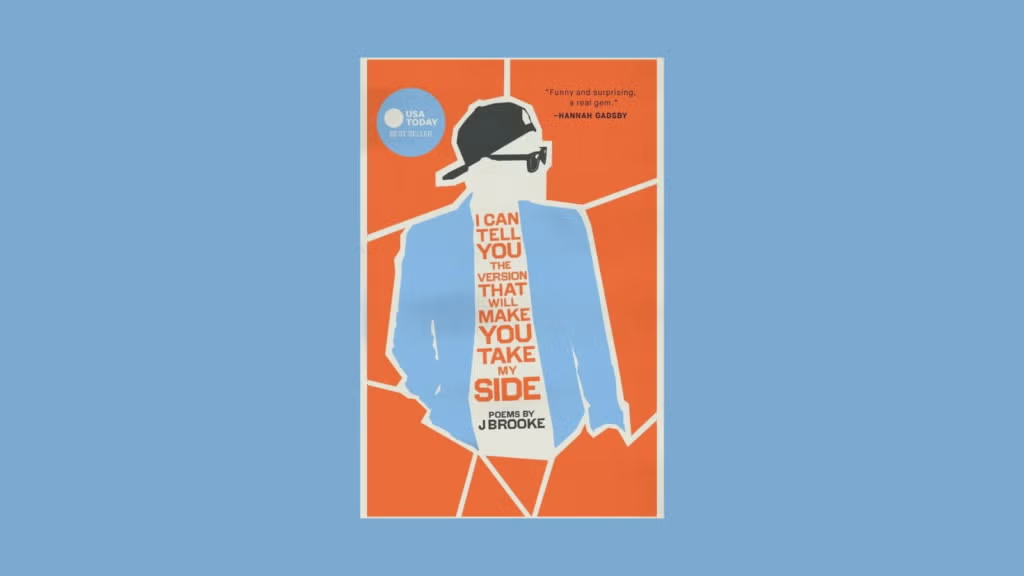
J. Brooke sets the tone in their debut collection, I Can Tell You the Version That Will Make You Take My Side, in their first poem, “Demoralizer”: “I can tell you the version / that will make you take / my side – but I’m not / going to tell you that / version.” The implication of the different ways in which Brooke’s could be writing this story begs the question: what version of the story are we getting and what’s its greater implication?
Split into two distinct sections, “Why I Am” and “Not Getting Top Surgery,” I Can Tell You explores the uniquely complex experience of authenticity and transformation, social and familial rejection, and the erasure and discovery of history that is inherent to trans and nonbinary identity. What makes Brooke’s debut so alluring is their multiplicity of perspective – while “Why I Am” looks inward, crafting its narrative around the early burgeoning queer adolescence of Brooke, “Not Getting Top Surgery” looks outward at a broader cultural engagement of gender nonconformity. Both of these sections embrace the beauty, pain, and even humor in the trans experience without blunting even the most challenging of poems.
“Why I Am” reveals the lack of agency that Brooke experienced as a child in nearly every facet of their life, whether that be physically, emotionally, socially, or even medically. The impact of this lack of autonomy is palpable in “Exit Strategy”: “The very first time I consider ending / my life / I am four.” A quiet contemplation on childhood suicidal ideation, Brooke is purposeful with each word, each space is an active dissociation from the events. Its narrative is simple, yet that’s what makes its truth all the more powerful: the act of choosing to live in a world that has done everything to make itself inhospitable to you is an act of protest in itself.
Confined within rigid gender roles by their mother, Brooke’s poems about their adolescence revolve around their struggle for autonomy and self-determination, which shapes their relationship with gender from an early age. “Before Surgery” stood out to me due to the sheer magnitude of its emotional honesty, addressing the absence of medical independence from many trans children’s lives and the ways in which adults treat their bodies as extensions of their own, restricting or enforcing medical care: “My nose not mine to decide about / is how my mom explained signing me up / for surgery as if a manicure.” Brooke weaves a retelling of their childhood evasion of traditional gender roles throughout, brilliantly dancing around manicures and their mother’s anger in a spirited series of verses, dissolving into a violence so startling that the ending itself feels like a surgical addition to the poem.
With the second section of I Can Tell You, “Not Getting Top Surgery,” Brooke emerges readers in a new timeline, entering an adulthood post-transition. Their narrative engages with their gendered experience in relationship with the world and culture that they’ve grown and survived in, all while discovering themself. While “Why I Am” may have been rife with rules and regulations regarding gender roles through a cis and heteronormative lens, “Not Getting Top Surgery” seeks out to break them all.
One of the poems that made a specific impression on me was a piece early on in the second section, “Private Albert Cashier”, in which Brooke unearths the often forgotten history of trans icon Albert Cashier to address a new distance Brooke has allowed themself from their mother: “I’m phoning you now, late, feigning concern / for your health, not mentioning my disdain / for the women in 1977 revising poor Albert’s / headstone to include his deadname. Probably / you knew these beasts. / I suspect you still do.”
Despite the heavy themes within I Can Tell You the Version That Will Make You Take My Side, “Not Getting Top Surgery” sneaks in little moments of levity in poems through objects like packer shorts, a Tickle-Me-Elmo, and Barbies through a queer and light-hearted exploration. “On My Mind” and “Out Late” are brilliant standout poems from the second half of Brooke’s collection. In these poems, Brooke is placed within the role of elder and protector of their young and queer family members, and their careful recollection of the quietly queer artifacts of gender in Brooke’s syntax and imagery. Within the second section of I Can Tell You, Brooke tells a new story about parenthood — one that allows for queerness to thrive.
Brooke’s unapologetic and urgent collection refuses to offer just one narrative about the trans experience, rather opting to portray it as a complex social position, one of both pain and joy. It is the beauty of these colliding contradictions on the page that creates such an emotionally gripping and accessible experience for readers to better understand the nuances of living as a trans person in America. The version of the story that Brooke shares has multiple moving parts, making it impossible to fit trans people and our experiences in a single box.