

This collection of CSSH articles explores language as the medium through which power, identity, and authority are established and contested across political, geographic, and historical contexts. The readings that follow ask us to look beyond what language says to examine more closely what language does. From ephemeral utterances to enduring inscriptions, words have a way of leaving their mark on the social world and those who inhabit it. In their study of language as social action, the authors attend to both the said and unsaid, reading between the lines and listening to the silences. Voices from the past speak to us from beyond the archive, lending themselves anew to contemporary debates over belonging, legitimacy, and the boundaries of being human.
Talk Isn’t Cheap: Language Ideologies
Language is never “just” talk; it is a medium deeply embedded in social relations and regimes of value with reverberating material effects. The following articles consider how ideologies of language are entangled in the creation and maintenance of social, moral, political, and spiritual hierarchies across space and time. Kathryn Woolard (2002) emphasizes that these ideologies are never about language alone: “they also delimit peoples, define their natures, order their relations, and channel their movements through the world” (447). Her essay examines how linguistic debates and contrasting logics of language in early Modern Spain refract broader tensions between Christians and Moriscos. Katherine Hoffman (2008) similarly discusses the conflation of language with ethnicity and religion in her essay on French colonial governance in Morocco. The French wielded language as a tool for imperial control and feared that a linguistic shift from Berber to Arabic would give rise to Islamic literary practices, which challenged French legal authority. Ideological frictions abound in Matt Tomlinson’s (2009) essay on Christian conversion in Fiji. While Methodist missionaries introduced new thoughts, terms, and practices to the Fijian universe, they simultaneously sought to undermine the truth and effectiveness of non-Christian speakers’ words. Paja Faudree (2015) introduces textual ideologies as an analytic for examining conflicts between how outsiders have written about hallucinogenic plants and healing rituals in Mexico and local Mazatec authors have responded to their accounts. Finally, Courtney Handman (2023) makes the unlikely connection between colonial subjects in Papua New Guinea and 21st century chatbots to challenge intellectual ideologies of language as a uniquely human attribute. In either case, suspicion toward unshared symbols and innovative forms reflects deeper beliefs about language as necessarily public, shared, and truthful—attitudes that both define and constrain the boundaries of humanity and sociality.
Faudree, Paja. 2015. Tales from the Land of Magic Plants: Textual Ideologies and Fetishes of Indigeneity in Mexico’s Sierra Mazateca. 57 (3): 838-69.
Handman, Courtney. 2023. Language at the Limits of the Human: Deceit, Invention, and the Specter of the Unshared Symbol. 65 (4): 726-750.
Hoffman, Katherine E. 2008. Purity and Contamination: Language Ideologies in French Colonial Native Policy in Morocco. 50 (3): 724-52.
Tomlinson, Matt. 2009. Efficacy, Truth, and Silence: Language Ideologies in Fijian Christian Conversions. 51 (1): 64-90.
Woolard, Kathryn A. 2002. Bernardo de Aldrete and the Morisco Problem: A Study in Early Modern Spanish Language Ideology. 44(3): 446-80.

You, Me, Us, Them: Language and Identity
Language is not only a constative means of describing the world around us; it is constitutive of the kinds of people we understand ourselves and others to be. The following articles explore how conceptions of personhood are interpellated and differentiated by and through language. Oren Kosansky (2016) examines how the French used linguistic difference as a means to categorize and mobilize colonial subjects in Morocco. He argues that colonial dialectology in Morocco rendered Jews objects of research and reformation by positioning them as a differentiated social category endowed with specific language abilities, attitudes, and affinities. The erasure of Jewish literacy and promotion of Judeo-Arabic orality situated Jews as lacking a fixed linguistic identity, and therefore more susceptible to the French civilizing mission. In a similar vein, Iracema Dulley (2022) discusses the constitution, racialization, and hierarchization of colonial subjects in Angola, this time through naming and translation. Colonizers tried to fix social positions with legal labels in Portuguese, which were constantly juxtaposed with, displaced by, and negotiated through Umbundu vernacular terms. Since interpellation requires iterability, slippages disrupt colonial power. Erik Mueggler’s (2021) essay on the dialectical structures of kinship and bondage in 18th century China traverses an expanse of spatial, semantic, narrative, and legal planes to illustrate the power of written texts to remake relations among beings, expanding notions of who can wield written language’s performative function and in what ways. Paul Manning (2002) centers Welsh-language nationalism around an industrial working class to describe how slate quarriers became emblematic of Welsh language and identity. Quarriers’ rhetorical strategies in labor disputes unintentionally helped install them as iconic ‘true Welsh speakers’ in the national imagination. In Sumathi Ramaswamy’s article, (1993) language itself becomes personified. Tamilttay is the Tamil language embodied, enthroned as goddess and queen and thus able to command allegiance, demand loyalty, and mobilize its followers (720), especially amid dilemmas of language rule in postcolonial India.
Dulley, Iracema. 2022. Naming Others: Translation and Subject Constitution in the Central Highlands of Angola (1926–1961). 64 (2): 363-93.
Kosansky, Oren. 2016. When Jews Speak Arabic: Dialectology and Difference in Colonial Morocco. 58 (1): 5-39.
Manning, H. Paul. 2002. English Money and Welsh Rocks: Divisions of Language and Divisions of Labor in Nineteenth-Century Welsh Slate Quarries. 44 (3): 481-510.
Mueggler, Erik. 2021. Rewriting Bondage: Literacy & Slavery in a Qing Native Domain. 63 (1): 99-132.
Ramaswamy, Sumathi. 1993. En/gendering Language: The Poetics of Tamil Identity. 35 (4): 683-725
Paper Trails: Translation, Literacy, and Scripts
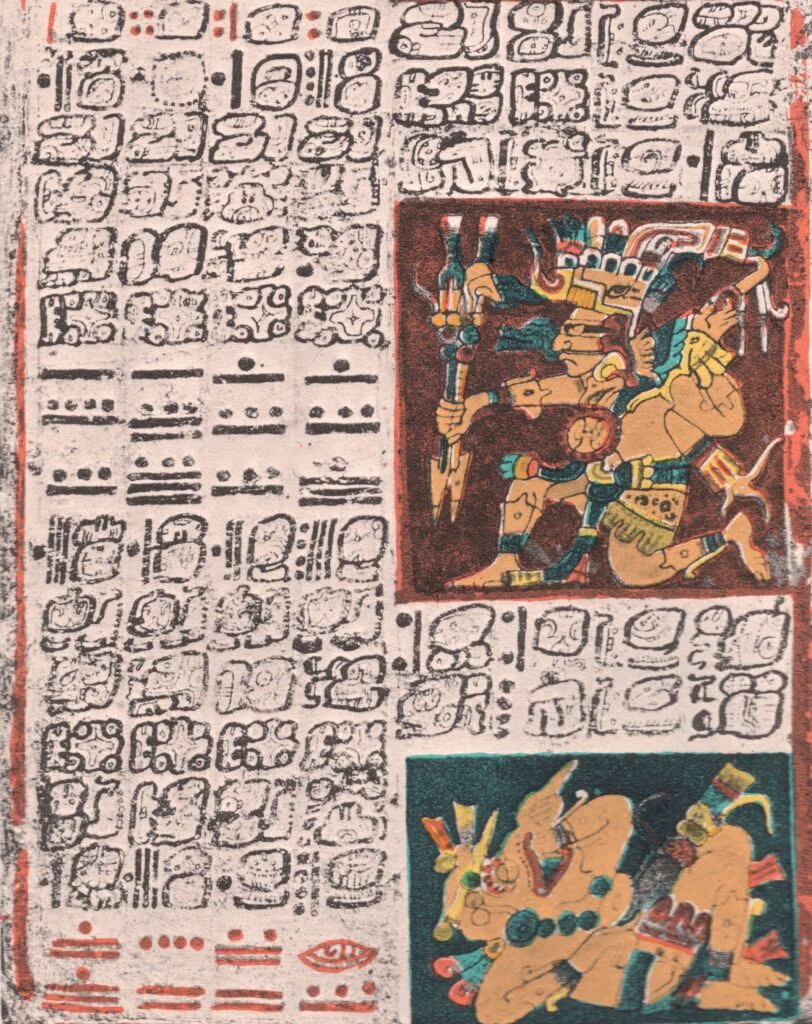
Writing is often taken for granted as an innate linguistic practice, rather than a learned technology that enables language to be materially captured, circulated, and de/retextualized across space and time, “being artifact as much as message” (Houston et al. 2003: 432). In his essay on the history and political life of imperial languages in the Indo-Iranian world, Sumit Guha (2024) outlines how empires actively privileged certain writing systems for governance, literature, and record-keeping as a means of reflecting and enforcing authority. Regime changes brought with them script changes; as a result, bureaucratic power was often accessed through literacy. This is apparent in Stephen Houston, John Baines, and Jerrold Cooper’s (2003) comparative essay on script obsolescence in Egypt, Mesopotamia, and Mesoamerica, in which the discontinuation of writing systems was socially and culturally motivated by imperial forces. In other cases, existing vernaculars were important tools for religious control and colonial conquest. Both Hilary Carey (2010) and Will Sweetman and Ines Županov (2019) describe how translating the Bible and fostering literacy were key missionary methods for Christian proselytization and conversion in Aboriginal Australia and South India, respectively. The latter highlight the importance of the printing press in the religious rivalry between Pietists and Jesuits. Pietists favored mechanically reproducing Tamil texts that could be widely circulated among and read by the new faithful, while Jesuits maintained that print materials were instruments for missionaries and catechists to proselytize, and not for direct dissemination to novice believers. Sonia Das’s (2017) own discussion of these rivalries further homes in on the ideological and technological natures of colonial printing and the far-reaching and longstanding consequences of the European objectification of Indian vernaculars. Piers Larson’s (2007) essay continues the thread of vernacular evangelization and literacy, but with a twist: Malagasy, the “language of slaves,” broke through the normally restricted bounds of colonial linguistics to achieve an important social, mercantile, and religious status.
Carey, Hilary M. 2010. Lancelot Threlkeld, Biraban, and the Colonial Bible in Australia. 52 (2): 447-78.
Das, Sonia. 2017. Failed Legacies of Colonial Linguistics: Lessons from Tamil Books in French India and French Guiana. 59 (4): 846-83.
Guha, Sumit. 2024. Empires, Languages, and Scripts in the Perso-Indian World. 66 (2): 443-69.
Houston, Stephen, John Baines, and Jerrold Cooper. 2003. Last Writing: Script Obsolescence in Egypt, Mesopotamia, and Mesoamerica. 45 (3): 430-479.
Larson, Pier M. 2007. Malagasy at the Mascarenes: Publishing in a Servile Vernacular before the French Revolution. 49 (3): 582-610.
Sweetman, Will, and Ines G. Županov. 2019. Rival Mission, Rival Science? Jesuits and Pietists in Seventeenth- and Eighteenth-Century South India. 61 (3): 624-53.

Dialects with Armies and Navies: Language Politics & Nationalism
A Herderian model of nationalism assumes the unification of one language, one nation, one people. Yet whose language becomes emblematized, and whose is relegated to the margins? These articles examine linguistic formulations of nationhood from various vantage points. David Laitin (1989) provides an early account of the role of language in state formation and challenging state authority. In the face of pressing Castilian Spanish linguistic and cultural hegemony, the revival of the Catalan language and subsequent “Catalanization” laid the foundation for Catalonia’s own nationalist movement. Patrick Eisenlohr (2007) explores the spread of linguistic ethnonationalism in postcolonial Mauritius and the contrast between a nationhood imagined through vernacular Mauritian Creole versus through Indian ancestral languages, each with varying political consequences. Gina Anne Tam’s (2023) interlocutors utilize claims of linguistic antiquity to create counternarratives that challenge the hegemony of Han ethnoracial identity in China, pushing back against the conflation of Mandarin with “Chinese.” Horng-luen Wang (2004) continues this interrogation of Chinese language policy with regard to Taiwanese identity. While Taiwan also adopted Mandarin as its national language, it diverges significantly from state-sponsored Mandarin in China in terms of script, romanization, lexicon, and pronunciation. On one hand, some state officials express concerns that these linguistic disparities pose a potential hindrance to future cross-strait unification; on the other, “the two languages-of-power, signifying two sovereignties embodied in different scripts, imply that there are two nations instead of one” (802), establishing the grounds for an independent Taiwanese nation. Lastly, Webb Keane’s (2018) essay demonstrates how national identity and religion became entangled during debates over Indonesian translations/interpretations of the Qur’an. In this case, the adaptation of holy texts were not only pious projects, but also nationalist ones, connecting local particularity and historical progress with the universal and timeless truth of scripture (765).
Eisenlohr, Patrick. 2007. Creole Publics: Language, Cultural Citizenship, and the Spread of the Nation in Mauritius. 49 (4): 968-96.
Keane, Webb. 2018. Divine Text, National Language, and Their Publics: Arguing an Indonesian Qur’an. 60 (4): 758-85.
Laitin, David D. 1989. Linguistic Revival: Politics and Culture in Catalonia. 31 (2): 297-317.
Tam, Gina Anne. 2023. “Our Roots Are the Same”: Hegemony and Power in Narratives of Chinese Linguistic Antiquity, 1900–1949. 65 (1): 27-52.
Wang, Horng-luen. 2004. National Culture and Its Discontents: The Politics of Heritage and Language in Taiwan, 1949–2003. 46 (4): 786-815.
Moniek van Rheenen is an Editorial Intern at CSSH. She is a PhD candidate in linguistic anthropology at the University of Michigan, and her research focuses on child language socialization, parenting, moral personhood, and conservative religion in Indonesia. Her work has been supported by the National Science Foundation, the US Fulbright Program, the American Institute for Indonesian Studies, and the Global Islamic Studies Center at the University of Michigan.
