

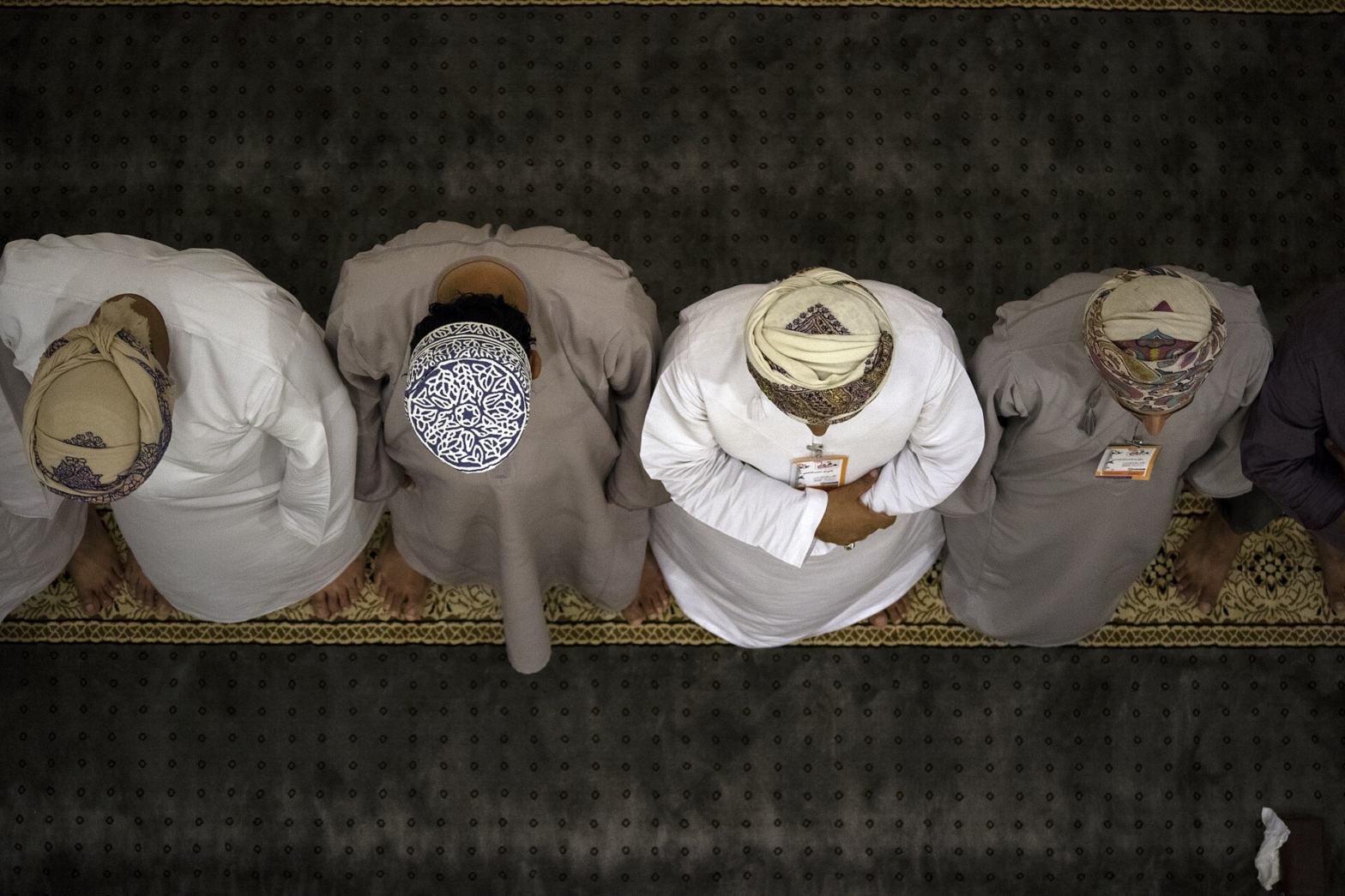
Our Goody winners are always amazing scholars. But they are never amazing in the same way.
Mandana Limbert, this year’s winner, does something we’ve never had an exact name for. We’re still not sure what to call it. “Lens crafting,” perhaps? Or “attention fixing”? It’s more than framing. It’s the ability to find one moment, one encounter, that brings into view all the dynamics that will shape the comparative analysis to come.
Limbert holds this special lens up to the reader’s eye in the very first paragraph of her paper. Revealing it to you now is not a spoiler. It’s what Limbert would want you to see first, to see through.
Here is the lens:
In 2003, on one of his first trips to Zanzibar since the 1964 revolution during which thousands of “Arabs” from Southern Arabia (now the Sultanate of Oman) were killed or fled, Sheikh Ahmad bin Hamad al-Khalili, Oman’s national mufti, was interviewed on Zanzibari television. In addition to inadvertently correcting the interpreter’s translation of his Arabic into Swahili on live television (touching off intense, vocal resentment about why he refused to speak Swahili despite his fluency), Sheikh al-Khalili informed those of Muscati and Omani descent that they should no longer perform the travel prayer (salat al-safar). The travel prayer, a truncated form of the daily ritual obligation aimed at easing the burdens of pious requirements during travel, has long been central to jurisprudential debates about proper worship. Sheikh al-Khalili was insisting in 2003 that this particular population in Zanzibar—Omanis who had migrated and settled on the island in the first half of the twentieth century and remained after the 1964 revolution— should accept that Zanzibar was their homeland, not Oman.
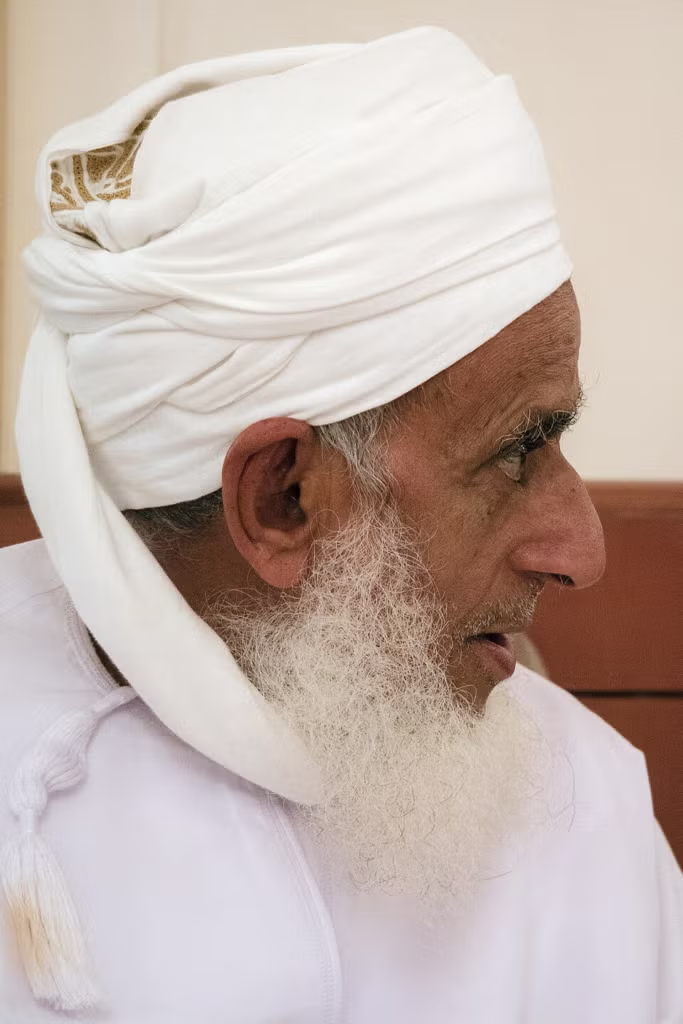
That’s it. Just 170 words. But every innovation Limbert offers, every analytical breakthrough she makes, is foreshadowed in this anecdote. It’s one of the best openers we’ve encountered at CSSH. When the Goody jurors say Limbert’s article is “gripping,” they’re describing an effect that starts at the very beginning and never lets up.
To understand how Limbert fashioned her comparativist lens, you’ll have to read the paper. It will take you across long stretches of time and through moral spaces and political systems that are constituted in radically different ways, but you will never be far from what Sheikh al-Khalili said on TV screens in Zanzibar in 2003.
We talked to Limbert about how she writes and builds arguments. She gave us a fascinating tour of her workshop, and a preview of things to come. We didn’t think it was possible, but now we like her paper even more.
Scroll down. And enjoy.
CSSH: Congratulations on your win. You’ve created a magnificent essay. We’re eager to talk to you about it.
Limbert: Thank you so much. It’s such an honor. I love CSSH and was just thrilled to have been able to publish an article in it. The award is truly beyond what I expected.
CSSH: Where should we start? You do a lot in this essay. People are going to read it in different ways. Eventually, there’ll be several viable, even contradictory, interpretations of your arguments. Since you’ll probably be asked to weigh in on this for the rest of your intellectual life, we might as well get started early. How would you describe what you’re doing in this article?
Limbert: Basically, I’m exploring notions of home and homeland through the management of mobility in the Western Indian Ocean in the early 20th century. I compare Omani religio-legal views about determining correct prayer in contexts of travel and migration and British legal attempts to control migration through identification and documentation. As a prominent Omani jurist put it, “The waṭan (homeland) is where the soul (nafs) resides and where the heart (qalb) lives. And, it is the opposite of travel (safar).” This understanding of homeland – which shaped a person’s moral standing and their devotional practice as a Muslim – was different from the idea that a person’s homeland could be determined simply by their place of birth, or residence, or by their status as a political subject in a territorially defined state. I juxtapose religious rulings and the implementation of ever-changing colonial immigration policies. The material shows how discussions and practices of mobility are integral to notions of homeland. It also calls into question the assumption that British rule imposed territorial order on a realm of unfettered mobility.
CSSH: The Goody jury loved the way you pull this material together. The methodology is impressive. You’re analyzing multiple imperial formations, using multilingual evidence. You move across pre- and postcolonial regimes, across legal systems, across regions. The arguments are careful but complicated. Unexpected, too. And on top of all that, the jurors describe the article as “accessible.” That’s a triumph in itself!
Limbert: Wow. Thank you. Because this world of layered legal and religious perspectives and processes is so complex, and because I was speaking to different scholarly traditions, I really had to maintain clarity both to make sure that the references were appropriate to specific fields and that they would be legible across them. Scholars of Indian Ocean history, Islamic studies, and European imperialism and colonialism begin from different presumptions about the arguments in their fields, not to mention about particular situations and contexts. I didn’t want to oversimplify the material, nor could I assume readers would be familiar with the complex conditions I was tracing. In some ways, this piece felt a bit like an exercise in translation. I guess this speaks too to the mission of comparative work and why it can be so hard. It’s not just a matter of comparing like-practices, but of bringing together fields that do not necessarily speak to each other.
CSSH: Exactly. That’s why accessibility is such a high bar for us. It changes the way you think about evidence and arguments.
Limbert: It also helped enormously to have reviewers and colleagues who understood what I was trying to do and were constantly pushing me toward greater clarity in thinking and writing. None of us writes in isolation, and this article is no exception.
CSSH: How long did it take you to write it? Are you a slow writer, or a sprinter? Comparison is tricky at any speed. It requires outlays of time and imagination that are hard to come by. How do you manage this kind of scholarship?
Limbert: That’s a great question. I’m generally a very slow writer (though I’ve had a couple exceptions when I surprised even myself), and this article took even longer than it usually takes me. I knew where I wanted to start, but where would the story that opens this article lead and how would I put together the different kinds of evidence? Even more complicated was how I could put side-by-side these different scales or perspectives, one pertaining to daily ritual and the other to an imperial order. It was also extremely hard to find a way to describe the political context because I was highly aware that, as I mentioned, readers who are familiar with it might get quickly frustrated, while others might find it confusing. I learned a lot by presenting this material in different venues and hearing from people about what they had difficulty following. Beyond the writing, the article is also based on research across such different kinds of sources: ethnographic work, the Islamic legal tradition of a particular moment, and archival research in Zanzibar and London. That took a lot of time too! I have to say that I can’t even remember when I “began” to write the piece.
CSSH: What really stands out is your ability to refocus our attention. The way you use “travel prayer” as a point of entry into Ibadi Muslim ideas of home and homeland is analytically surprising. Not many people would start there, but that’s because they’re already tangled up in the political-legal systems that grew out of British imperial policies. You’re trying to reconnect with something else. It’s something from the past. And it’s something that, you argue, “still resonates” today.
How did you realize that Ibadi teachings on prayer could help you build a comparative analysis that didn’t start and end with the privileged categories of the territorial nation-state? It must have been a peculiar discovery process because, as you note in the paper, many Ibadi thinkers today have accepted as “natural” many of the assumptions that define the modern nation-state.
You didn’t just have to arrive at Ibadi legal traditions, you had to arrive at a particular moment in that tradition. Did you have a map?
Limbert: I wish I had a map! That would have been easier! If anything, and I hope this doesn’t sound too corny, I relied on two things: ethnography and being a bit stubborn. For this piece, I started with something unexpected that someone mentioned almost in passing, and I began to dig, keeping my eye on it and remaining open to seeing where it would lead. But you’re right. It only made sense as something interesting to pursue because I was already attuned to Ibadi legal traditions and Oman’s political history. I’m profoundly grateful to some generous guides on Ibadism. For years, the Ministry of Religious Affairs in Oman would organize an annual conference on Ibadism, bringing together scholars from all over the world to share their work. It was always a humbling experience, and I learned an enormous amount. It also helped me appreciate the particularities of the historical shifts of the twentieth century.
So, I was already curious about how Ibadis who were committed to the Imamate “fit” into the British imperial system and the Zanzibar Sultanate. But I hadn’t anticipated that such fitting (or ill-fitting) would manifest itself in prayer. As soon as I heard the story about travel prayer, it both made complete sense and surprised me. Basically, it was a chance conversation and not something I was looking for, though it reflected a set of questions I was already wondering about.
Starting from prayer allowed me to think about how people who were crossing these political divides actually navigated and adjusted to them in concrete, embodied ways. It helped me think about what it really meant for people in their daily lives, rather than what an abstract treatise might proclaim. That’s the wonderful thing about fatwas; they provide both an actual question (even if sometimes for a hypothetical scenario) that someone is mulling over and a response, sometimes with the logic behind a response. I owe my appreciation for fatwas to the late Brinkley Messick. But, yes, it meant constantly keeping at bay that “voice” that pushes many of us to jump to the more abstract scale of territoriality and jurisdiction.
CSSH: That’s where the “stubbornness” comes in, as method. Deciding not to obey that voice. Which is hard, because the imperial archive speaks in that voice, as do dominant forms of post/colonial theory.
You note that if British administrators, circa 1910, knew anything about travel prayer, or Ibadi notions of homeland, they certainly didn’t consider these ideas important for setting trade policy or for managing large volumes of human traffic. Ibadi ideas about travel and home didn’t, in other words, deserve their attention.
You also note, early in the paper, that scholars of imperial systems often argue that the British imposed territoriality – and, eventually, a whole set of nation-state boundaries – on populations that, in precolonial times, enjoyed “unfettered mobility.” If there were prior forms that governed mobility and belonging, they are considered unknowable, or politically unimportant. Again, they are not worthy of attention.
Those two trends combine to form a powerful historiographical alliance. You’re writing against it. In a way, you’re forming your own historiographical alliance with Ibadi jurisprudence. How did you decide to do that?
Limbert: I like that, “stubbornness as method”! Yes, I was responding to what British officials didn’t consider relevant, and yet what clearly mattered for people in making these decisions to move.
But British officials didn’t treat all religious practices pertaining to homeland this way. The question is also how some practices come to matter and not others. Interestingly, in the twentieth century, the question of alms payments – also a religious obligation – did become part of the debate about belonging and homeland among British officials working to establish territorial boundaries on the Arabian Peninsula. In the latter case, how people were enacting the religious obligation of almsgiving became evidence for (in the British perspectives) the power of rulers and the subservience of subjects. It was used to delineate the boundaries between Oman, the UAE, and Saudi Arabia.
But to make this claim, officials translated almsgiving as “tax.” And by seeing almsgiving as a tax, they were blind to (or dismissed) a form of homeland that was spatially more relative. There was no recognition of personal obligations and responsibilities that shaped the flows, redistribution, and limits of wealth outside more centralized extraction. So, even when British officials recognized religious practices, they did so in so far as the practices demonstrated a system of rule and extraction that could help map territorial borders.
Starting with Ibadi jurisprudence, whether with prayer or with almsgiving, I could more clearly see a notion of homeland that had significant effects, and yet was also personal and flexible, structured around obligations and responsibilities. This notion could come into view even though it was illegible to British officials and, to your point, is consistently obscured in the literature that celebrates a “nomad metaphysics.”
CSSH: That’s a brilliant turn in the paper. Most readers won’t see it coming, and that’s because they don’t realize how tightly “nomad metaphysics” is related to the same set of assumptions that drove colonial policies.
Limbert: Thank you so much. I think the scholarship that romanticizes nomad metaphysics does so in part to valorize a way of life located outside power structures that determine territorial boundaries. However, just because there is no power aiming to produce or enforce such borders does not mean that people don’t orient their lives spatially, with clear ideas or preferences about settlement, and with important obligations and responsibilities related to them. It fails to see the ethical expectations, pulls, and practices that might compel people to “stay,” not to mention the political forms that shape those expectations. It rests on a kind of binary between rigid structure and possibility, between a kind of centralized rule and unfettered fluidity. And, yes, it reproduces the British colonial imaginary that there is either a recognized power that can be transformed into territorial borders or there is “free” movement. Prayer, marriage, alms – the profoundly important orientations that guide daily life – do not necessarily abide by one or the other.
CSSH: Nur al-Din al-Salimi, the jurist whose work you explore, was an advocate of the Imamate model of governance. He lived in the interior of Oman, not in the coastal areas ruled by the Sultans. It sounds like he didn’t travel much, though he corresponded with Omanis everywhere. The Imamate that was established in 1913 was landlocked, and it was led by elected religious leaders, not hereditary dynasts. You did ethnographic fieldwork in a part of Oman that once belonged to the Imamate. How did this shape your analysis? If you’d started in Muscat and Zanzibar, would you be asking the same questions?
Limbert: It made an enormous difference that my ethnographic fieldwork was in the area that had been aligned with the Imamate. In fact, you asked about my “map,” and again I guess it would have to be ethnography. The history of the Imamate continued to matter decades after its demise in the mid-1950s. People would often speak with reverence about that period, despite the economic hardships of pre-oil life. The veneration of the past is, of course, often a critique of the present, and these comments were no exception. But, for me, they also pointed to how – whether as critique or not – the political form of the Imamate remained “present” as a possibility. This experience in the region of the former Imamate also made evident to me that – unlike what I had heard from elites on the coast – many people from the Imamate had traveled to East Africa too. So, the question was, if they were aligned with the Imamate, how did they manage their religious obligations and responsibilities in Zanzibar, where they had to adjust to both British and Sultanic rule?
CSSH: As soon as you ask those questions, you’ve moved to a transregional scale. How would you situate your work in the larger Indian Ocean literatures? CSSH has been publishing excellent articles on this region for years now, alongside all our Middle Eastern and South Asian scholarship. Your work connects those zones, and the Zanzibar focus brings in East Africa as well. What can you see when you triangulate from those intellectual/geographical locations? You’ve argued, for example, that in Indian Ocean contexts the term “Arab” is more akin to a “caste” label than to an ethnoracial or linguistic category, as it tends to be understood further north and west. This comparative sensibility must be informing your analysis all the time.
Limbert: CSSH has published amazing work, and I’m honored to be part of that scholarship. I remember when I was starting out in graduate school, I would read the work of other Middle Easternists and not really recognize the terms and processes they were analyzing. I felt like I either had to try to “fit” Indian Ocean histories or processes into scholarship that tended to be based on Ottoman administrative zones or do a kind of translation and insist on the validity of the categories. In a way, because the Indian Ocean regions (and they are multiple and layered, as Nile Green clearly described) never “fit” in the standard area studies groupings, many of us end up beginning with the work of comparison and translation. I no longer feel it necessary to justify the argument that the Indian Ocean world is relevant, but I do believe that the impulse of comparison remains, and I for one find it very productive. It pushes me to try to articulate and clarify why certain categories can’t be taken for granted.
As for the field itself, one way I see my work fitting in is that the scholarship has rightly demonstrated the importance of migration, movement, and circulation across the ocean and between regions, and the limitations of approaching people’s experiences as somehow contained within the nation-state. Economic life is particularly valuable for understanding these regional networks, as are religious networks and the circulation of scholarly works and legal concepts. That said, the political forms that might tether people to a space or a particular governing system, or shape their frames of connection across those spaces, are similarly complex and rich. So, while we emphasize the long histories of mobility, it’s also important not to lose sight of the pressures to “stay.” Likewise, we should never underestimate the power of the colonial and nation-state systems.

CSSH: And we can’t ignore the links between oceanic systems.
Limbert: Yes. Absolutely. I find comparisons with other oceanic realms, networks, or systems helpful. The influence of Mediterranean studies was particularly significant for a time. Questions of shared cultural practices and environmental conditions across long historical periods, despite immediate events, served as a useful frame for the field. At the same time, the influence of British policies and control – especially in the nineteenth and twentieth centuries – clearly distinguished Indian Ocean societies. Engseng Ho beautifully adjusted the lens to acknowledge these long connections and networks, while also keeping British colonial powers and policies in view. Not everyone’s work needs to do this, but I find the histories that foreground the Atlantic and the Mediterranean very productive to think with.
CSSH: On the topic of “thinking with,” have you seen the recent CSSH essay by Matei Candea and Paolo Heywood? They’re discussing new trends in anthropological theory, and they think you are doing something creative with form. Your analysis of travel prayer, they say, fills in the artificially empty spaces that are so common in post/colonial studies of non-European societies. What fills those spaces in your analysis? “Not a formlessness awaiting (colonial) ordering,” they say, “but a competing formal system with a radically different architecture.” As much as they appreciate that, they’re even more impressed by how your work “demonstrates the embodied and lived nature of the forms she traces, enacted through the bodily movements and orientations of prayer, as well as the fact that forms are far from politically quietist: forms here are both anti-colonial and rigorously structured, both quotidian and cosmologically significant.”
Did you know you were a formalist?
Limbert: Hahaha! I read Candea and Heywood’s article and was really moved by their description. I would like to meet them. I think they’ve articulated something very important, which is that in recent decades anthropology has tended to celebrate “formlessness,” yet such suppositions don’t actually reflect many people’s lives or values. They can blind us to the unexpected kinds of forms that people might be inhabiting. But to be clear, I think they are saying I’m an “anti-formalist formalist!”
CSSH: That sounds right. And come to think of it, Candea and Heywood are both Mediterraneanists. That can’t be a coincidence, can it?
Limbert: I’m sure it’s not!
CSSH: Here’s another tie-in. We recently hosted a conversation with Fred Cooper and Krishan Kumar about decolonization. One of the themes they discussed was the fact that so many anti-colonial movements were not nationalist. They were transregional. They endorsed pan-Muslim or pan-Arab or pan-African unions of various sorts. Yet it was the nation-state form that quickly came to dominate the postcolonial world. You would have fit right into this conversation! The ideas of home and travel endorsed by Nur al-Din al-Salimi were not nationalist. That’s clear. But they have since been folded into Omani identity and history such that they belong now to a modern nation-state, as part of its heritage and religious identity. Cooper and Kumar didn’t quite agree on the inevitability of this kind of transition, but it would seem that you are drawn to historical alternatives. You say they still “resonate,” but do they have a future as political ideas?
Limbert: That would have been a great conversation to join. Gary Wilder has made similar arguments. I appreciate their view that perhaps the nation-state was not inevitable, though it’s also hard to see how other political forms could have become dominant in the mid-twentieth century. Still, yes, it’s important to recognize that other possibilities not only circulated during decolonization, but also continue to be debated and even manifest in practices like prayer. How one prays (or fasts or pays alms) is not only an act that embodies and performs an orientation of belonging and homeland, it also challenges the territorially bounded form of the nation-state. I wouldn’t want to predict the future, but do I think that these expressions are not only “layered,” but are also aspirational for some people? Absolutely.
CSSH: Another way to get at “futures” and “resonance” is to look directly at the present. You wrote your paper before the US and Israel attacked Iran and pulled Oman and the other Arab Gulf countries into a regional war. How do you read your article now, within and beyond this context? It seems that we’re now seeing all kinds of imperial and anti-colonial forces unleashed, “rigorously structured,” “quotidian,” and “cosmologically significant.” Does your own work help you make sense of what’s happening?
Limbert: Important and difficult question. There are many ways to look at this, but I want to focus mainly on Nur al-Din’s style, which is deliberative. For him, and those who adhere to his teaching, a homeland is about where your religious obligations and responsibilities lie. It’s not about loyalty to a ruler, much less blind loyalty. It’s about awareness and considered decision-making. About recognition of the political conditions in which we live and whether we feel at ease in them. And it’s about making active choices that demonstrate such awareness. Of course, the kind of “ease” available to different people is highly unequal; he was not speaking about equal citizens. Nevertheless, his style is diametrically opposed to the erratic style of action, for example, of the current US president as well as to his assumptions about political homeland with his demands for blind loyalty, fantasies of a fortress nation, cruel deportation policies, and the reveling in the killing of perceived enemies.
CSSH: So true. These are very different political idioms. They’ve been interacting for a long time, across several imperial and postcolonial systems. You’re working on a larger project that moves in and out of those systems. Will your CSSH article be a chapter? We hope so! Can you tell us about the larger project?
Limbert: Yes. I’m writing a book. It’s about migration, marriage, and changing notions of homeland across the Indian Ocean. I focus on discourses and practices of travel and marriage, and on the lives of people caught up in the tumult of the twentieth century. It traces Oman’s layered transformation from a religious polity to an ethno-territorial state.
The CSSH article brings together material from the first two chapters, though the chapters extend the analysis of how British policy confusedly identified people from the Arabian Peninsula as “Arabs” and the effects of such categorizations. I try to show the messy alignment of geography and race taking shape. The next two chapters turn to what happened after the migrants (a term that needs unpacking given the political and economic conditions) arrived in Zanzibar and began to settle and marry. The final chapters analyze the “return” to Oman after the 1964 revolution, when travel and marriage again helped align geography and race, though of course never fully. Much more so than the article, the book emphasizes how gender and kinship, marriage and sex, are critical to these processes of political formation.
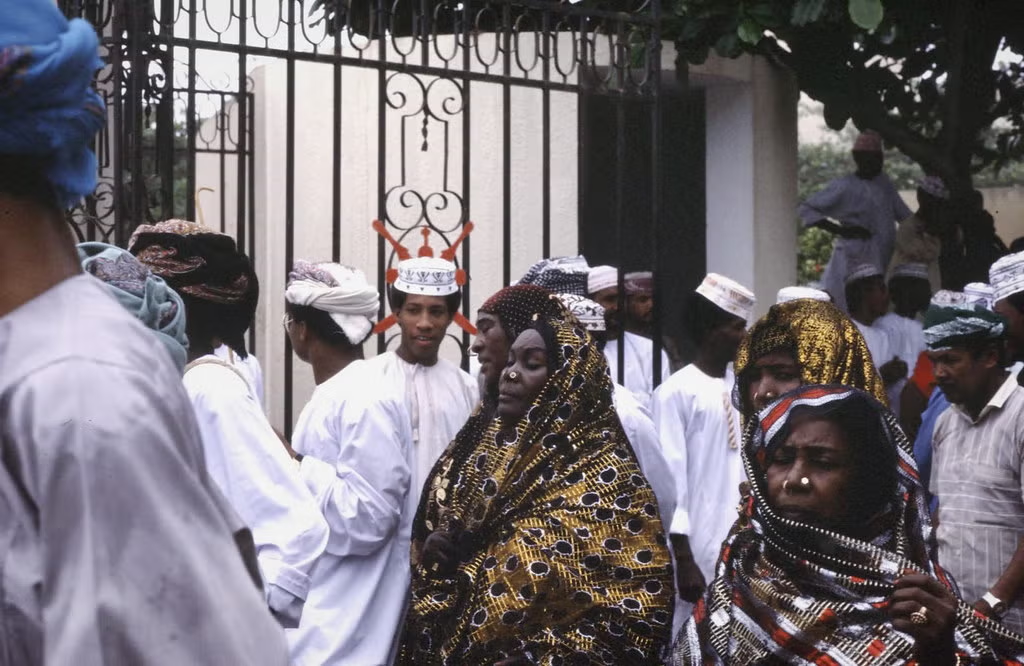
CSSH: The emphasis on sex, marriage, and Arabness will be fascinating. It’ll be interesting to see how you treat them on a transregional scale, as objects of law and elements of statecraft. What kinds of materials will you use?
Limbert: I draw from religious texts and fatwas, colonial records, newspapers, oral histories, and ethnography. It’s in the debates about marriage, sex, and descent leading up to and through the Zanzibar revolution of 1964 that the fault lines of being Omani and Arab, African and Zanzibari, produce the most visceral tensions. Omani discourses were also fraught. They fractured among those who wanted to make Zanzibar their homeland and those who remained committed to the world of the Imamate. These patterns often belonged to an intimate kind of politics, but they were also touchpoints of very intense, societal conflict and, as you say, they become elements of statecraft.
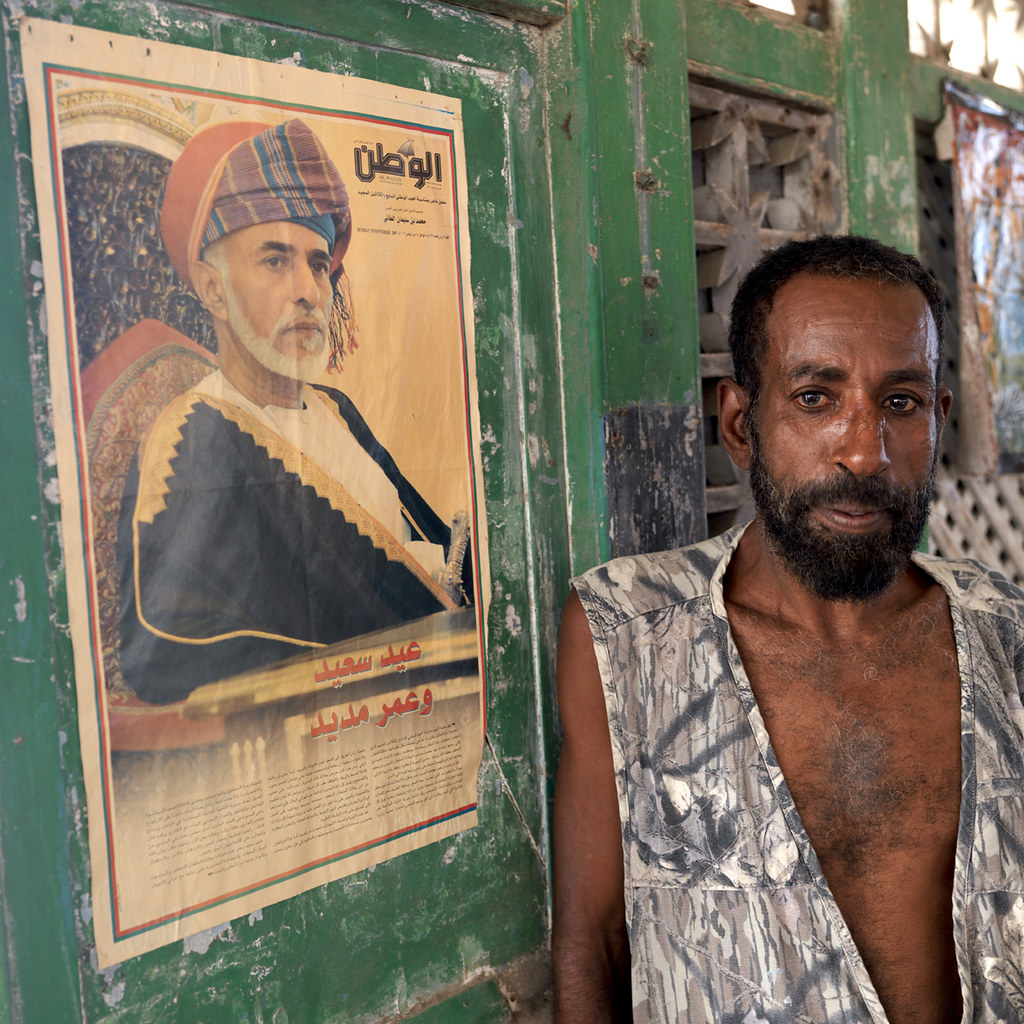
CSSH: Interesting. There are probably looping effects and historical replays. Forms of domestic life that remain important over time.
Limbert: Definitely. As families settled “back” in Oman, repatriation was arranged through presumed “ethnic” origins (not prayer) while marriage again took center stage as a vehicle of membership and belonging. After the Imamate dissolved in the 1950s and the Sultanate was transforming into an ethno-territorial state, Oman’s borders became more cartographically determined. The limits on marriages became more territorial too.
Still, it’s not a simple trajectory. As you note, there are lots of looping effects. People turn to religious laws of travel and marriage that do not abide by the logic of this new state formation. I see the management of travel and marriage as mutually constitutive. They are recursive processes, and realizing that can help us understand how these political transformations are layered. And tenuous.
CSSH: It’s complex terrain. Your analysis conveys that. But you also foreground ideas that, in the Ibadi tradition, are meant to be clear and accessible. Nur al-Din al-Salimi’s definition of human belonging and mobility, for instance, is remarkably concise. “Travel and watan (home/land) are opposites. If one is removed, the other appears. God knows best.” It seems reductive. Too spare. But it also seems generative. It captures much that we are talking about when we talk about dispossession, localism, diaspora, migration, citizenship (cultural or technical), indigeneity, subjecthood. Is it the formulaic quality of Nur al-Din’s statement that creates this effect? Is it the reminder that humans can’t fully know or control what’s being removed, and what might appear as a result? Were you struck by the power of this claim? Its bluntness?
Limbert: Yes, I was struck by the statement in so many ways. I was struck by its clarity and forcefulness. For Nur al-Din, the boundaries between the two are clear. One cannot be both “home” and “traveling.” Our responsibilities and obligations in one or the other cannot be confused. But the formulation is also beautiful in the way the passive voice also makes it feel like a slow transition, and not only something that we do not control. As one walks out of town, let’s say, the built environment fades from view and one transitions from one state of being to the other. The edge is not generalizable or abrupt; there is no gate or checkpoint dividing one state from another, nor is there a political/state power determining the division. And yet, the distinction between home and travel is still definitive. They are different modes or “forms” of life.
CSSH: Yes. Living as gendered, sexual beings, As kin. As marriage partners. As religious beings. All those identities have traveling and at-home variants.
Limbert: Exactly. To me, it’s particularly interesting and evocative that Nur al-Din begins with travel, so if we retain the parallel construction of the sentence, it’s actually travel that is removed, and “home/land” that appears. So, the walking is not away from home but towards it; it’s home that “appears.” One way I was imagining this was as a kind of “fog” of travel being removed or lifted, and “home” gradually coming into view.
CSSH: He’d probably love that. You engage so generously with Ibadi ideas. The genuinely transformative moments in your paper come when the reader can see you opening up, in the language of analysis, the insights so densely packed into Nur al-Din’s model of travel/watan. You’re making things appear by moving things around, by traveling and staying resolutely in place. God knows best how you do it, but it’s a masterclass in comparative analysis. We’re glad you published this article in CSSH.
Limbert: Wow. I’m not sure what to say. I’m so grateful.

Mandana Limbert is Professor of Anthropology at Queens College and the Graduate Center, City University of New York. She is the author of In the Time of Oil: Piety, Memory, and Social Life in an Omani Town (Stanford University Press, 2010); co-editor (with Elizabeth Emma Ferry) of Time Assets: The Politics of Resources and Their Temporalities (School for Advanced Research Press, 2008); and (with Nelida Fuccaro) Life Worlds of Middle Eastern Oil (Edinburgh University Press, 2023), as well as numerous articles and book chapters. Her forthcoming book is tentatively titled, “Oman, Zanzibar, and the Politics of Becoming Arab.” Her research has been supported by the National Endowment of the Humanities, the American Council of Learned Societies, and the Advanced Research Collaborative (CUNY). She is a member of the Austrian Academy of Sciences.
