
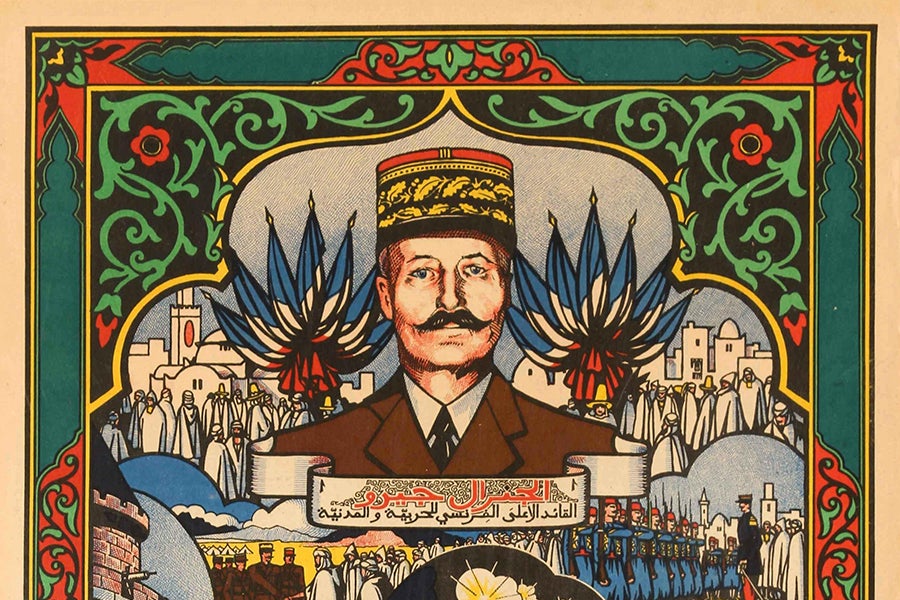
Lacy Murphy Synopsis: This talk examines how French colonial authorities in Algeria mobilized Islamic visual culture in wartime propaganda during World War II. Focusing on posters produced by both the Vichy regime and Free France, it explores how propagandists incorporated Arabic script and Islamic ornament into colonial visual culture to cultivate Muslim political loyalty during…
Tag: Minority Arts Topics
Mural Painting in Colonial Tunisia, ca. 1900 CE

William Gallois Synopsis: In the late nineteenth century, towns across North Africa suddenly began to be covered with wall paintings. This talk explores the origins of these murals, asking why they appeared at this moment, how they related to the arrival of European colonists in the Maghreb, and in what ways such visual cultures were…
Sacred Spaces, Shared Cultures: Cairo’s Synagogues and Egyptian Jewish Life and Heritage

Yoram Meital Synopsis: This presentation explores Cairo’s synagogues, treating them as “living archives” that reveal the rich social, cultural, and religious life of the city’s Jewish communities from the late nineteenth century to today. It emphasizes the porous exchange of visual and material culture, showing how synagogues incorporate motifs from Islamic and Coptic architecture alongside…
Mongol Cosmopolitanism: The Case of Rashid al-Din and his Moses

Mika Natif Synopsis: This talk examines seven paintings of Moses featured in Rashid al-Din’s Arabic copy of his World History, the Jami‘ al-Tawarikh. These images portray Moses, or Musa in Arabic, as both supreme ruler and prophet-king, an ideal figure whom Rashid al-Din may have sought to emulate. Through their connections to diverse visual and…
Rashid al-Din and the Compendium of Chronicles
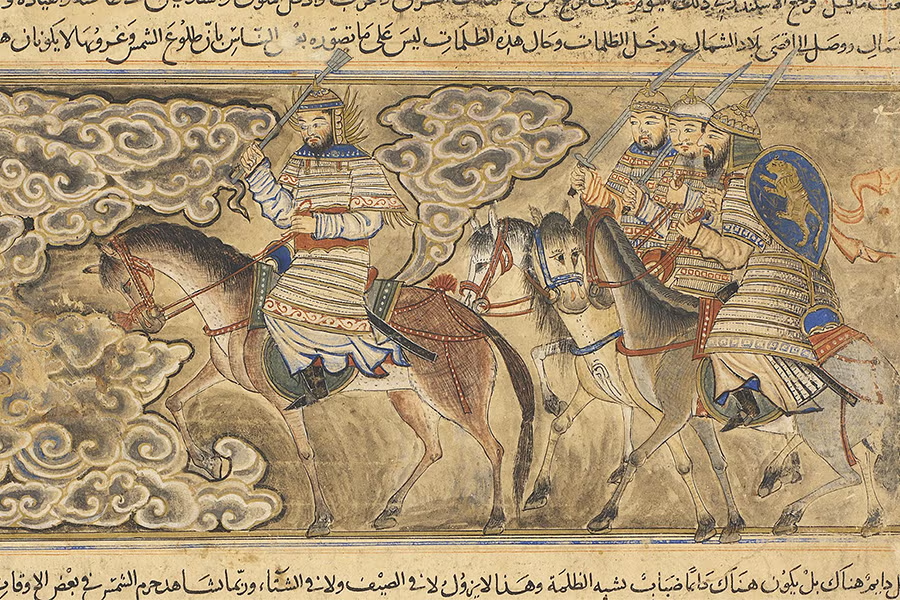
Jonathan Brack and Stefan Kamola Synopsis: Rashid al-Din, known as the “Doctor from Hamadan,” was one of the most prominent personalities of the period of Mongol rule in Iran, from the mid-thirteenth through the early fourteenth century. In addition to his political responsibilities as the advisor and minister to a generation of Mongol rulers, he…
Ottoman Costume Portraits: Photographs in the Elbise-i Osmaniyye

Erin Hyde Nolan Synopsis: This presentation examines the Elbise-i Osmaniyye, a catalogue of popular Ottoman costumes commissioned by the Ottoman court for the 1873 Vienna World’s Fair. The Elbise contains 320 pages of text and 74 phototypes of men and women in regional dress. Photographic albums such as this one – which were made in…
The Nîshans of the Yezidis of Northern Iraq

Eszter Spät Synopsis: This presentation explores the nature and role of the nîshans or sacred objects of the Yezidi “priestly” lineages in Northern Iraq. Such nîshans, literally meaning “signs,” are also referred to as hadimas or “seals.” They function both as symbols and proofs of the special descent of the pîr and sheikh castes, the traditional hereditary religious…