
Amy Butcher is an award-winning essayist and author. Her first book, Visiting Hours (Blue Rider Press/Penguin-Random House, 2015), earned starred reviews and praise from The New York Times Sunday Review of Books, NPR, and others. Her work has been featured on NPR and the BBC, anthologized in Best Travel Writing 2016, and awarded grand prize in the 2016 Solas Awards’ “Best of Travel Writing” series and the 2014 Iowa Review Award. Her essays have appeared in Granta, Harper’s, The New York Times “Modern Love,” The New York Times Sunday Review, among others. She is the Director of Creative Writing and an Associate Professor of English at Ohio Wesleyan University and teaches annually at the Iowa Summer Writing Festival and the Sitka Fine Arts Camp in Sitka, Alaska. She lives in Ohio with her three rescue dogs, beautiful beasts.
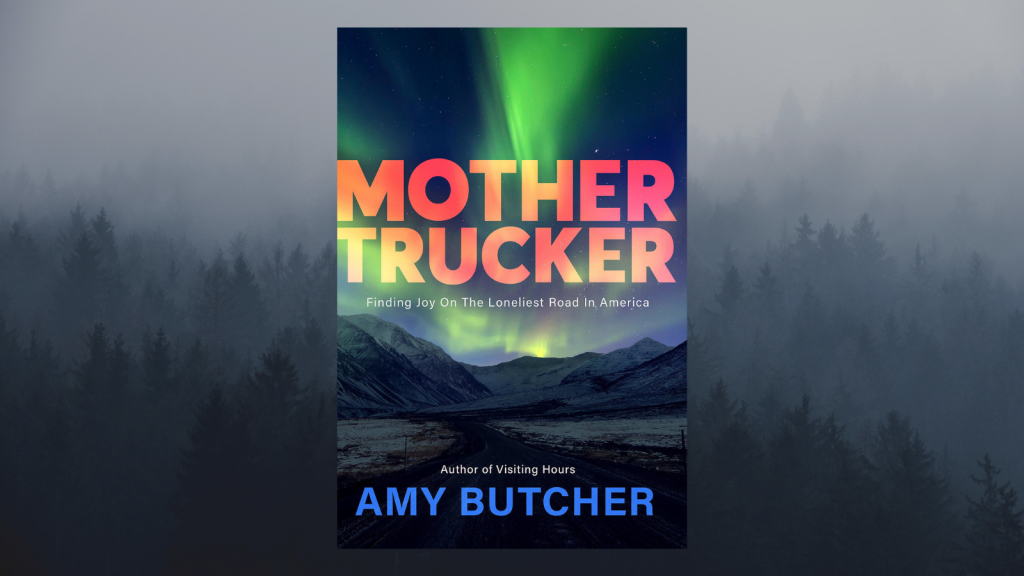
Her newest book, MOTHERTRUCKER: Finding Joy on the Loneliest Road in America (Little A; November 1, 2021) chronicles Amy’s journey to Alaska to meet Joy “Mothertrucker” Wiebe, the nation’s only female ice road trucker, and Amy’s personal experience with domestic violence. She spoke with her former Iowa Summer Writing Program student and nonfiction essayist M.D. McIntyre domestic violence, about the process of bringing Mothertrucker into the world, and some of her favorite writers.
M.D. McIntyre (MDM): It is so great to talk to you again. We first met in June of 2017 when I was taking one of your essay workshops at the Iowa Summer Writers Program, and I remember you were heading up to Alaska later that summer. Did you already know about Joy “Mothertrucker” then?
Amy Butcher (AB): No, but I was looking for a new project. It had been a few years since my first book came out and I knew I want to do something very different. I was really interested in Alaska mostly because I was teaching up there every summer in Southeast Alaska at an Arts camp for kids. I wanted to try to find something to write about within Alaska that I could jump into after that summer trip, but I hadn’t heard of Joy.
These things move strangely and organically. I was interested in writing about northern Alaska, because I really wanted to see the northern lights. I was interested in some of the stories I had heard about the northern lights, but I spent much of my time in Alaska in the summer, so I was looking for a project that might pull me back there in the winter. You know, selfishly, I wanted to have this life experience. I was also really interested in the Arctic Wilderness – I have three rescue dogs, and so I’m often in the woods. I was thinking about some sort of project that could involve the environment, and I was really interested in women in particular and women’s narratives. So at that point in 2017, the project that I envisioned was a collection of essays about women in Alaska. I was envisioning commercial fishermen. Truckers was something I had been kicking around, but I really didn’t have a lot of expectations. I’m on social media a lot. I would use Instagram, specifically searching hashtags like arctic Alaska, Fairbanks, or Dalton Highway. One hashtag would lead to another and eventually, I found Joy.
MDM: So it just kind of came to you.
AB: I think we have things we’re interested in, you know, and I tell my students, lean into that, even if you aren’t sure where it is going, or you think it’s kind of silly. The projects we tend to pursue are the ones where there’s an urgency or a spark there for us.
MDM: The book has a journalistic quality to it. It felt like it was part narrative nonfiction and part memoir. Did you plan this as only a narrative nonfiction piece?
AB: I thought of it that way almost the whole time I was writing it. I wanted this book to not involve me—except as the person writing it. I was deeply moved by Kerry Howley’s Thrown, where she profiles mixed martial arts fighters in the Midwest, and really taken by Jennifer Percy’s Demon Camp, which depicts veterans who have returned from Iraq and Afghanistan. So I didn’t want to be a part of the narrative at all, and I just wanted to profile others. I was really resistant to making it about me or writing memoir. I thought I was writing profiles of interesting women, an essay collection. But then I was spending time with Joy. She was this petite woman in an industry that requires such physicality of the body. You’re not just driving the trucks. You are tying down the loads. You are unloading them. You are wrapping the tires in chains and going over steep overpasses. I was really interested in the dichotomy of her small frame and her larger-than-life personality and her confidence in this industry dominated by men.
I kept telling Joy, “I think you’re a badass,” and for her I think it became increasingly important to show the ways in which she was strong, and what made her strong. Which speaks to a larger conversation, because it was not just her love of the arctic wilderness, or being alone in the middle of it that brought her to the job. It was the idea that it provided a salary unprecedented by anything she could find just working in Fairbanks. It provided financial security in case she needed to leave her marriage, which was abusive. The project just evolved naturally from there, because I was in this relationship myself that was increasingly escalating and abusive, and as resistant as I was initially to the idea that I would be in the story, it felt like that was exactly what the project needed.
MDM: Did you have a “short stack” for this book? What were your favorite books you looked to where narrative nonfiction and memoir merge?
AB: For this book, I really relied on Leslie Jamison’s The Recovering. She outlines a specific time in her life when she was in a relationship with a man, and also her addiction narrative. I was really taken by the way that story blended journalistic inquiry and research with her personal narrative. That book was really paramount for me and inspired me in a lot of ways. Not the least of which was navigating a research project and profile, but aspects of memoir as well.
I’m also thinking of Blair Braverman’s Welcome to the Goddamn Ice Cube, which is also a really fantastic work. I mean, Blair Braverman is an incredible writer. She and her partner dog sled mushers raced in the Iditarod. The way she was writing about Alaska was something I really looked to for inspiration. It was important for me to resist the notion that Alaska heals people, or the idea that you go to Alaska and see the majestic beauty and untouched wilderness and then you are transformed. It is a cliché that Alaskans seem really resentful of and I wanted to show it wasn’t just the place. I mean the place is beautiful and provides a wonderful backdrop, but this story was absolutely about the woman and my conversations with Joy. It happened in incredible isolation in the truck of a cab, and there was an intimacy and vulnerability that might have not have surfaced otherwise.
MDM: This book has a kind of special element to it, where the people in your academic world and your close friends, and Joy’s world and her friends in Alaska, together represent the political divide in America. Over the last few years, friendships that had existed for decades fell apart, people talked about major fights and divisions in their families. But in this book you and Joy were coming together from this place of love. Did you think about that when you were writing the book?
AB: I did. I think one of the things that we scrapped largely from a book, I mean there are still little tails of it here and there, but there is the fact that my own relationship really escalated after the 2016 election. There were a series of scenes about me going to the Women’s March in Washington, and the way that my partner handled that because he was a conservative. There were a lot of scenes like this that my editor and I ultimately scrapped because we worried that it would date the book.
While Donald Trump and the 2016 election might have been in many ways an igniter for the abuse and the hostility in my own relationship, I think the larger narrative of women being abused, being threatened in their own houses, and feeling unsafe in their bodies became a more universal topic to focus on. We also cut it because I didn’t want this book to alienate a reader who might be coming from a more conservative background or someone who might vote right, because I think ultimately the larger story is about women. I was very cognizant of that and worked pretty diligently to keep the book as open as possible, so that women of any background could try to find some place in it.
MDM: The book feels so focused because the narrative of you and Joy driving together takes place over just a couple of days. How did you trim and focus the narrative? Do you have advice for writers who are having trouble setting boundaries for their narrative?
AB: I feel lucky because the drive itself provided some of the structure, but it was really
tricky. Because how do you make a reader care and feel engaged and moved when you know, the landscape outside is shifting, sure, but essentially it’s following two women over the series of a 400 hundred mile drive to a place, and then a 400 mile drive back?
I was also bending this narrative arc because the reality is we arrive in Prudhoe Bay and we have a lovely, but kind of cozy, comfortable evening eating this food in the Prudhoe Bay cafeteria. I was really at first overwhelmed about the lack of tension that was happening physically in the story, and it was through continuing to write that I realized the story was evolving in an emotional way. In a conversational way.
I tell my students all the time, you could be so attached to your work that you’re not able to make drastic moves in order to best serve it. I was joking with my students that my editor and I ended up cutting about the first forty pages of the book, too. My editor firmly believed the book needed to begin with Joy and with me. The first forty pages were a lot of reflection on what it means to grow up as a woman in a patriarchal society where our bodies are not safe anywhere, and we cut those pages. The book begins with me at the airport going to meet Joy.
MDM: I really felt the tension and danger on the road, and part of that is knowing there is a tragedy that happens on the road later, but I have a friend who always jokes that memoir is terrible because you know the person lived to write the book! But for me, the highway still held a tension.
AB: Thank you. It was that very danger that brought me to Joy in the first place, then we sort of moved away from the danger of the highway altogether, and it became about a larger, pressing danger than women face every day in their own homes.
MDM: You were already in the relationship you describe in the book when I first met you, and you were professional, open, bubbly, well-educated, and independent. This is also how you portray yourself in the book, while admitting that you feel there is a real disconnect between how you see yourself and how you feel inside this relationship. I felt like that was a particularly important message about how abuse works.
AB: A lot of writing this book and thinking about this book centered around the idea that we are two white women driving this highway on Native land and we come from two very different backgrounds, but we have most every resource available to us to leave. Honestly, it was really difficult feeling as though the story mattered. This Gabby Petito case that has recently taken the country by storm and along with it, a really valid and important argument that we’re putting all of this attention and time and resources into figuring out what happened to this young white woman when thousands of indigenous women are missing and murdered and no one even knows their names, much less what happened to them. Much less holding anyone accountable for what happened to them.
So I kept coming back to: why does this story matter? It was important to recognize my privilege, but I wanted the book to be a plea for visibility for all women. A lot of people, and I’m one of them, when we think about intimate partner violence, we think about a very specific kind of violence, and it’s physical. And there’s a sense of hierarchy and a sense of triaging of the abuse. I think our culture insists that there is a manageable and appropriate level of abuse.
I met with women who had also been in abusive relationships and several of them pointed to the fact that abuse commonly escalates. It grows progressively worse. I think a lot of the power that I found in writing the story was coming from talking to other women who could say, very plainly, this is abuse. It’s violence. I still get uncomfortable, because I know that so many women—so many individuals—have it so much worse. But I also feel very strongly that it’s important to increase the visibility of what intimate partner violence looks like, and the way in which it functions and the way it does commonly escalate.
MDM: Your story feels both like an anthem on how and why to leave, but also a vivid picture for someone who has never experienced abuse on how and why women stay. You mention the Gabby Petito case, a national news story that dominated the headlines recently and a domestic violence case that ended in murder. What were you thinking while that story unfolded?
AB: I’ve been really angry. I wrote an op-ed about the Gabby Petito case for The New York Times because it has been really difficult for me to watch that story unfold. The abuse of my partner also began on a trip out West. I wanted to go camping alone and I wanted to go out west and see the parks. At the time, things in my relationship hadn’t escalated. Also, I was told that my trip out west wasn’t safe for me to do as a woman alone, and I needed to bring my partner.
I think so many women feel moved by this case, because they see some aspect of their own experience in it. But there is also the important conversation about the time and resources—in terms of law enforcement and even people online providing help—to find this one white woman. But there are thousands of indigenous women and women of color, you know their cases never get the attention, they never become household names, and it’s a really crushing conversation.
I also think for a lot of people watching that bodycam footage [bodycam footage of Gabby Petito captured by police in Utah in August and later published online] it feels like a very textbook case of abuse. I’ve been really struggling with that. It only further evidences the way in which our culture reinforces the narrative of whose lives matter and whose lives don’t. The fact that we all knew exactly what happened to her before we knew what happened to her—it’s so clear. She was cultivating a social media presence markedly different from the life she was living. I watched her videos. There is so much in there where victims of abuse can see what is happening. I feel like it reinforces my belief that our culture tells women certain kinds of abuse are manageable.
MDM: Are you working on anything new?
AB: I am. I have spent the better part of the past year and half working on a new project. It’s a marriage of my first two books, really. I want to continue to write around the criminal justice system and criminal justice reform. I want to write an incarceration narrative of a woman who is serving a life sentence. Right now, it is about her narrative as a woman in the society in which she was raised in. But I haven’t even told my agent about it, so that’s probably all I can say right now!
MDM: That sounds really interesting. I guess I will just be waiting to see that one hit the shelves then. I have to ask: what are you reading right now?
AB: Well, I am obsessed with Melissa Febos. I loved Girlhood. It is the most amazing book. I’m in also in love with Jo Ann Beard’s Festival Days. For her to have a new book out after so many years is just so wonderful. I’m absolutely in awe of her ability to defamiliarize the everyday and write about things in a new and interesting way.
She has an essay in particular, called “Cheri,” in which she is completely absent from the essay. She writes about a woman who benefited from assisted suicide by Dr. Jack Kevorkian and I am just blown away by her ability to write about someone who she admits she never even met. She wrote this essay based on extensive interviews with family and friends, and research, it’s just the most amazing piece of writing. And she has a similar essay in the collection, “Werner,” which I’d also read many, many years ago. It was anthologized in The Best American Essays in 2007 which was edited by David Foster Wallace. I was a senior in college in my first ever creative nonfiction workshop and that was our course text for a class with Professor Kathryn Rhett. I certainly didn’t think that what Jo Ann Beard pulled off in “Werner” was something that I could do as an essayist. That essay was what made me stick with creative nonfiction. It’s what made me apply to an MFA program in non-fiction. It’s what brought me to the University of Iowa. I mean, truly, so much of what I’ve done in this field is due to that essay. I’m just fangirling now—ha!
MDM: I’m with you, one hundred percent. I just read through Festival Days this summer.
AB: I have to also mention T. Kira Madden’s Long Live the Tribe of Fatherless Girls, which is just one of my favorite books. Mira Jacob’s Good Talk is another favorite. For really recent stuff, I just read Maggie Nelson’s On Freedom: Four Songs of Care and Constraint. I have to say, too, that I am really taken by Hilary Plum. I’m reading an advance copy of her next book, but a few years ago she wrote an amazing book called Watchfires, and so I’m excited to dip into her new book.
MDM: Thank you, I’m so excited to have a new reading list! And thank you so much for chatting with me.
AB: Yes, thank you so much, I really appreciate it.