
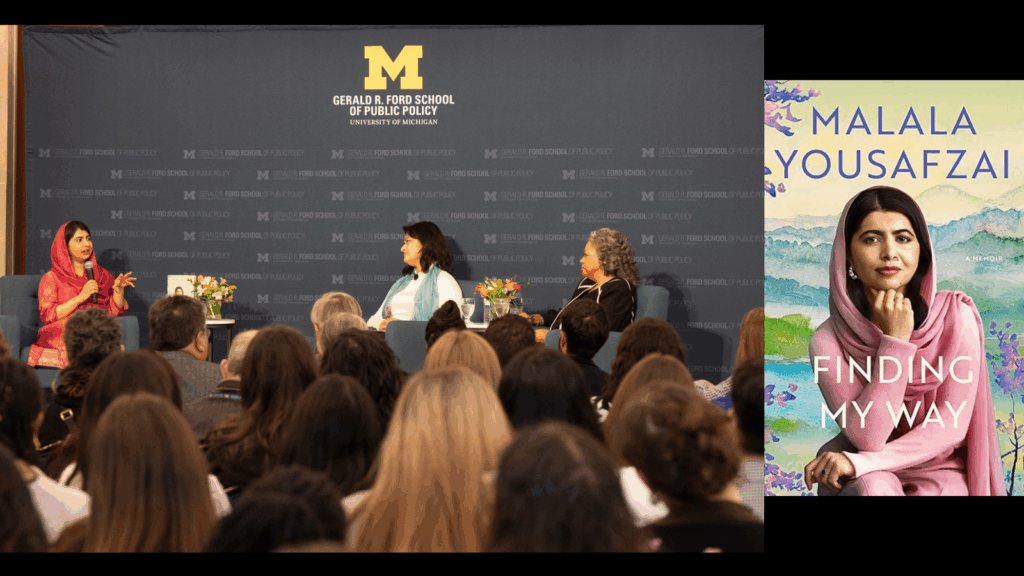
Malala Yousufzai does not fidget. She does not move back and forth in her chair; or wave her hands wildly in the air; or move one leg over the other, and then back, and then one ankle over the other, and then back. No, Malala Yousufzai sits down, stage right. With immaculate posture, she crosses one leg over the other, gathers the microphone in one hand. And then she speaks. Seated beside her, in front of six hundred embodied persons and who knows how many more on the internet, I feel acutely restless. My hands flutter; my legs shift. It is as though every inch of this armchair must be explored by my seated frame, as thousands of eyes stare, mostly at Malala, but also, because I am there, at me.
On October 24th, 2025, amidst the book tour for her new memoir, Finding My Way, Malala came to the University of Michigan, a public appearance for a mere two thousand viewers, for an hour and half conversation with me and Ambassador Susan D. Page. In her Instagram account with its three million followers, Malala has been on Zarna Garg’s couch, the patient in an elaborate therapy gag; she has pointed to a bong, she has climbed into a rowboat, and she has shown off her weightlifting moves. Malala has been on YouTube, announcing herself a “gym bro”; she’s been on the Modern Love podcast, discussing infinity scarves; she went on The Tonight Show with Jimmy Fallon, declaring “I am a fun person.” The girl who enraptured the UN General Assembly is now a grown woman, and in Finding My Way we witness that transition.
Finding My Way is very different from her previous memoir, I Am Malala, which was published in 2013 – the same year as Sheryl Sandberg’s best-selling bible of corporate feminism, Lean In. Coauthored with the war correspondent Christina Lamb, I Am Malala gave a detailed account of the Taliban’s takeover of Malala’s home region of Pakistan, the Swat Valley, narrating its deterioration into a multinational war zone alongside compelling anecdotes from the life of a young girl. That memoir culminated in Malala’s shooting by the Taliban in 2012, and it outlined the excruciating path of surgery, recovery, and rehabilitation that followed. Finding My Way picks up where I Am Malala ended, but there are no details of world history, and there is no credited co-writer, either. Instead, we read about Malala’s college wardrobe. We read about her dating adventures. We read about her boardgame nights, and her Galentine’s Day brunches.
A girl named Malala was shot by the Taliban, and co-wrote I am Malala in response; a woman named Malala, older and wiser, has written Finding My Way, a memoir haunted by the realities of today’s anti-feminist backlash. To read Malala’s two memoirs alongside each other is to engage in a sobering twenty-first century timelapse. In 2001, after 9/11, the Taliban’s atrocities against women were declared an international crisis, urgent enough to justify the violence of military invasion. Two decades later, as the Taliban resumed control, their practices of gender apartheid are mostly ignored, within an international order increasingly indifferent to human rights claims. The memoir’s most explicit discussions of feminist dilemmas are around marriage, and these also serve, in time-honored romance novel fashion, as convenient occasions to extend the memoir’s marriage plot. Reader, she married him, as you already know from Instagram or Vogue or Modern Love, but if you buy the book you can enjoy reading about how she made him wait. Having spent her teenage years engaging world leaders about feminism, the woman Malala now directs her feminism close to home.
Finding My Way is skillfully written: a chapter of more serious content is followed by a chapter of lightness, and the overall arc is one of triumph. Malala – spoiler alert – does indeed find her way: she gets the guy, she gets the degree, she even develops a personal sense of style. But she also begins to have symptoms of PTSD, symptoms that the book details in all their bewildering, incapacitating, and terrifying variety. We watch her start therapy: this, too, is a success, a testament to the value of seeking help when you need it. Her life up to her 2014 Nobel Peace Prize is covered in Chapter One, and the remainder of the memoir focuses insistently on the personal: Clothes, grades, friends; the difficulties of fame, of early success, and of personal security guards. Overprotective mothers; the bad boy downstairs; the pointless, pervasive, conspiracy-minded cruelties of trolls. She writes of the harassment after someone photographed her wearing jeans, and explains: “I could stand behind a podium all day, calling out the worst abuses perpetrated by men, and it would never stir up the level of media attention that wearing jeans did” (40). Even when she finally visits Pakistan, fulfilling a trip that had been repeatedly blocked by the Pakistani government, the emphasis is on Malala’s feelings, not their loaded political context: she ruminates how one uncle’s thoughtless remarks about her appearance left her feeling “exposed and reduced, as I had been so many times before, to my injuries and scars” (96).
Finding My Way is at its strongest when it connects trivial details to larger feminist questions, attesting that, yes, the personal is the political. But surely, too, the political is more than just the personal, a reality that I Am Malala acknowledged through extensive information about rural northwest Pakistan. Finding My Way, in contrast, depicts the Pakistanis she meets at Oxford: urban sophisticates who “knew how to shoot pool and find their shoe size in multiple countries” (83). It tells a story of a class transformation, from an impoverished rural girl to a cosmopolitan woman, one who spends her twenty-first birthday in Rio de Janeiro.
Afghanistan is barely mentioned in Finding My Way, relegated to a single chapter focused on August 2021, when the Taliban resumed complete control. And yet, perhaps Finding My Way will be the work that can compel people to spend a moment thinking about the brutalities of the US withdrawal, precisely because of how Malala sprinkles the sad stuff of geopolitics into the triumphant arc of her own journey.
As Malala’s marriage plot approaches its happy conclusion, it is juxtaposed with the tragedies of contemporary Afghanistan. The girl of I Am Malala woke up with a piece of her skull sewn into her abdomen, the woman of Finding My Way, now happily engaged, flies to Boston so that nerves and flesh from her legs can be moved into her face. As she does so, the US starts its withdrawal from Afghanistan. Malala writes with care and passion, using the power of the specific detail to prod our outrage: the girl child married off to avoid abduction by the Taliban; the teenage boy killed by falling from the wing of a US evacuation flight. She lists the women politicians who helped her evacuate Malala Fund staff from Afghanistan, and writes scathingly of male world leaders: “Not one of them picked up the phone or replied to my messages now. To the men who ran the world, I was just a photo op” (264). Untying the bandages from a recent surgery so that she can speak to the press about the US withdrawal, Malala tells us: “All those years that I stood on stages while people clapped and told me, through tears, how my story moved them—I had thought it meant that they wouldn’t let this happen to other girls” (266). Suddenly, the lighthearted text of Finding My Way shimmers with indignation, alternating between the outrage happening at a massive scale in Afghanistan and the traumatic responses that it triggers in her own body. She provides details with an effective brevity:
Less than a month after taking control of Kabul, the Taliban prohibited girls from attending school past sixth grade. Today, Afghan women are not allowed to attend university or hold a job. They are banned from public parks, gyms, and swimming pools. If they leave their homes, they must cover their faces and bodies from head to toe and be accompanied at all times by a male chaperone. They must also remain completely silent, as they are forbidden to speak or sing in public. Afghanistan is now one of the only countries in the world where the suicide rate is higher for women than for men. (268)
But Finding My Way is not a history, political or otherwise: it is a memoir committed to the growth and development of a child into an adult. To help us understand the implications of the Taliban, we quickly shift to the guileless charm of the child Malala, now remembered through the painful maturity of the woman she has become:
I thought about long nights in the Birmingham hospital, when I would lie awake imagining a conversation with the Taliban. … I planned to recite all the verses from the Quran that prove girls have a right to education. Then I would show them what a good Muslim I was …. I didn’t realize that they would never respond to openness and dialogue, especially with a fifteen-year-old girl. (268-9)
And these memories, too, are subordinated to the triumph of “finding my way”: she thinks of her peers’ concerns with their career plans, and finds, in Afghan women’s sufferings, that “My purpose is the same today as it has always been” (269)
Finding My Way concludes with a visit to the girls’ school the Malala Fund has built in Shangla. Malala asks the students what their dreams are for the future:
The answers worried me: doctor, doctor, cardiac specialist, army doctor, neurosurgeon, programmer. So many Pakistani parents push their children toward medicine or engineering, unable to imagine or accept other professional paths. … I wanted these girls to know that no matter what path they chose, their education would have value. (299)
This is Malala’s great rebellion today: if the girl Malala told us that feminism should enable us to do good things, like go to school, the woman Malala insists that feminism is also the right to do what we wish, to have a life beyond the choices that others impose upon us.
In retrospect, it seems obviously absurd that we asked Malala to lead us in the issue of girls’ education. Her experience of being denied an education was catastrophically singular; for millions of girls, the denial of education is nothing so dramatic, and yet all too intimate. It is a little less food at meals, a little more work at home, an accumulation of obligations, inconveniences, and everyday risks. And so, for most girls, and now most women, education disappears for reasons that seem inevitable and incremental, rather than devastating: nothing at all like a grown man shooting a 15 year old in the face.
Did Malala write this memoir alone? I don’t know, and I’m not sure it’s all that meaningful to know. Finding My Way gives authorial credit to Malala alone, but Malala’s writings have been coached from the very beginning of her public life. Her very first writings, for which she first became famous, happened when she was just 11 years old: they were created through conversations with the Urdu journalist Abdul Hai Kakar. Hai Kakar would call her in the evenings and then curate the words he liked most, publishing them under her byline, itself the pseudonym “Gul Makai.” I Am Malala explains:
He would guide me, asking me questions about my day, and asking me to tell him small anecdotes or talk about my dreams. … Then he wrote up my words and once a week they would appear on the BBC Urdu website. He told me about Anne Frank…. (I Am Malala 80)
This detail startled me: we all know how Anne Frank’s story ends. To be launched into public life as the next Anne Frank is to be promised literary immortality through early mortality. Whether an 11 year old could weigh this bargain is not a question that can be usefully asked.
When Malala came to campus, the tickets sold out immediately, within hours of the event posting online. Because it was Malala, I met the President of our University; because it was Malala, I also met the President of our Police Department. Her security guard hovered throughout, rarely seated, never smiling: when we moved from room to room, we walked through dim passageways and underground tunnels, burrowing in the innards of a building where no one could find us. There were guards posted at every doorway and every junction: Malala walked straight ahead, her bodyguard right behind her. This is Malala’s life, for over a decade now: the underground deviations, the elaborate security, the choreographed hiding – and then, on emergence, the enormous stage, the electrified audience with their adoring grins.
In the weeks before and after the interview, so many people spoke to me about Malala. They said little of the Taliban, and not much about women’s rights or feminism, and of Pakistan only if they were, themselves, Pakistani. Instead, most of them, especially the younger women, spoke of how old they had been when Malala had been shot. They felt that they had grown up with Malala: that in her outsized life they had found a place to chart the world’s expectations for teenage girls. They didn’t just seem to love Malala –against all my expectations, they identified with her. They saw themselves as changemakers, just like her; they felt scared, and they wondered how she didn’t. It is fitting, then, that the one moment at which Malala seemed to lose her composure was in response to a student question about a would-be activist who feels scared. “Don’t be scared!” Malala spluttered, almost shouted, into the microphone, before resuming her usual measured tone. Her passion, or perhaps even impatience, flared as she answered – “We must be more afraid of the injustices than of opposing the injustices” – and then, once again, it was gone, replaced by her extraordinary composure and self-possession. In Finding My Way, today’s Malala writes that “The worst moment of my life had been not a turning point, but a pause—an opportunity for leaders to act appalled that the Taliban would dare to shoot a child, throw some money into girls’ education, and then return to the business of growing economies and winning elections” (267). I wish, I very much wish, that I could say that she was wrong.
Our interview was photographed, for well over two hours, by a staff photographer I had not met before: walking backwards, crouching, hovering, always present, Dieu-Nalio Chery took the usual array of flattering headshots, convivial stills, animated group photos of securely employed people in comfortable chairs. Six years ago, on September 23rd, 2019, Dieu-Nalio had been shot in the face by a Senator in his native Haiti. He remained in Haiti, and he kept working as a photojournalist, and in 2020 he was a finalist for the Pulitzer Prize. In 2021, he was threatened by gangs; shots were fired at his car. He and his family fled Haiti just to survive. Today, his employment comprises graduation photos and faculty headshots.
In organizing the Malala Yousafzai interview, our team had conjured an unlikely tableau: an exile, once shot in the face by a leader in his home country, photographing a more famous exile, more terribly shot in the face, by a more notorious leadership. I knew, of course, the horrifying situation in Haiti, but I had missed entirely Dieu-Nalio’s defiant heroism and the international news coverage it had attracted. I had not thought about Haiti for months, not until the photos from the Malala event arrived. At that point, I immediately looked him up. How, I wondered, did these photos look so good? I never thought I’d find the answer in grief-riddled photos of brutalized protesters.
When we entered the room – Malala leading, Dieu-Nalio photographing – the energy was propulsive: hundreds of audience members, of various ages and races, grinning ear to ear just because Malala was there. And when we stood to leave the room, I looked out upon a sea of cell phones, their metallic eyes pressed upon us, the human flesh holding them aloft.
At the end of the evening, after the VIP meet-and-greet, Malala and I take one last picture, just us. She places an arm lightly on my back: it feels like a benediction. I hope the interview has been a success. But what, in these times, is success? As Malala writes, astonished by her earlier naïveté: “When I was a child, I thought if I spoke out, things would get better” (266).