

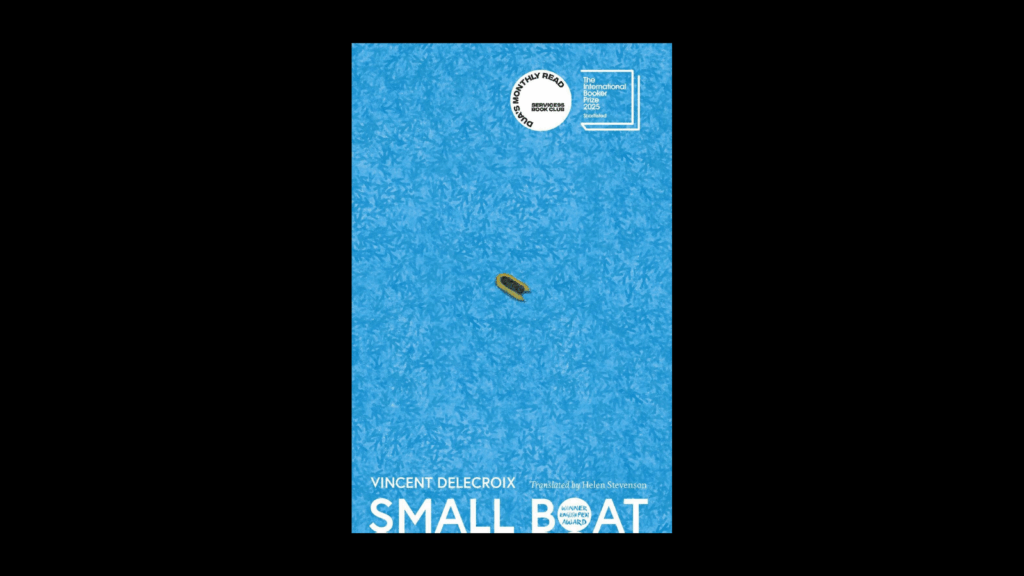
French writer and philosopher Vincent Delecroix’s inspired account of migrant tragedy takes satisfying form in his International Booker short-listed novel, Small Boat. The slender work is surprisingly involute. It gathers steadily upon the slippery axis of human conscience, and is persistent in its demand that we fathom of its narrator and our compatriot—a seemingly ordinary citizen of a guiltless world—the unimaginable.
Delacroix’s fiction, translated by Helen Stevenson, is a timely meditation encapsulating the true-to-life “Migrant Drama” (as coined by Small Boat’s narrator) playing around the globe, and particularly concerns the perilous English Channel crossings undertaken by thousands each year from the Calais area in France to the UK. While various news articles have reported political discourse surrounding the recent controversial agreement between the UK and France, a deal that is a “one for one” migrant return special, if you will, Delecroix’s astonishing account returns moral gravity and reckoning to center stage through disturbing perspective. In its examination of complicity, the novel forces a mirror: We the consumers of the sensational, we the self-soothers and commentators, we the hand-wringing and the scandalized, we the censorious and righteous rest of the world—as our condemned narrator accuses us—are only “moved by the spectacle of suffering” (48).
Small Boat’s narrator is an unnamed French rescue operator who is being investigated for negligence. Twenty-seven dead migrants in the cold channel, their bodies drifting from English back to French waters come morning. Why weren’t they rescued? A police inspector who bears an uncanny resemblance to our narrator—reflective, yes—repeatedly poses this question to her. “They were in English waters,” (45) our narrator emphasizes, unflappable as ever. Her voice from that night, her recorded comments to the migrants before they drowned, is played back to her: “I didn’t ask you to leave… It was your idea, and if you didn’t want to get your feet wet, love, you shouldn’t have embarked” (19).
Delecroix’s acclaimed novel is based on true events in the English Channel on the night of November 24th, 2021, when the French regional monitoring and rescue center, CROSS at Cap Gris-Nez, logged a call about a small boat in distress. After multiple exchanges over the course of several hours, liability for the dinghy was volleyed across nautical borders. Neither French nor English rescue vessels ultimately acted to save the migrants. Twenty-seven of twenty-nine were counted dead, most among them Iraqi Kurds, Afghans and Ethiopians. Callous comments from the French rescue operator, inadvertently captured off-microphone, served as evidence for an ensuing years-long investigation.
Such an inquisition is ostensibly an attempt to identify the fundamentally responsible actor, a source-point of negligence. Small Boat’s elegant adaptation of the event, however, favors an interesting dimensionality, the idea that such an inquiry is inherently more exhaustive. Rather than identifying the agent of carelessness or even conscious indifference, what is required of us after every episode of the Migrant Drama is the preservation of the species itself. A reassurance, via reassertion of exceptionalism. The rescue operator who fails to rescue might possess a native immorality, he or she might be a singular incarnation of evil.
The matter of the soul, the impracticality of its taking the stand, is laid bare for us by the observations of our narrator. She dissects the phraseology of the police inspector interrogating her, the ineffectual constructions she believes are meant to trap her, and discredits the foundation of the police inspector’s “inferior” arguments as predicated upon pathos, moral distinction, and other logical fallacies. When the police inspector uses the word “sickening” to characterize what the narrator is saying, the narrator derisively thinks it “really isn’t a police kind of word” (52), concluding that the investigation had transgressed into the jurisdiction of “a moral assessment” (54), and that “her line of questioning seemed to me stupid and naive—characteristic of a too common determination to seek psychological, or even pathological explanations for everything” (69).
It is a testament to Delacroix’s philosophical persuasion that we, the readers—though not always certain of the extent to which these refutations are actually verbalized to the inspector—do not tire of an unorthodox narrator’s often circuitous interiority. Furthermore, following the threads of the narrator’s reasoning urges a look toward the genesis and coherence of our own convictions. And although the policewoman is the one asking questions, her words betray an implicit declaration on behalf of all of us. Our narrator’s defense, on the contrary, puts us to trial. This inversion of courtroom posturing is fascinating.
After all, our narrator is a doting mother, visits her parents weekly, is partial to long runs by the shore—signs of an otherwise innocuous citizen—and is convinced she is only the last link in an already “sunk” situation: “They were washed up well before they were drowned” (39). Why should she bear sole culpability—she theorizes indignantly, with mathematical rigor—what of the very forces which drove the migrants from their homes? What of the bystanders who are rather good at spectating and empathizing but not at all at acting? What, even, of providence, when it is God who “possesses far more resources than the French navy” (51)?
In the narrator’s view, the migrants were “pushed to the sea’s edge by a bigger, invisible wave, a wave coming from the land” (40). In her estimation, that might have begun by the migrants’ own miscalculation: “Maybe they even started to sink the day they got the idea in their heads that everything would be better elsewhere, when they started to want supermarkets and child support” (40). When the investigator reminds her of the existence of war, famine, discriminatory law, poverty, ethnic cleansing, climate change and xenophobia, the rescue operator obstinately insists again, “I’m not the one holding the broom, sweeping them across the earth’s surface and throwing them in the rubbish bin of the channel…Who’s asking them to leave? Not me, that’s for sure” (40). She claims that she holds no anti-migrant sentiment and, in fact, as her occupation calls to duty external of personal opinions, she rightfully does not have “any thoughts about them at all” (29). When we the readers and the police inspector ask her with bewilderment, “You can’t see the harm in all this?” (96) The narrator, recalling drives down the coastline after work, manages to even shift blame to nature itself: “The sea with its guts glutted with women and children…lifeless, enormous, malign” (97). And what of collective time, the best accountant? Objective assessment of the situation, by her idea, also requires a more macroscopic, temporal view. “Why don’t you listen to years of recordings…How many have I saved? Let’s add them up” (109).
Delecroix skillfully excavates moments of the narrator’s inner turbulence: “On the one hand, I could justify everything…the decision is rational and therefore virtually irreproachable, but that on the other hand, deep down…lay something aberrant and inexplicable” (60). In recalling the sea again after the small boat event, the narrator thinks: “There it is alongside me, pursuing me, watching me … It is waiting. It pretends to sleep or be busy doing something else” (98). Numerous times when the narrator is being questioned about in the police office, she looks out the window to construction workers outside. Her illusory impression is that “the sea, incomprehensibly, had begun to encroach on the building site” (31). She also summons the image of her daughter often, couching herself in a sticky comfort (incensing, perplexing) that “she’s not in danger of drowning in her little bed at night or in her bowl of hot chocolate in the morning” (31).
The accused French rescue operator, a timeless representative of the banality of evil, proves an effective vessel by which Delecroix critiques the highly political and indifferent global theater of our times. Although this narrator is our primary lens, a short section in the third perspective of the actual drowning event trisects the novel and is also illuminating. The prose in this section is spectacularly lucid and sensory. The depiction of elemental onslaught upon the migrants as they are engulfed in the frigid channel reorients us, administering a certain shock as to the territory into which we may have strayed in our following of the narrator.
In one sense, the narrator is correct in her idea that the small boat capsizing is a single point of disturbance which began elsewhere. Of course, the reason for the countless small boats out in the channel every night is the collective wave of violence, though our narrator refuses to comprehend the migrants are victims of this wave instead of being its co-creators. Her doubling down on this falsehood is the true perpetual sinking, and Small Boat reminds us of this calamitous wave’s long approach and its slow breaking, the breaking which washes over all of us on land, seeping into our very selves, severing us from any semblance of redeemable identity. The French rescue operator has always been confident in the wave as the migrants’ unassailable fate: “Don’t you get it? You will not be saved” (106). As for the collective conscience, we might be equally damned.