
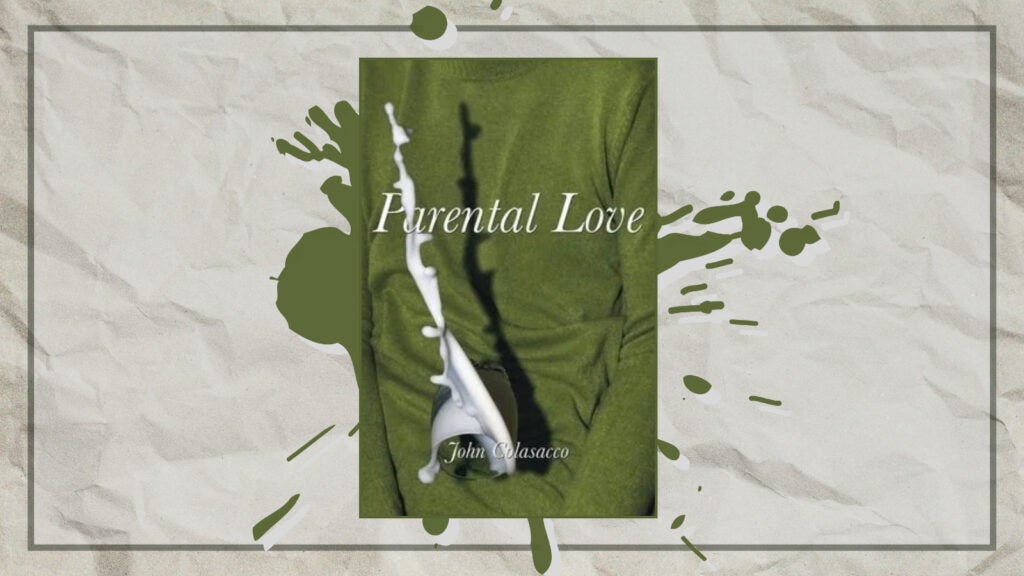
Life is weird. We make clocks and doctrines and mythologies to mitigate that weirdness most of the time, but frequently our systems of meaning-making, such as memory, actually create more weirdness. Weird is a word in Shakespeare’s Macbeth used to name the prophetic witches—the “Weird Sisters” meaning not “strange” but “fateful” and “visionary.” John Colasacco’s new narrative book-length poem, Parental Love, embraces memory as myth, envisions the way recollection aside from fact. In myth, magical events occur, surreal characters appear, and the whole earthly landscape is tinged with significance. Colasacco, who earned a B.S. in advertising before his M.F.A., maintains an ongoing project on Instagram called ‘Poems for Brands.’ He is well aware of how language can create rather than simply interpret or describe. Though this process can be unsettling, in an interview about an previous book-length poem, The Information Crusher, Colasacco admits: “I became aware of a frustration I have with my memory.” Out of this frustration, he seems to have turned into the riptide, allowing memory to enact itself creatively.
He’s worked in similar poetic forms before: spare narratives in his books Two Teenagers and Antigolf. In Parental Love, however, that interest in the generative power of language becomes inseparable from the instability of memory itself. The book continually asks what it means to remember what happened, and whether the remembered version might be more truthful, or at least more revelatory, than the event itself.
The story starts with the refrain, “After my parents got divorced,” and the son-speaker’s life is covered from childhood (at least as young as eight, though few specific age references are given) to adulthood when, in the epilogue, the speaker has become the father of a son himself. This refrain, and minor alterations to it, serve as a kind of anaphoric structure, and the writing is organized into brief couplets unmarred by capitalization or punctuation throughout. Post-divorce, the boy seems to move through the world tagging along with his father as they encounter off-kilter characters with dubious motives. The two go together to buy a used Toyota from expressionless farmers who have “a cold alien way about them,” and the quest of buying a used car is central and repeated and comes with the question: “what if there’s some defect / we don’t know about?” The question applies to the car, but it also applies to family, memory, and the self. This quest leads them to talk to a man with one white eye who asks, darkly, to hang onto the boy for a few days as a deposit, and though the father gets angry and storms away, the boy’s child perspective is totally different:
but I thought, why not stay with the man
for a couple days
we could ride in that white car
I liked the idea
Unsettlingly at times, the son accepts the bizarre as ordinary since the world of the book has already taught him that ordinary family life can be just as inexplicable. His childlike apprehension is especially telling when he finds a feather that “seemed like one of the most // beautiful things you could find / but they said it was dirty.” Here, he sees beauty where the adults see dirt, and Parental Love relishes in this kind of dissonance.
Colasacco crafts color symbolism throughout the book, imbuing objects with a resonant echo each time they appear. Early on, the pre-divorce family goes on an uphill climb and sees a red house they once rented. It smells good and has a package on the porch, a metaphor of nostalgia and the warmth of the family’s past, and that red house returns later in the story like a fire in the distance. Meanwhile, the accumulation of references to whiteness or off-whiteness—milk, moths, teeth, moons—becomes one of the book’s recurring visual and emotional motifs as there is persistently a need that remains unfulfilled. In one instance of this motif, late one night the boy wakes and takes out the trash but keeps wandering, pushing at his tooth until it comes out, and then places it on train tracks and watches as the sun comes up; it’s an image that is grotesque and aesthetic, and just after this the father grows a tooth. Father and son often blend into one character as the boy also co-experiences his father’s dream, and knows that “he was like I was / I didn’t like either of us.” The father is not merely someone the son remembers; he becomes part of the son’s own imaginative architecture.
The speaker’s life spans decades, but time rarely behaves like conventional narrative time. The book moves through ghostly fog, tenses slipping from past to present and back again. Characters revisit orphaned places: an abandoned church, a closed restaurant. A gothic quality persists, and the world seems constantly to have existed before the speaker arrived and to disappear just as he begins to understand it. His internal world is funhouse-mirroresque, captured in an art piece he creates:
I drew tall
stretched-out cities
I drew people
tall as houses
I imagined living all alone
And this image returns in the epilogue with the speaker’s son; what begins as a child’s private fantasy becomes a kind of inheritance. Later, in the epilogue, the son repeats and slightly alters the father’s imaginative gesture with burnt sticks, as family history is reenacted and ashen, which calls to mind the ancient Greek idea of generational curse, as the speaker thinks, “at any second / you may do something wrong // and be punished forever.” The statement carries religious implications, but it also describes the child’s experience of family life: the rules are mysterious. This becomes explicit when the father tells his son that he won’t remember any of this, and when the son asks what, the father spills open and says, “this room / your whole life // you’re going to forget all of it.” If there is one, this is the thematic climax of the book. The father tells the son that his experience will eventually become merely “your ‘childhood,” a category that replaces the lived experience. Memory becomes recursive. The son remembers his father telling him that he will forget, and the adult speaker remembers remembering that warning. What is preserved is not necessarily the event but the awareness that the event will disappear.
Late in the tale, the father tells the son that he has to learn “how to bring water / to a slow boil” and then says, “you have to tell me what you know / that no one else / knows yet.” These strange instructions feel like fragments of an initiation ritual, but they beg the questions: what are the things a son needs to know from his father? What does a father need to know from a son? The book never quite answers, perhaps because the answers are exactly the things that memory cannot preserve. Instead, the father breaks down. He becomes soft, timeful, sad, and perspective itself overwhelms him, but it also feels like an utterly relatable human moment:
you’re grown up
now, I guess…
it was a lot of fun
you know,
it was over
much
too soon
This is one of the most affecting moments because the surreal machinery briefly falls away. The father recognizes that childhood has ended, while recognizing that it was never really his to keep. The son has become an adult, and the father is left with memory. In the epilogue, the narrative suddenly shifts, and the speaker is now a father himself as everything feels repeated, repeatable, reincarnated, rebirthed.
Colasacco’s writing is fulfillingly genre-challenging as Parental Love is simultaneously a novel, a book-length poem, a memoir-like family narrative, a dream, and something more difficult to classify. It has a traditional narrative in some ways: a clear protagonist, setting, conflict, dialogue, and plot told in simple diction. But there is no conventional capitalization or punctuation, which creates a blurring effect, a stream of time and memory. Couplets and space give the novel its poetry, its ambiguity of linebreaks and mysteries, which remain unresolved because its subject is precisely the impossibility of resolution. Memory, after all, doubles back, invents connections, forgets details, preserves images without explanations, and sometimes transforms an ordinary moment into something mythic. This is particularly apparent in the book’s recurring preternatural experiences and references to death, church, confession, and holiness. At one point, the speaker’s teacher calls home and suggests that he may be possessed, claiming, “it’s not so strange.” It is, of course, strange and in this landscape, not so strange simultaneously. Of a priest, the speaker says, “inside him // all the incredible sins / he’d been told.” It’s a poet’s vision: to think of the incredible sins inside someone, to extend that for the reader into an implicit asking of what’s inside us via memory and confession? When the mother tells the boy that after she dies she wants to be a bird with a red throat, in response the boy decides he wants to die “just to see.” The impulse is characteristic of the book: death is not simply an ending but another transformation, another possibility of seeing what comes next, though this is not an untainted reassurance; after all, in the very end, the son has become a father and tells his own son, “there is always something to be scared of.” The world is frightening because it is strange, but it is also beautiful for precisely the same reason.
John Ashbery once wrote, “I too often feel like a person I know nothing about,” and Parental Love’s deepest subject is the unknowability of the people closest to us: our parents, our children, even ourselves. We spend our lives constructing stories about them and about ourselves, and those stories inevitably change. What remains is recurrence—images, fears, desires, and fragments that return to us, altered but recognizable. In his latest work, Colasacco captures the kind of surprising magic that makes one pay attention. He makes memory a landscape, and the reader wanders through it as if through a dream. The result is strange, funny, frightening, tender, and finally moving: a family story in which the past cannot stay past, the child cannot remain a child, and the father and son continually become versions of one another. This is a wandering that artfully pushes past the moment of the brief lyric, past the potential dryness of a documentary, past the temporal and imaginative limitations of a memoir. It’s a captivating world-building of one’s own past where the great mystery is not what happened; it is what survives.