

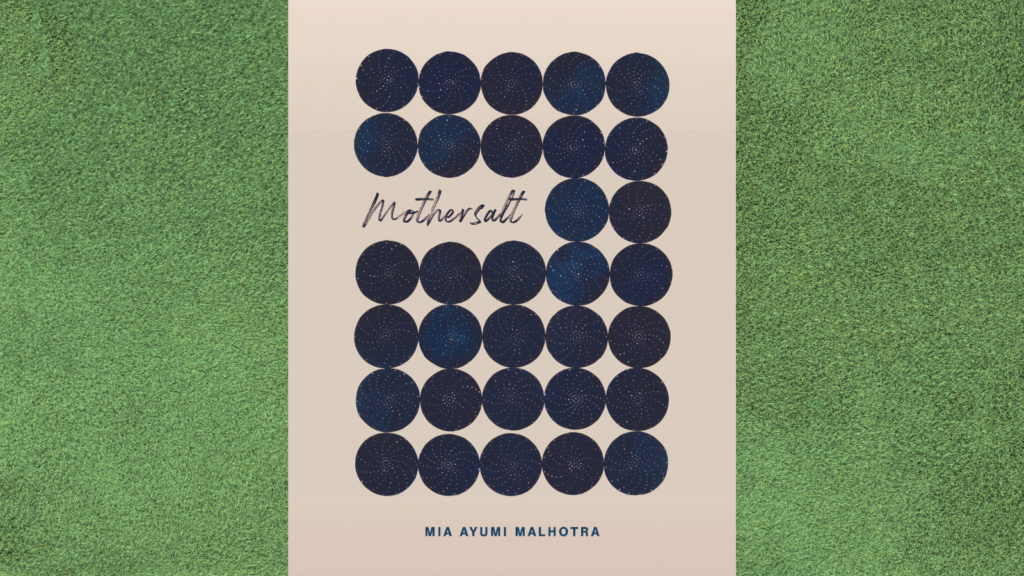
“How many mothers, after giving birth, feel like a ghost in their own story?” writes Mia Ayumi Malhotra in Mothersalt, her second full-length poetry collection. A confrontation and a practice of embodiment, Mothersalt is shaped and reshaped by the pressures and facts of the body. When existing forms are insufficient for what must be carried (by the poem, by the speaker), Malhotra’s exploration of form and subject offers an evocative discussion of history, race and gender, and the constant question of who maintains the fragile space of the lyric I.
Written in single sentence stanzas and prose blocks that nod toward the zuihitsu (and Sei Shōnagon, the writer perhaps best known for the form) Malhotra writes in “On Form”:
“I became a mother and I began to write like a Japanese woman.
Which is to say: I began to write like myself–from the imaginary whence my mother’s mother and her mother before her came.
Things That Are Distant Though Near: Festivals celebrated near the Palace. The zigzag path leading up to the temple of Kurama.
When I became a mother, my lines began to grow less regular, less sculpted–and this itinerant prose did not adhere to shapeliness.”
The “imaginary whence” is a generative construct; a place of work that is also a place of birth. And perhaps I consider this “whence” all the more concrete because it is invoked by a person writing (towards? directionality is hard to say in empire) within a diasporic tradition. After reading this poem, I wanted to know if Sei Shōnagon, quoted in italics, became a mother. It feels like an unfair question when she created so much work. But the questions of mind-work and body-work are deeply entwined throughout Malhotra’s collection. Like an anthropologist, Malhotra gathers her evidence in “Gestation and Becoming,” from “The radiance” that “for a time, gathered around my body” to “The fetus’ skin, so thin at this stage, may not be touched, lest it pull from the body. A shroud, unraveled.” I’m interested in how she proposes this confluence of risks–a shared fragility–carried by the poem and by the pregnant body. They are both vulnerable, the poem and the fetus, the mother and the writer, when the outside gaze crosses a certain threshold.
What Mothersalt offers is a narrative about birth where the body is addressed. Through a scattered sequence, Malhotra’s “Dear Body–” poems build multiplicity, alternates and alternatives for the birthstory (“If birth is a story, maybe I can write it backward and forward”). Though the event has already happened to the body, memory is more plastic. And in the sequence, the bodies do shift. The pointing cry “It’s her!” becomes a chorus. No longer the declaration that “the doula cries” before “they rush me to the bed,” it becomes an announcement “we say and press her to my chest.” Even the subject (the body of the speaker versus the body of the daughter), becomes interchangeable. These rivulets of language and narrative offer the possibility that form (a living body!) need not dictate function.
Expanding this study of memory, the speaker returns again and again to the present in a sequence of poems called “Today”:
“Today you touched your chest and said your name for the first time.
Today you asked what comes after white hair. Maybe rainbow, you said.
Today you said, When I grow up I’m going to marry Mama.
Today you read one of my poems and said it was a silly one, because when you read it you could hear me using my important person voice. “
I linger on that last line and the question of what it takes to remain in the present tense. The present tense demands constant attention. It means taking the active role as witness. We often feel distance between ourselves and the version of ourselves who can issue a statement (of memory, fact, or evidence). By which I mean, we create distance when we feel we are likely to be under additional scrutiny. Like the fetus, the I is fragile. I think it’s important to note that the poem “On Collapse” which follows this one is also a kind of testimony, one in which the distance of another’s scrutiny alters the form:
“I once shared a table with a person whom I will not name, who looked at me in a way that made me feel foreign, even to myself, and asked why, if I was raised overseas, I spoke such good English.
Why do you feel comfortable saying this to me?
The space suddenly stripped of its easy, familial feeling. The rest of the family, cutting strawberries in the kitchen.”
While the event takes place in memory, Malhotra maintains an ongoingness of thought. The family is still cutting strawberries in the kitchen, strawberries which may be the same as those we saw a few poems earlier, in the first of two “Today” poems (“Today you said, But my cake didn’t have chocolate writing, and I said, Well, at least it had strawberries”). But the confrontation demands some change in the self, some invocation of the “very important person voice.” Malhotra writes:
“Some people are born into the I and feel it is their birthright to say I this and I that, but others are made to believe that I doesn’t matter, especially in relation to They, which means our coming into selfhood is tentative and sometimes belated.
Why, when the moment collapsed, taking with it my sense of I-ness, I felt so powerless.”
I cannot help but think of the many times I’ve heard a critic disparage the lyric I in the context of confessional poetry or identity poetics. So often the critique of content (experiences of historically marginalized writers) is made through a critique of form (the I, the lyric). Who is allowed the preciousness of the self? And who must compose the defense of their work, of themselves, alongside their work? Every time I read Mothersalt, I think the speaker’s retort, “Why do you feel comfortable saying this to me?” is genius. It is essential language I put to memory just as Malhotra has put it to memory. The line, borrowed from Claudia Rankine’s Citizen, reminds the reader that the scene in “On Collapse” does not happen in isolation, and neither does the language Malhotra reaches for. The allusion allows for a polyvocal retort, and we feel the weight of that polyvocality in its use. The speaker rejects becoming the object of the sentence. When the poem repeats how “The rest of the family, slicing fruit at the counter,” is “Listening, but not speaking,” we’re reminded that this confrontation is about the body but (as with “Dear Body–”) the responsibilities of witness are not singular. The reminder, in another interpretation, is also a retort which examines the distance between “when the moment collapsed” and the “imaginary whence” Malhotra describes in “On Form.” The forced response is forever at odds with what it means to “write like myself.”
Last night, two friends told me how our elders are the hardest to parent. They both used the gender neutral, to parent, because mothering is not socially neutral though mothering can be gender neutral. The “writer-mother,” as Malhotra describes, is “that impossible beast,” “chimeric,” interrupted and “accrediting toward some hazy impenetrable distance.” I’ve seen panels and heard discussions about the biases against the writer-mother, and yet, despite the known fact of her, she is allotted so little space. For a long time, I struggled to write about this collection. I know very little about motherhood beyond being mothered. I will very likely never be a mother, but Malhotra’s collection matters so much for my body, too. In examining early motherhood and her vocation as a writer, Malhotra’s work is one which constructs, alongside a human child, a body for the tentative I, the ghost of the self.