
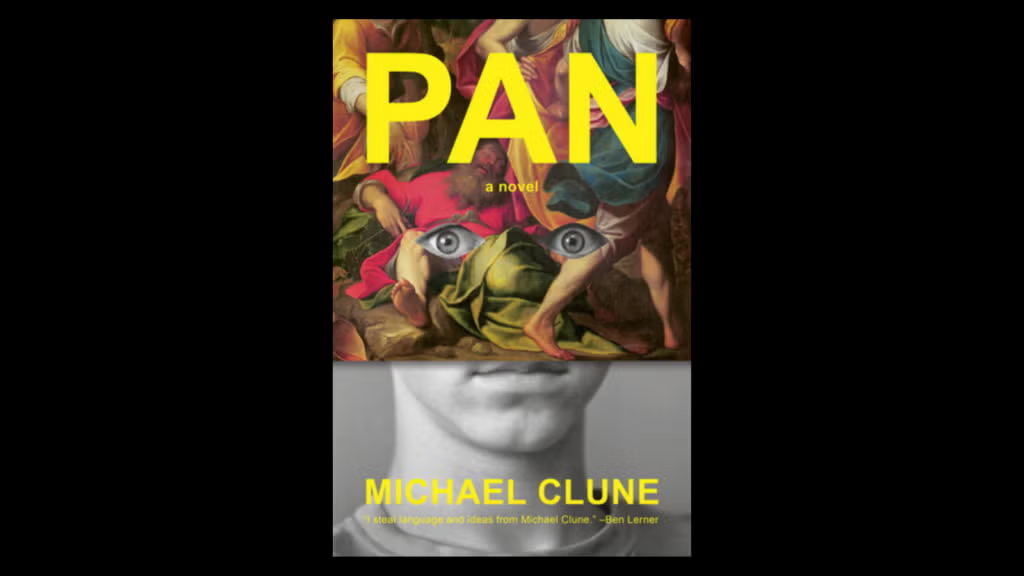
Michael Clune’s fictional debut, Pan, is a suburban novel. But not the emerald-lawn, private-drive, multicar-garage sort of suburban. Chariot Courts, the subdivision where the novel’s fifteen-year-old protagonist, Nick, lives with his divorced father, is located in the distant suburb of Libertyville, Illinois, where land is cheap, and the construction of their townhouse (“There was no town anywhere. I guess it’s a polite term for ‘little house’”) even cheaper.
For Midwesterners like myself, Chariot Courts might recall those blob-shaped “communities” on the outer edges of the region’s urban centers. The ones with weeds growing through cracks in winter-worn parking lots; the ones situated behind sad commercial strips of used car dealerships, gas stations, and members-only warehouse clubs. These are places where living happens in private. As Nick remarks on the first page, “No one’s face held any kind of future for any neighbor, and so you couldn’t even remember what the people who lived right next to you looked like.” Picture all the typical alienation that comes with suburban seclusion, but without the overt projections of peachiness that come with wealth. A shithole, some might say. Perhaps it’s no coincidence that a novel so steeped in social isolation also provides readers with such an intimate depiction of its narrator’s inner thoughts.
***
Like his twentieth-century predecessors Knut Hamsun, Marcel Proust, Virginia Woolf, or William Faulkner, Clune writes about what it’s like to have a mind and experience the world in a fundamental way—but in an unmistakably twenty-first-century idiom. As is the case with his two previous memoirs, White Out and Gamelife, Clune’s artistic talents shine brightest in Pan when used to capture the machinations of perception. While White Out renders with startling detail the mind on heroin–and the mind addicted to heroin—in Pan, Clune turns his attention to the workings of the anxious, panicked mind.
There’s something self-reflexive about Clune’s creative endeavor: writing about the mind and sensation having only one’s mind and senses as the primary tools to do so—sort of like a computer running diagnostics on itself. Simile is a recurring device used to this end. In one scene from Pan, Nick experiences something like the aftershocks of a panic attack—the memory of the sensation of what he describes as “something leaving my head”—which by this point in the novel he has identified as a sure sign of panic. Recalling the memory, he says, “It would course through my body, a sensation I knew I hadn’t made up or hallucinated. Just as you know, when you remember the taste of cinnamon, that you’ve really tasted cinnamon. You haven’t made it up. No one could make that up.” Or, some forty pages later, when experiencing an actual panic attack, which he attributes to a visitation by the god, Pan, Nick relays his thoughts in similarly peculiar terms: “That panic vision has burned down my eyes like wax candles, and now it’s burning through my interior, dissolving it. My body like a pool of water, I thought, in which Pan’s vision floats. In which His thought moves in electric charges.”
Clune’s uncanny portrayals of anxiety may have a particular resonance with readers of his generation and the next ones. A 2024 report on a psychiatric study conducted between 1990 and 2021 discovered a 52 percent increase in the global incidence of anxiety disorders in people aged ten to twenty-four. Though there is no explicit mention of the year in which the novel takes place, one can infer that it’s set in the late eighties or early nineties (Clune was fifteen in 1990) from the awkward, teenaged attempts by Ty—Nick’s best friend—to make small talk with a cabbie while the two of them get a ride to Ruby Tuesday: “‘What about the Bulls, huh? Fucking Jordan, right?’ The cabbie made a noncommittal sound. ‘Michael Jordan is unbelievable. Isn’t he unbelievable? Come on. Forget about it. What did you say your name was?’”
One enduring appeal of Clune’s writing to these generations of increasingly anxious readers might be the spot-on renderings of these mental disorders he’s able to accomplish with such syntactically simple sentences, as is the case with Nick’s first experience of a panic attack while sitting in geometry class: “The textbook lies next to my hand on the desk. Next to the textbook is a large blue rubber eraser. Hand, textbook, eraser. Desktop bright in fake light. My hand, I realize slowly, it’s a . . . thing. My hand is a thing too. Hand, textbook, eraser. Three things. Oh.”
Perhaps the most frightening aspect of the first experience of a panic attack is the alienness of it—the feeling that something bad is happening without being able to identify it. It’s one reason so many people mistake them for heart attacks. Here Clune captures the alienness of that first time, the feeling of panic to someone who has neither the knowledge nor the vocabulary to fully understand what’s occurring. And he does this with the most basic observations. Two sentences are literally lists of objects (including Nick’s thingish hand). It’s an accomplishment of representation—a testament to the real-world value that literature offers readers. Such imaginative writing enables us to see the world more clearly.
***
By the end of the novel, Nick’s father sends him to live with his mother, who has a house in yet another suburb. Worse than the relentless wind, for Nick, is the incessant sound of the highway, which lies invisible just beyond a hill behind his mother’s house. The constant automotive noise becomes the impetus for one of the book’s more memorable passages. If its unexpected focus on interstate transit sets it slightly apart from the rest of the narrative, its theme remains in keeping with the rest of the novel:
When we visit a city we pretend we are seeing the public, but the city is a quaint nineteenth-century picture of the public, in a yellowing photo album in the attic. The Highway is the public’s modern presence. Each person enclosed in their speeding shell of plastic and metal, with the stereo and sometimes even the television turned on, insulated from the others. They see only the few shells around them, and they hear them not at all. They are inside the public place, but not of it. A dynamic paradox of our civilization.
Just as the arcades provided Walter Benjamin with insight into the psychosocial space of nineteenth-century Paris, for Clune, the highway serves as a defining image of late twentieth-century life—an era in which the “cult of commodity” investigated by Benjamin a century ago has become a dominant societal force. If Chariot Courts hems Nick in from his neighbors, making it so that he is “[a]lways surrounded by unfamiliar faces,” the highway is the public counterpart to his residential seclusion. Here, travellers are not only separated from one another by one of America’s most worshipped commodities—the car—but also by the torrent of information, noise, and imagery that they consume within their climate-controlled “shells.” Perhaps it’s no coincidence that Clune here has chosen the same word that Benjamin uses to describe the domestic spaces of the nineteenth century in Arcades Project:
In the most extreme instance, the dwelling becomes a shell. The nineteenth century, like no other century, was addicted to dwelling. It conceived the residence as a receptacle for the person, and it encased him with all his appurtenances so deeply in the dwelling’s interior that one might be reminded of the inside of a compass case, where the instrument with all its accessories lies embedded in deep, usually violet folds of velvet. What didn’t the nineteenth century invent some sort of casing for!
These vehicular shells observed by Nick function as mobile extensions of the residence, the nineteenth-century appurtenances traded for cupholders, air fresheners, USB cables, and podcasts. For the modern American, encased in comforts, the exterior has been made interior.
In several ways, Pan could be characterized as a novel about interiority: the interiors of domestic spaces, mental spaces, public spaces. Each of these pose a form of confinement for Nick, a separation from the world. Yet as Nick begins to write about his confinement, he finds that the trick is not to live insulated from the world but rather to venture out into it: “You wrote about the boredom and horror and emptiness of this world—all the Chariot Courts’ artificiality—but if you did it well enough, you’d have made it your own. A home for the familyless. And when you moved into it, panic wouldn’t move with you. You’d have created a level of the world invulnerable to panic.”
Home. Not a fitting word for Chariot Courts, even less so for his mother’s house, which Nick calls “a satire on the very idea of home.” But one Nick uses for those parts of the world he has begun to transcribe, the ones that have grown “deeper, more mysterious, richer.” Oh.