
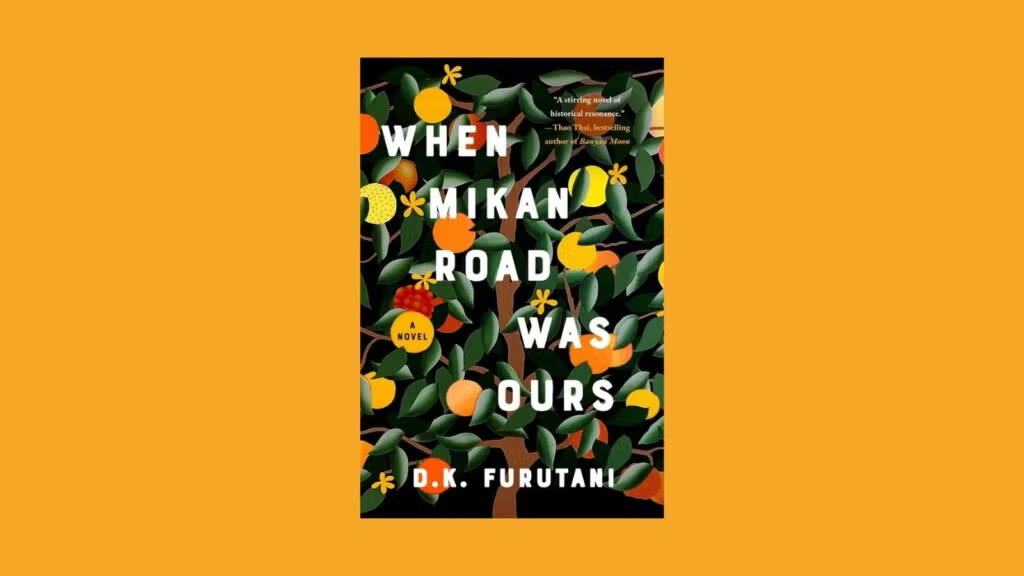
D.K. Furutani’s debut novel, When Mikan Road Was Ours, is the portrait of a family and their experiences during an underexamined era in American history.
In present day Los Angeles, a high school English teacher called Murano lives a life cleaved from his family and from his Japanese ancestry, until a memoir opens a pathway to earlier generations.
What happens when an isolated individual is able to trace his family back to the Issei, the “first generation” of Japanese immigrants who settled in North America? The memoir within the novel invites both connection and confrontation as Murano grapples with his preexisting notions of belonging, and the impact of unearthing family history on his life.
The novel explores identity and belonging in the context and aftermath of the incarceration of Japanese Americans during World War II. With a complex history to honor and carefully excavate, D.K.’s writing is unsentimental yet expressive, a tool he uses to tell this story in a way that values authenticity.
D.K. and I met at McCormack Writing Center in the Autumn 2023 novel workshop, led by Omar El Akkad. It was an honor and a joy to interview D.K. on the origins and the process of his novel over Zoom. The interview was recorded and edited for clarity.
D.K. Furutani was born and raised in Los Angeles, where he resides with his wife and three cats. His debut novel, When Mikan Road Was Ours, won the third national BOOKS LIKE US contest.
Lu Han: In your author note, you share about how the gift of your great-uncle’s memoir opened the door to your family history. How did you approach writing a novel that honors both the personal family history and events with historical weight? Was there ever tension between fact and story/narrative? Did the facts and the research drive the story, or was it the other way around?
D.K. Furutani: Knowing there was both a national history and personal history to draw upon allowed for a bit of freedom from the onset, as the history provided a predetermined world for the characters to move through and live within. I would always start with the history, with the actual settings and places where family members of mine lived in or encountered, and build a scene from there, letting the fictional aspects take over once context had been established. So the factual and the fictional fed each other in a really interesting way, which was both a fun and challenging writing experience.
The tension arose when I felt I was leaning too much on the history, that I wasn’t moving anything forward unless I had permission, earned through more intentional research, to represent the history on the page. Because while drafting, my intent was to always depict the history with respect and accuracy. But I also felt the responsibility to keep true to the characters who’d begun asserting their personalities and values the more I wrote, the more the story developed. That’s where the tension rose frequently throughout writing. Taking something I knew was real, and trying to honor it in a way that didn’t overdramatize or sensationalize the facts, while also placing the fictional characters at the center of a family drama.
LH: As the story came together, was there a point where the tension started to resolve?
DKF: There was a deep conflict in me about not only misrepresenting history, but that I’d also come across as biased while doing so, or that my own personal connection to the story would make me seem impartial. I think it took diving more deeply into the research, more specifically oral histories and lived experiences, when the resolution came. I understood I could relay a period of history in a more direct and candid fashion, that I didn’t need to shy away from both the accomplishments and the struggles of Japanese Americans, of how they built on them, endured them, or were defeated by them. Whether or not they survived or thrived, I was trying to depict that in an authentic way.
LH: You have mentioned that this novel took six years to complete. How different is the final version of the story from the story that you thought you were writing when you started?
DKF: It depends on how you’re viewing it. On a plot basis, the final version is pretty much an exact copy of the first draft’s storyline. But over those six years revising, my knowledge and understanding of the history of Japanese Americans, especially of those incarcerated and those reintegrating into American society during the resettlement period, greatly expanded, and with this knowledge, I hopefully was able to provide more nuance and distinction to the characters and their lives. This was something that I feel not only benefited the story, but also showed me that writing takes patience. Scenes should be revisited. And having to draft and redraft and revise is not always the worst thing. It’s something that, looking back, needed to happen in order for the book to get to the place where it eventually got to.
LH: Yes. It seems like an unskippable part of the process.
DKF: It is. Especially when there are multiple eras depicted in the story, each impacting specific characters in challenging and compelling ways. I find myself still thinking about this idea of tension between fact and story narrative. It’s wonderful.
LH: The opening scene of the novel places us squarely in setting. Specifically, in the quiet, haunting aftermath of a family violently displaced. It’s a brief but evocative scene before we launch into the current timeline with Murano, our narrator and protagonist, in present-day LA. Did you always have this scene in mind to open this story?
DKF: This is going to sound like I’m exaggerating, but I think I had about 15 to 20 different versions of an opening before settling on this particular one. Even then, when I had it, it was cut down to about a third of its original form. The original first scene for the book was just a memory of Murano’s grandfather. I liked it, but it didn’t really connect to the novel’s stakes, or introduce readers to the larger implications of the story. Aspects of that memory did end up in the novel during the editing process, but they weren’t right for the opening. They lacked oomph. Openings are difficult to write, as there is so much at stake for both the writer and the reader. It was a lot of trial and error to get the opening to a place that felt right for the book.
LH: When we meet Murano, whose first name we never learn, he has recently lost his father, dealt with a health situation, and, while he does not technically live alone, he has a fairly isolated life apart from his job as an English teacher. How did you come to Murano as the lens through which this family story would be discovered?
DKF: If you think back to six years ago, it was 2020, and we were in the pandemic. I was spending a lot of time by myself. I was feeling disconnected and isolated. There was also this unescapable tension escalating in our society—the murder of George Floyd, the rise of anti-Asian hate speech that was becoming more and more prevalent, the murders of Breonna Taylor and Ahmaud Arbery.
I was angry, and experiencing confusion, for what was happening at the time as well as for what I was reflecting on internally. I couldn’t ignore a feeling that the injustices I was seeing unfold in our society must be similar to what my family suffered during World War II. But I admit I was ignorant to their plight. I’d heard snippets growing up about a farm, taken from them due to their forced displacement during the war. But beyond that nothing was ever talked about. So I had this curiosity of, what happened to the farm?
Then I started putting together the pieces of this character who is looking to make sense of the present by looking toward the past. In that sense, Murano did spring from this feeling of isolation and a desire to feel more connected to his identity.
Secondly, the idea of a narrator learning with the reader, and the reader learning with the narrator, appealed to me. I never wanted Murano to feel like he was an expert teaching the reader about this history. I always felt his distance and ignorance was something that would humanize him more, because he is a guarded individual, but is forced to confront this part of himself by learning more about who his family were. He’s tempted to know more about the family, but also is afraid of what that might reveal about him, his life, his choices. I thought that was a compelling conflict for him to reckon with.
LH: In his isolation, he also identified himself, at the beginning, by who he wasn’t. He reflects on the ways in which he is not like his father, and on the ways in which he is disconnected from his immediate and extended family. Did you always know that he would be known by his last name, Murano?
DKF: This was sort of a strange curiosity I had in shaping his character. This story is a portrait of an entire family. In a sense, by only giving him this family name, that’s his only representation to the reader. It’s something he can’t escape. And that was another point of tension, this sense of not wanting to be a part of something, but ultimately having that thing be the hallmark of who he is.
LH: Right, especially at his job as a teacher, where he is only called by his last name by his colleagues, his students, the students’ parents.
DKF: And even that name, without meeting him or seeing him, creates an assumption made by the person seeing it written out on a piece of paper or in an email. Which again presents him with a choice: he has to either step into that perceived identity or forge one for himself.
LH: We do get a family tree in this, not at the beginning of the novel, but at the beginning of Benjiro’s memoir. But the family tree stops before Murano’s generation, which was a clever way to give us that information without revealing Murano’s first name.
DKF: Right, and a part of the exploration of this character was to look at the connectedness between generations. Yes, the triumphs and the accomplishments that perpetuate livelihood for the succeeding generations, but also the obstacles and the pain and the trauma that resonates with children and grandchildren. It’s all wrapped up into this Murano family name that he cannot escape.
LH: In that exploration, the novel weaves between present-day LA with Murano, where there is escalation with an issue he is facing, and his great-uncle’s memoir dating back to 1901, which we get excerpts of throughout the novel as Murano is reading through the memoir. Can you talk more about how you arrived at this structure? When you were writing did you go back and forth in drafting, or did you complete one storyline or timeline first, then stitch them together?
DKF: The plan was to always have the alternating timelines. But, whenever I was feeling stuck in what I was writing, if I didn’t know where something was going, I would switch back to the alternate time period, either back to Benjiro’s or forward to Murano’s. After taking what seemed like a breath away from each narrator a few times, I realized that Murano could actually start to interact with his world differently after reading certain sections in Benjiro’s memoir, and that he would be impacted by what he read. That impact could be doled out in a way where learning something fairly minimal about his family, like the fact that they grew blackberries, could impact him in the immediate. It sets into motion a pathway for him to start thinking about this connection to his family, or spark something in his daily life when he’s interacting with colleagues in a situation where he’s forced to act.
In that sense, the memoir itself starts to serve as a guide for him to draw on in moments of isolation. And even though his family is not physically there to advise him, they’ll be present in his life nonetheless.
In a structural sense, having the two different timelines gave me something of a challenge, or a puzzle, to recognize how the events in each are related, and to have these layers of conversation build throughout the narrative.
LH: Layers of conversation is a great way to describe this. There are multiple forms within this novel—we already mentioned the memoir, that’s known. But there are also letters, and without getting into who they come from and why, because the readers will get to experience that, how did you decide on using letters? And how did you decide which characters would speak directly through a letter? In a way, that’s the purest form of a character’s voice.
DKF: That’s absolutely true. For the first few weeks of writing, I’d focused only on Murano and Benjiro. I’d also been reading a lot, and looking to other authors and their particular styles. Since Murano and Benjiro were written simultaneously, their voices have very similar tendencies (which is not to say there isn’t some intent to that) but I also wanted to switch things up.
I got to the point in the narrative where Benjiro receives a letter from a family member, and in writing it, I thought to myself, wow, this is different. It was fun to embody another character.
I also felt it was important to give the reader a chance to step away from a single perspective, and start absorbing and seeing firsthand what other individuals were experiencing and feeling.
As I got further into learning about the history of Japanese Americans and the methods they explored in resolving feelings about their incarceration, I felt the pull of a more creative outlet for certain characters, expressing themselves through a letter, or through a poem or story they wrote. Being able to do that was a really enriching writing experience. That’s when I felt I was closest with the characters. Thinking about how a character would phrase something, or what image they would come up with in a poem—these were the most rewarding and entertaining parts of writing this.
I mentioned earlier the 15 or so scenes I wrote to get to the final version of the opening. It was after going through and exploring different voices that I came to one voice in particular, where I found something I really liked. So that voice ended up as the starting point of the novel.
LH: Without giving away too much, I appreciate the voices and perspectives we hear from toward the end of the novel. Both the creative forces in those voices and how, indirectly, they connect to the tone of the opening.
DKF: Included in the list of resources at the back of the book is a work titled Making Home from War: Stories of Japanese American Exile and Resettlement, edited by Brian Komei Dempster. I used the idea behind that book as inspiration to explore a character who might find something meaningful from a writing exercise, say a poetry prompt, to work through their trauma via art.
LH: Were there any characters that came more easily to you or that were especially challenging?
DKF: Murano comes to mind, because on the surface there’s obviously some parallels between who he is and my own life experiences, so it may appear he was the easiest to write. But a closeness to a character is not always easily transferrable to the page. He’s a representation of a family that didn’t always express themselves clearly or openly. So I didn’t want him to be so cryptic as to shut out the reader, but his guarded nature is nevertheless an important element to his character. Which means I couldn’t just have him suddenly become so forthright without just cause. It was a real journey fleshing him out in a way that felt true to his character while also not frustrating the reader.
Another difficult character, one that I distanced myself from, was Eito, who is the great-grandfather of Murano, and the father of Benjiro. I found I wasn’t comfortable depicting the Issei generation, given my unfamiliarity at the time I started writing. This goes back to the tension between fact and character/story. I didn’t want to misrepresent him, so I had him moving throughout the world as a presence that’s felt and is known and is respected, but not something that we have a lot of direct access to in the same way we do with the rest of the family.
The irony now is that the next work is primarily about the Issei.
LH: This is a great segue to the last question, which I’m excited to hear more about. You shared an excerpt in fall 2023 with our workshop, from a work that was completely separate from this novel. It’s set in what Benjiro refers to in his memoir as “Tent City,” where Japanese and Mexican migrant workers were forced to live. Could you share more about that work, how it came to be, and how you see that novel in relation to When Mikan Road Was Ours?
DKF: In my research on the agricultural history of southern California, I learned that there was a thriving beet industry in Oxnard. They were harvesting beets to extract and refine sugar, and there was a lot of work available. It drew Japanese immigrants seeking opportunity, but also presented a history where individuals from different life backgrounds were occupying the same space, despite very different roles and options for mobility. I was fascinated by it.
This all goes back to the many failed starts of the novel. One in particular zoomed in on Eito Murano’s time in Oxnard. It had him waking up inside a tent to show that was the start of his life in America. But things quickly got away from me, as I then introduced another character who started to command the page, who was suddenly taking up more and more space, pulling me away from the focus of the Murano family. At this point, the Mikan Road manuscript already had over 100,000 words, so I thought, I’m introducing a new, unfamiliar main character? How do I make this work? Ultimately, Mikan Road is about a multigenerational family, so I scratched those pages from the manuscript and turned to a different avenue. But in immersing myself in Eito’s “origin” story, in the experience of working the fields and living in close quarters with others he may have only met that day, I felt comfortable approaching the Issei generation in fiction.
So I separated that piece, and turned it into its own story about two Japanese immigrants who top beets together in the fields. I removed Eito and replaced him with a character named Tetsuya. He works and lives with a second character, Hiroji. The more I explored the dynamic between Tetsuya and Hiroji, the more their dynamic started to feel like George and Lennie from Of Mice and Men. And I really liked investigating this underrepresented experience of laborers who immigrated to America. George and Lenny aren’t the only field hands that traveled around California looking for work.